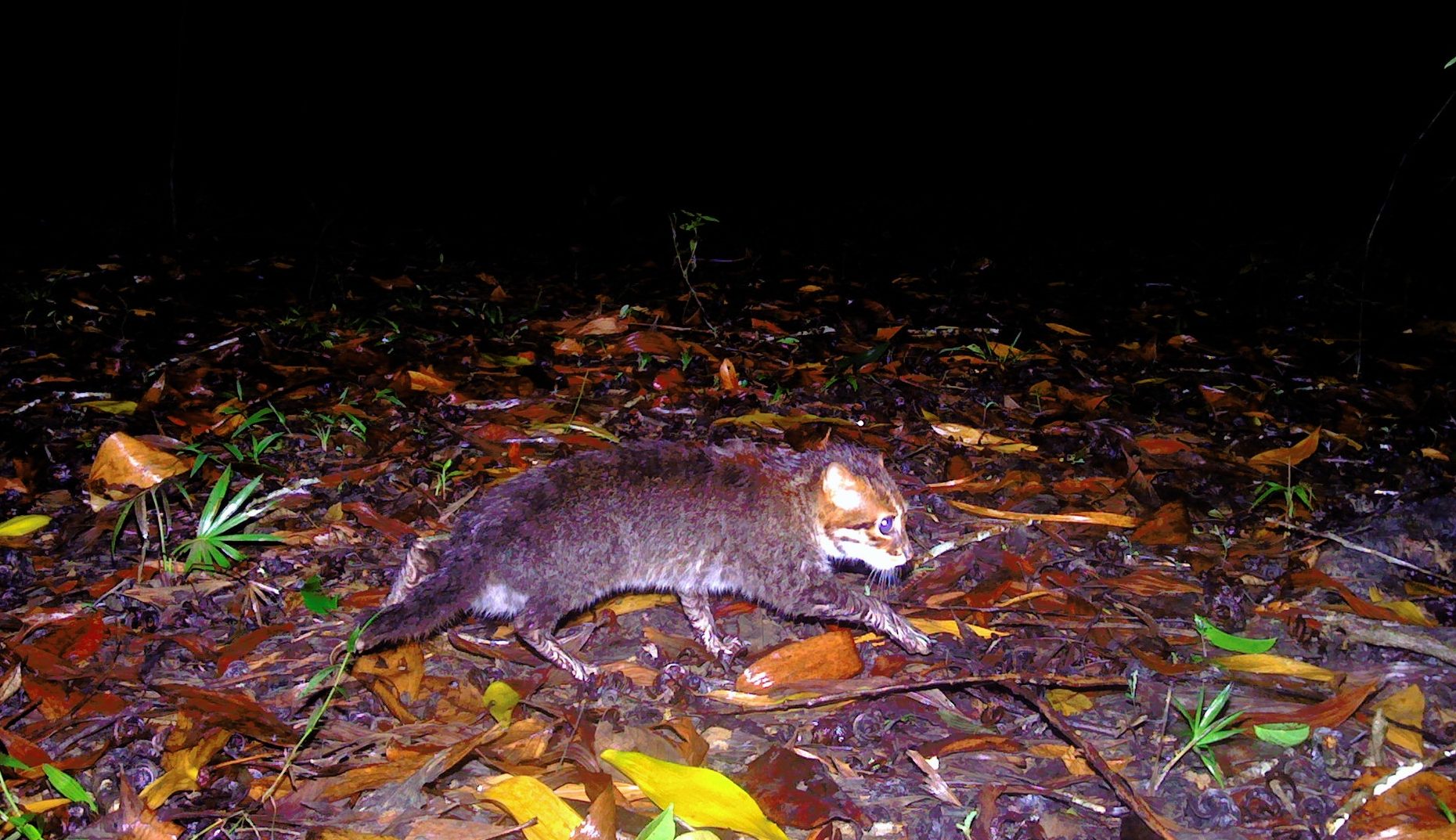
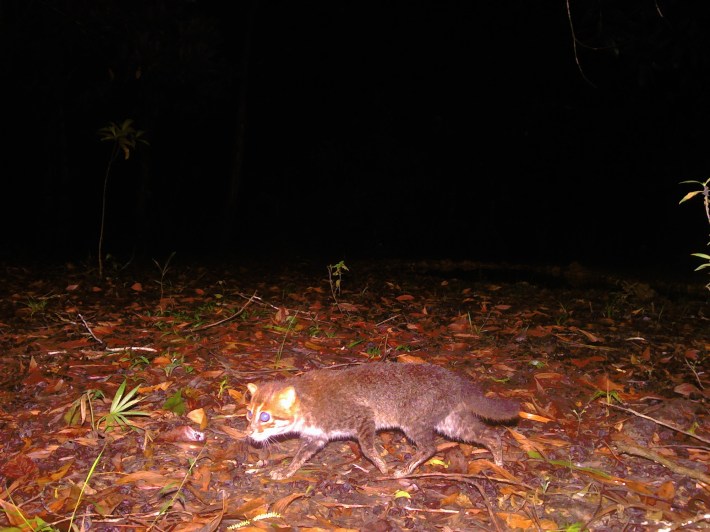
When news broke this weekend that an elusive, endangered wildcat was spotted in Thailand for the first time in three decades, I rejoiced, obviously. What wonderful news that the flat-headed cat, which is estimated to have a wild population of just 2,500 in Southeast Asia, had not gone extinct in Thailand. The wildcat's presence was confirmed by remote camera traps, which recorded the cats 13 times in 2024 and 16 times in 2025, in the swampy peat forests of the Princess Sirindhorn Wildlife Sanctuary. What an abundance of flat-headed cats where there formerly appeared to be no flat-headed cats at all! What joyous news to close out the year!
And then I saw a better photo of the flat-headed cat, and my mood soured. The head of this cat did not seem so flat to me.
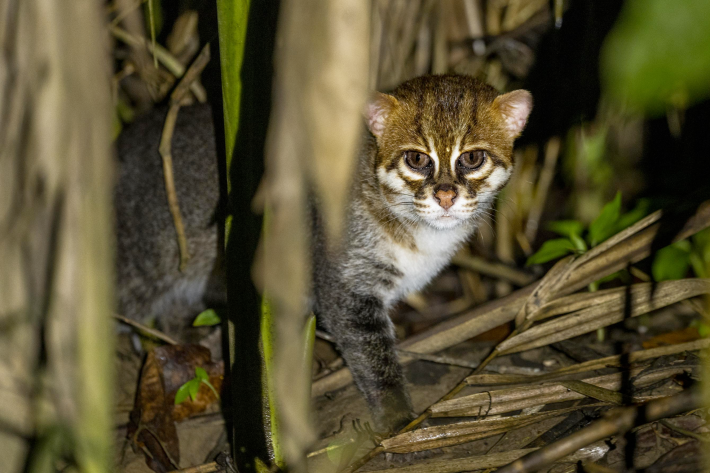
As I read more, I learned that this cat was "[n]amed for its distinctive flattened forehead and elongated skull," according to a press release from the conservation group Panthera, which announced the cat's rediscovery. A flat forehead, perhaps. But the press release proceeded to share some of the flat-headed cat's other distinguishing traits, which include but are not limited to: weighing half as much as a housecat, having a short, tubular body with slender legs and a stubby tail, and sporting webbed toes. Surely any of these traits are just as, if not more, distinguishing than a flattish forehead! Tubular cat, stubby-tailed cat, need I go on?
When I ran these grievances of nomenclature by Barry, he agreed. He even went so far as to suggest that you could show anyone a photo of the flat-headed cat, and they would come up with a better name for the creature than "flat-headed cat." I decided to put Barry's theory to the test and poll my colleagues, to see what names they would suggest for the elusive feline that some call the flat-headed cat. I used Slack and DMed each person individually so as to ensure their cat names did not influence each other, and shared this photo of the flat-headed cat, which we cannot include in this blog due to copyright issues. My esteemed editor was the first to throw a name in the ring.
Barry Petchesky: i would call them: Round-Eared Cats
Kelsey McKinney: gerald
It was at this point I realized I needed to reframe the question, as the average person does not need to concern themselves with the differences between common names (flat-headed cat, moon jellyfish), scientific names (Prionailurus planiceps, Aurelia aurita), and proper names (Barry, Kelsey). Moving forward, I clarified the difference between such names in my question.
Kelsey McKinney: bear cat
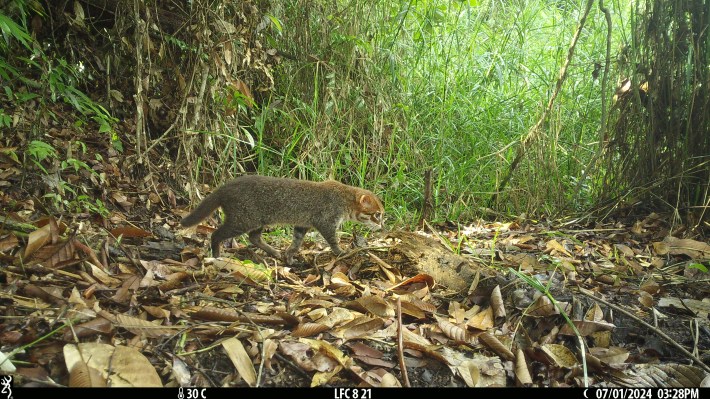
Some of the people I polled were kind enough to offer a justification behind their proposed names, some of which were grounded in actual taxonomy.
Patrick Redford: taxonomically speaking, that is a Brush-haired cat
Patrick Redford: i was looking at this guy and thinking about possibly distinguishing physical characteristics
Patrick Redford: the coloration, face stripes, and “ear situation” are all notable but nothing feels quite unique, though i do say that as a cat non-expert
Patrick Redford: that leaves, to me, its somewhat stout body and its wiry looking fur, the latter of which seems more distinctive to me
Others offered more explanations grounded in cat culture.
Kathryn Xu: k so the face reminds me a lil bit of the designer breed squished-face cats
Kathryn Xu: so mayb a forest/wild munchkin cat or smth
Kathryn Xu: i think michael would be a good proper name
Another colleague (Brandy Jensen) ethically recused herself from renaming the cat, because Barry had already revealed the cat's existing common name to her before the conception of this blog.

Several other colleagues offered names that were less interested in the cat's physical characteristics than the cat's overall vibe, which can still be a crucial methodology for differentiating species.
Maitreyi Anantharaman: it's a cat with kind of a mongoose vibe
Maitreyi Anantharaman: so i will say mongoose cat, like spider monkey
Tom Ley: hmmm he kinda looks like an ugly bobcat? like if a bobcat had 0 swag
Samer Kalaf: weirdly reminds me of a slow loris, so maybe i'd call it a fast loris
Several colleagues were kind enough to offer multiple names for taxonomists to choose between. Many species have more than one common name. (Such abundance can be fun, but also annoying. Take, for example, the seaweed Codium fragile, which is known by any of the following names: green sea fingers, dead man's fingers, felty fingers, forked felt-alga, stag seaweed, sponge seaweed, green sponge, green fleece, sea staghorn, and oyster thief.)
Ray Ratto: Either Vyacheslav or Thelma.
Israel Daramola: I would call it fox or foxy
David Roth: If I actually did the assignment, it'd be something like Rustyhead Cat. If I am following my heart, I'd say his name is Herbert.
One colleague took a truly inventive, portmanteau-esque approach, inspired by the cat's head resemblance to a garbanzo bean and the existence of another cat called an ocelot.
Albert Burneko: the rounded garbanzelot
Another colleague took the assignment very seriously, giving the cat not just a common name, but also a scientific name in what mostly appears to be Latin.
Chris Thompson: ok, if i encountered this animal in the wild, pursuing my work as a naturalist, and i had to give it a name in my journal so that i could bring my findings to the Royal Society.....i think i would call this cat Smart Face Cat
Chris Thompson: Felis Smartfaceus
Chris Thompson: it's bizarre but i feel like i could reason with this cat
But there was just one colleague who offered a name that validated all of my hesitations around the flat-headed cat's existing common name.
Luis Paez-Pumar: cutie mctootie pants. but actually hmm like redfur cat or round-head cat? I don't know haha I am feeling the PRESSURE
I am not a scientist, not a naturalist, nor a taxonomist. I cannot presume to know the challenges one faces when naming a new species of animal. I cannot grasp the many factors that surely must go into a new common name. I can only imagine the disappointment one must feel in realizing that "all the good names are gone." And yet I still feel that if the average blogger were to look at a cat that you have named the "flat-headed cat" and think to name it "round-head cat," then your name for this cat has room for improvement.
Who named the flat-headed cat? Two guys named Nicholas Aylward Vigors and Thomas Horsfield, who described the cat in 1827. As they write, "The first of these subjects is a small Cat, distinguished at once by the extreme depression of the skull." As such, they named it Prionailurus planiceps, which translates to "flat-headed."
I am not debating that the cat's skull is depressed. But is that really the first thing you think of when you see the cat? There is so much more to this cat than a putatively flat forehead. Even Vigors and Horsfield try and fail to articulate the cat's unique and singular vibe, which may remain ineffable to us humans: "In its form and habit it has some resemblance to Mustela; but its face has the true physiognomy of the feline tribe. Its place in the series cannot be determined without a more minute comparison of its various peculiarities than we can at present undertake."
Perhaps the true common name of this peculiar weasel-like feline (Peculiar weasel cat, anyone?) will elude us just as the actual cat continues to do, slinking around the swamps of Southeast Asia and feasting on snakeheads and other aquatic prey. Until then, we must brainstorm a common name that appropriately matches this little cat's freak. If you've got one in mind, drop it in the comments, please.