For almost my entire life, Venezuela has been a punching bag, a nasty joke couched in fake concern. I used to participate in some of that punching, to be clear. But as I grew into political consciousness, I struggled to reconcile, both within myself and whenever I was asked about the country where I was born and partly raised, the conflict between my slowly burgeoning leftist beliefs and what I had been told socialism did to Venezuela. I mainly took a "Eh, what can you do?" stance, if not an outright hostile one towards Hugo Chávez and the Bolivarian Revolution. That hostility only felt more correct when Nicolás Maduro took over following Chávez's death in 2013.
It was around that time, however, that I began to realize that Venezuela wasn't a rogue state, or some evil dominion in dire need of outside intervention. It wasn't, and still isn't, perfect. No country is, and this one was born of the imperialist context that has threatened to completely subsume Latin America. What I mean by that is that the United States decided to do its best to try to dominate Venezuela, and to make an oil-rich country subservient to the world's biggest oil consumer. The realization that Venezuela serves that purpose for the U.S. helped me understand why it was in the state it was: It needed to be beaten down by American economic and military pressure, so that it could become both a cautionary tale for the American right and a cog in the broader neoliberal enterprise. Venezuela became less a country in the American collective hivemind than a boogeyman, a place that could be pointed at as a failure whenever someone tried to consider a better way.
I was not immune to this framing, which was so common growing up in the U.S. and away from Venezuela. It has been hard, throughout my life, to feel the pride I should want to feel for my homeland, because I have had such a confused political understanding of both Venezuela and Venezuela's place in the world, and in this hemisphere specifically. Put another way, I was ignorant and unwilling to question the narrative that I had been fed. The slow process of correcting that ignorance only left me more confused on how to feel about Venezuela as a whole. I'm still working on it.
For me and millions if not billions of other people, sports tend to be the easiest way for that sort of pride to manifest. This is why sports can be so thrilling, and also why they are so useful in nurturing the least reasoned and most unreasoning sort of nationalism. Venezuela's sporting history has provided me with few moments of true joy, and previous generations haven't had it much better. Our soccer team holds the indignity of being the only CONMEBOL side to never qualify for a World Cup; frankly, we've only gotten close a couple of times, and even with the expanded field for this summer's debacle-in-waiting, Venezuela could only manage eighth, behind traditional bottom-dweller Bolivia for the last play-off spot. In basketball, well, we had Greivis Vásquez and Carl Herrera, as well as two Olympic appearances. So that's pretty good. If we have a hockey team, it's news to me. (We do, apparently.) There hasn't been much to celebrate as a Venezuelan sports fan, with one very obvious exception.
While I don't believe my Venezuelan friends when they say that the country could be great at soccer "if we loved it as much as baseball," it is impossible to argue with the towering, unreasonable love that Venezuela does have for baseball. Baseball is the sport I first grew up watching; I have vague memories of being tiny and going to Leones del Caracas games with my dad. I also remember playing it on the streets of La Guaira, the port town where my mom's family lived; we used milk cartons as gloves and played on slanted streets that made ground balls an adventure. I am not unique in this: Everyone in Venezuela played baseball, and after Tuesday night's World Baseball Classic championship win over the world's dourest juggernaut, I don't see that changing. If you watched the Venezuelans play in the WBC, you probably wanted to go out and play it, too.
One of the side effects of Venezuela's general incompetence on the global sports stage is that I've had to adopt other nations as my own in other sports. I love Lionel Messi as a Barcelona fan, and so Argentina became my South American soccer team. I love Dwyane Wade as a Miami Heat fan, so the Redeem Team in 2008 got my cheers. Rafael Nadal was my guy, so I was locked in as hell on the Nadal-Alcaraz duo at the 2024 Olympics. But in baseball, it has always just been Venezuela, and there's been little but heartbreak on that front since the World Baseball Classic started in 2006.
OK, sure, "heartbreak" is a bit dramatic. There have been a couple of WBCs where I watched maybe one or two games (I don't even remember the inaugural edition in 2006), so it's not like I live and breathe for this event every three or four or six years like I do the World Cup. But! I do don some vinotinto apparel each time out, and I root root root for my country's one actually good national team, a team that has rewarded those efforts mostly by being just good enough to get my hopes up while juuuuust not good enough to win anything. I was there in 2009 when Venezuela beat Puerto Rico 2-0 in one of the most raucous crowds I've ever been a part of. I was there two days later, when Venezuela beat the United States, 10-6, to win the second round pool. I was not in Los Angeles for the subsequent 10-2 semifinal beatdown at the hands of South Korea. That was the closest Venezuela ever got to glory in the WBC before Tuesday night.
That was the stat that everyone kept spouting off this time around: Somehow, this country that is so well-known for baseball, which has produced more big leaguers than any country besides the U.S. and the Dominican Republic, and which is not particularly good at any other sport, had never even made the final of the WBC. Hell, that 2009 semifinal loss is the only time Venezuela ever finished in the top four. No matter how good the team had been, no matter how loaded the lineup, it never measured up against the real powerhouses of world baseball, the Japans and United States and Dominican Republics. Even Puerto Rico and South Korea had better histories in the WBC.
When the D.R. beat Venezuela 7-5 in the final Pool D game this time around, I thought this was yet another March of WBC disappointment. By losing to the Dominicans, Venezuela drew Japan in the quarterfinals, and I had no real hope of them going any further. Just as in 2023, when Venezuela actually won its group before drawing the United States in the quarters, my country had to contend with the defending champions on a mission. In 2023, Venezuela scored four runs in the fifth inning, taking a 6-5 lead that swelled to 7-5 in the seventh. And then Trea Turner happened:
This time around, against Japan, Venezuela took the lead on the second pitch of the game via Ronald Acuña Jr.'s home run. Then Shohei Ohtani tied it up with a leadoff homer of his own, and then Japan scored four more in the third. It was 5-2 at that point, and it felt over—another game, in another tournament, in which Venezuela puts in a nice effort but doesn't have enough talent or just doesn't perform to the talent level it does have. Before I could feel too sorry for myself, the tide turned, not just in that game or the 2026 World Baseball Classic but in Venezuela's sporting history as a whole. Anyway, the morning after, that's how it feels.
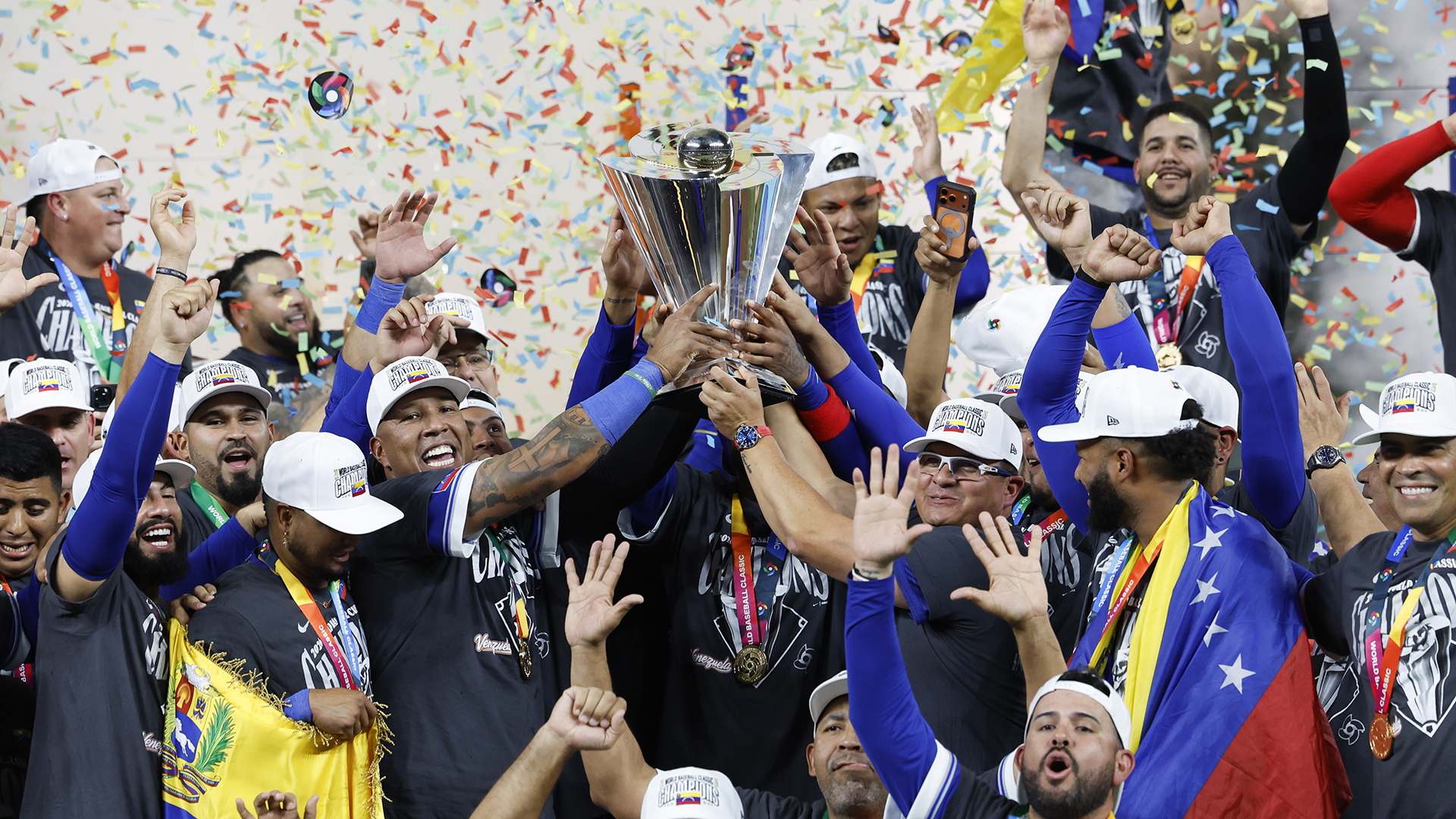
So: Venezuela would roar back to an 8-5 win over Japan, then beat Italy 4-2 on Monday night in the semis, and then beat the U.S. 3-2 to win the whole damn thing on Tuesday. Wilyer Abreu's game-winning home run in the quarterfinal will go down as the single greatest hit in Venezuelan baseball history, but there were others on this improbable run: Eugenio Suárez's game-winning double on Tuesday, Acuña's infield single to tie the game against Italy, even WBC MVP Maikel Garcia's own home run in the Japan game. But it's the violence of Abreu's swing in that comeback against Japan, and the sound the ball made upon the contact, and how immediately and thoroughly that sound was drowned out by the roar of the Venezuelan crowd in Miami—that is what I will take away from this tournament, and from this title:
Even as I write this on Wednesday morning, it still doesn't feel real that Venezuela, my homeland, actually won something. I have never seen it happen; the last time Venezuela claimed a major international trophy was in 1945 and, of course, it was in baseball, at the Amateur World Series. The closest we had gotten in my lifetime was probably the 1-0 defeat to England in the 2017 U-20 World Cup, but as devastated as I was that day when Venezuela came so close to glory, it wouldn't have felt quite right to have the country's long-awaited title come in soccer.
No, it had to come in baseball, because it is our sport, the one we actually care about and that truly runs vinotinto red in the country's collective bloodstream. (You may note that Venezuela swapped to blue jerseys instead of vinotinto for the final. That is not my problem.) And it probably had to come against the U.S., the geopolitical bully that has idly shoved Venezuela around for generations, and that invaded and kidnapped Venezuela's head of state just a couple of months ago. That the U.S. team was so ostentatiously playing for The Troops, and with so little joy in what is such a traditionally joyful event, only made this victory sweeter. For one of the only times in my life, I felt a whole lot of people rooting for Venezuela wholeheartedly, not treating my country as a pariah or a punchline. For one of the only times in my life, it was Venezuela getting the headlines and the joy and the multilingual "Vamos" yells. For maybe the only time in my life, Venezuela felt like a winner, and it feels fucking fantastic. Venezuela 3, United States 2; I'll never forget it.