

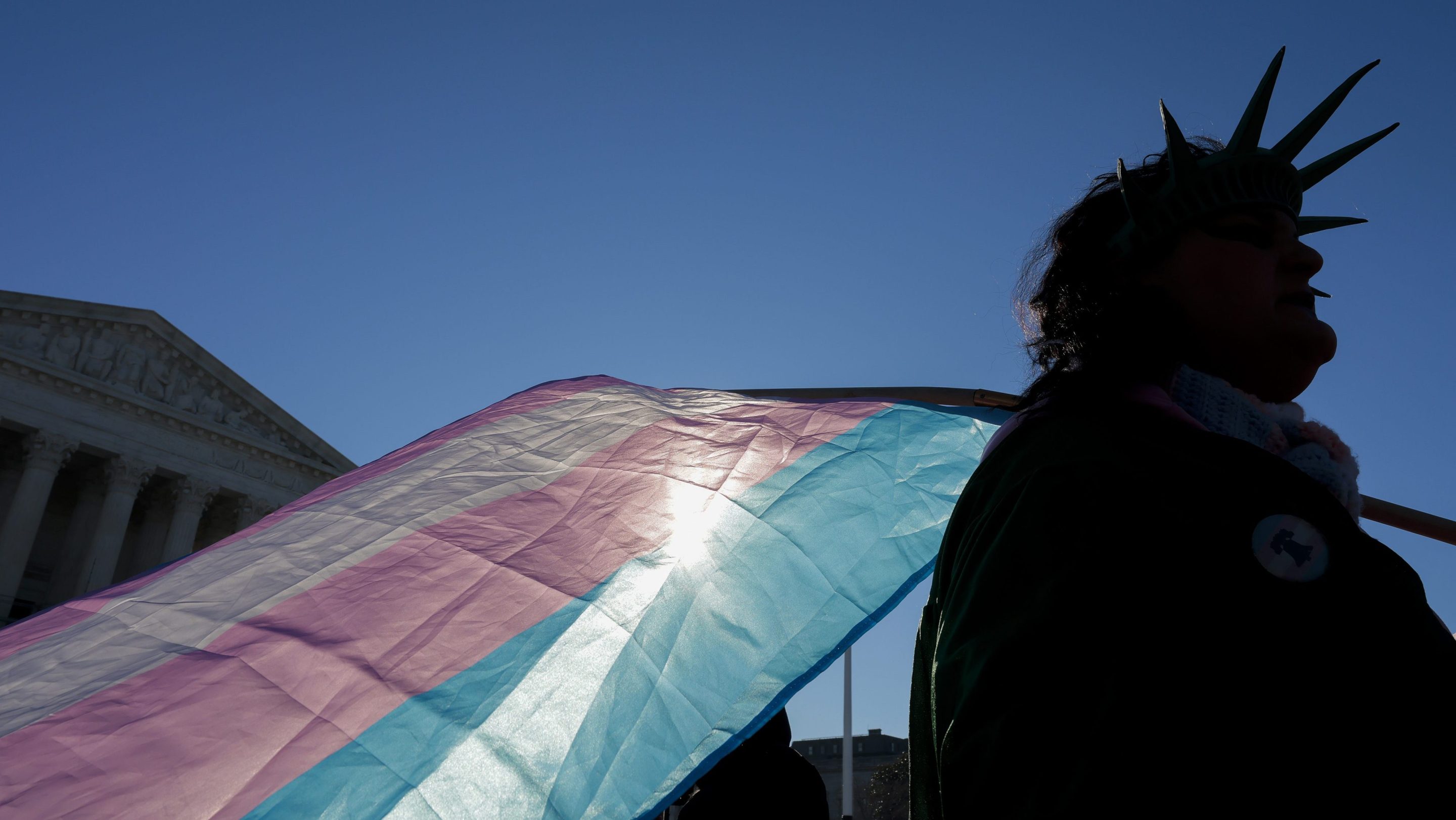
The U.S. Supreme Court, in an opinion released Tuesday, voted 6-3 in support of two state laws that ban trans girls and women from playing women's sports at public schools and universities. The ruling applies directly to bans in two states—Idaho and West Virginia—while bolstering similar bans in more than two dozen others.
Writing for the three votes against—all of which came from the court's liberal wing—Justice Sonia Sotomayor said that to the court's majority, "the facts do not matter, even though the consequences are serious."
"Sports, of course, are often zero sum," Sotomayor wrote, "but the law need not and should not be."
The justices were ruling on two separate cases, argued together because both involved laws that effectively banned trans girls from all sports in public schools and universities. They did so by saying that a sports team's makeup had to be based on each person's biological sex at birth.
In West Virginia, a young girl named Becky Pepper-Jackson—who transitioned as a child and received medical care to help her have a hormonal puberty typical of a girl—sued West Virginia through her mother because the law meant she would not be allowed to participate in sports.
In Idaho, Lindsay Hecox sued Idaho because she wanted to try out for Boise State's women's cross country team, which she could not do as a trans woman, even though she had undergone hormone therapy. In September, Hecox asked the court to dismiss her case, saying she no longer played any sports covered by the Idaho legislation and she wanted to focus on graduating.
"From the beginning of this case, I have come under negative public scrutiny from certain quarters. I also have observed increased intolerance generally for people who are transgender and specifically for transgender women who participate in sports," Hecox told the court. "I am afraid that if I continue my lawsuit, I will personally be subjected to harassment that will negatively impact my mental health, my safety, and my ability to graduate as soon as possible."
The court's majority opinion, authored by Justice Brett Kavanaugh, hinges on two ideas: The physical safety of cisgender female athletes is compromised by the presence of trans athletes, and allowing trans girls to compete in sports would be inherently unfair to cisgender girls. In legal terminology, the majority said that the bans did not violate Title IX—the federal law barring discrimination based on sex in education—nor the Equal Protection Clause.
Kavanaugh's points will feel incredibly familiar to anyone who has followed conservative media in recent years and, specifically, the story of Payton McNabb, a former high school athlete who said she was almost killed by a spiked volleyball hit by a trans athlete. Kavanaugh's opinion mentions volleyball, noting that it is a sport "where spiked balls can cause serious injuries."
"The Constitution and Title IX," he wrote, "do not require an overhaul of women’s and girls’ sports throughout America."
In her dissenting opinion, Sotomayor pointed out that the West Virginia ban was not instituted to stop a barrage of trans girls invading women's sports. Rather, Sotomayor wrote, it replaced a policy that allowed trans students to participate in sports based on their gender identity, so long as their school believed it wouldn't make the competition unfair.
The same West Virginia system also allowed for any student's participation to be challenged through the West Virginia Secondary Schools Athletic Commission board of directors, she wrote. What the ban did was take away a system that allowed decisions to be made on a case-by-case basis and replaced it with full-on exclusion.
Sotomayor did not go so far as to say that the young athlete who sued in West Virginia automatically had the right to play on girls' teams. Rather, she wrote that the highest court in the land erred by rubber-stamping the bans without further inquiry. The Equal Protection Clause, she wrote, "demands much more" of a state that uses "a sex classification to achieve legislative aims." From her opinion:
Perhaps West Virginia could meet those demands. Perhaps not. In either event, because unresolved factual questions prevent the Court from assessing the merits of B. P. J.’s equal protection claim at this time, the Court should allow the District Court to address those factual questions in the first instance. Yet in an opinion unencumbered by fact or law, the majority today cuts off that process prematurely, deciding instead that B. P. J.’s case must end now.
Kavanaugh's opinion also repeats, over and over again, how important it is to acknowledge that 27 states, the NCAA, the International Olympic Committee, and the U.S. Olympic and Paralympic Committee have put similar policies in place. But, as Sotomayor noted, this ignores several facts—including the history of why gender testing hasn't worked in the past, the lack of scientific citations in the IOC policy, and the pressure put upon the organizations by the current administration to draft and enforce the bans.
(It's also worth remembering that, as far back as 2010, the NCAA allowed trans women to compete in women's sports after a year of hormone therapy. And the West Virginia case was filed during the presidency of Joe Biden, who sought to expand federal protections for trans girls and women in sports and education.)
Sotomayor cited a case largely ignored by the majority opinion: United States v. Virginia, in which the court, by a vote of 7-1 in 1996, found that women could no longer be excluded from the Virginia Military Institute. Even if many women wouldn't be able to make it at VMI, the exclusion of a minority of women was still enough to declare that a fix was necessary. "Unresolved factual differences matter," Sotomayor wrote, "even if the classes of people to whom they might be relevant are themselves small."
In terms of the law, Sotomayor's opinion dissented only in part. She wrote that she too believed that the West Virginia case did not have a strong claim under Title IX. This opinion largely hinged on the Javits Amendment, which does allow schools to have separate teams for boys and girls in sports. However, Sotomayor wrote that on the equal protection claim, "the majority, at this stage of the litigation, gets the answer wrong."
One liberal justice did go further. In a separate opinion, Justice Ketanji Brown Jackson wrote that the court should have left open "the possibility that Title IX's definition of 'sex' is more capacious ... there is reason to doubt the soundness of the concession that Title IX's reference to 'sex' means only sex assigned at birth."
Two justices who voted with the majority also wrote their own opinions. Justice Neil Gorsuch wanted to make clear his belief that "nothing in Title IX clearly and unambiguously alerts funding recipients that they are prohibited from restricting a school-sponsored sports team to biological women or girls."
Justice Clarence Thomas took aim at the broader idea of providing legal protections for trans people. Thomas wrote that he does not consider trans people "a suspect class requiring heightened equal-protection scrutiny." He goes on to write that he believed gender dysphoria to be a "mental state," meaning trans people do not have "the immutable characteristics on the basis of which our precedents have applied heightened scrutiny—race, sex, or national origin."
No one else signed on to Thomas's opinion.
The decision in full can be read below or by clicking here.