
In the late 1990s, Olympics officials were suddenly eager to exit the business of testing women’s DNA. After three decades of requiring all women athletes to sit for chromosome tests in order to compete, the International Olympic Committee, in a daze, seemed to realize it was on the wrong side of history. The American Medical Association had recently come out against DNA testing in sports, and so had a formidable coalition of sports doctors, media commentators, Hillary Clinton, Pakistan Prime Minister Benazir Bhutto, and—not to be outdone—the entire national government of Norway. Even Olympic athletes themselves were railing against the chromosome tests, with an athletes’ commission recommending in 1998 that the Olympics drop their testing requirements.
There was something frankly queasy about the whole DNA testing business, which the IOC had first embraced in the late 1960s, during the height of U.S. and USSR hostilities. But in the aftermath of the Cold War, the logic of DNA tests seemed woozier than ever. When the IOC announced it would ditch chromosome tests beginning in 2000, the Salt Lake City Tribune wrote that “an unfortunate vestige of the Cold War” had finally been eliminated. Everyone seemed prepared to move on; a member of the IOC’s medical commission declared that, soon, “gender testing will be gone forever.”
The sentiment sounds preposterous today. This month, as the world gathers for the Winter Olympics in Italy, chromosome tests have quietly returned—copy-pasted from the ‘90s, just with a new sheen. Sports officials are positioning the very DNA tests they had once left for dead as a “noninvasive” and “extremely accurate” way to protect “the integrity of female competition,” the new chosen euphemism for disqualifying trans and intersex women. The international federation that governs track-and-field events, World Athletics, and the boxing federation World Boxing recently announced that all women athletes in their sports will have to sit for a chromosome test.
Winter sports are getting these policies, too. The International Ski and Snowboard Federation just passed a similar chromosome testing rule that will go into effect in July. Many commentators are speculating that the IOC, which oversees all of the individual sports federations, might soon institute a blanket rule that requires all women to sit for chromosome tests. The IOC’s new president, Kirsty Coventry, says she supports a so-called “scientific approach” to women’s eligibility.
What is the point of resurrecting chromosome tests now? No new science is behind this push. These chromosome tests are just as discriminatory and confused as they were three decades ago. But their rehabilitation represents an all-time act of historical amnesia, a political redefinition of womanhood that Maria José Martínez Patiño, an athlete who was disqualified for failing a chromosome test in the 1980s, recently said amounted to a “setback of several decades.”
These new rules are undoubtedly an outgrowth of the transmisogynistic panic we’ve seen take hold in sports in recent years. They represent a total rollback of the Olympics' attempts, however watered down they were, at more inclusive policy: In 2004, after ditching chromosome tests, sports bodies allowed many trans women and intersex women to compete, as long as their hormone levels did not exceed an (arbitrary) maximum. It turned out that inclusion was messy, of course, and athletes and activists rightly questioned whether it was a human rights violation to make trans women, or women with higher-than-average natural testosterone levels, take testosterone suppressants.
Rather than deal with these questions about hormone levels, biological sex, and gender identity thoughtfully, the right-wing political backlash has provided convenient cover for sports officials to reverse course. They are using this moment to resuscitate widely disputed old definitions of womanhood, with little concern for the fact that many women athletes will, in the process, become casualties.
Sex testing first became international policy in 1936, amid a broader panic about butch women in sports. In August 1936, when the American Helen Stephens won gold at the Berlin Olympics, a series of European newspapers pointed to her broad shoulders and deep voice as proof that she was a man. “It is scandalous that the Americans entered a man in the women’s competition,” one Polish newspaper claimed. The absurdity of this statement hardly registered. A few days later, the federation that oversees track-and-field sports passed a rule that allowed doctors to strip down and examine the body of any woman about whom there were “questions of a physical nature.”
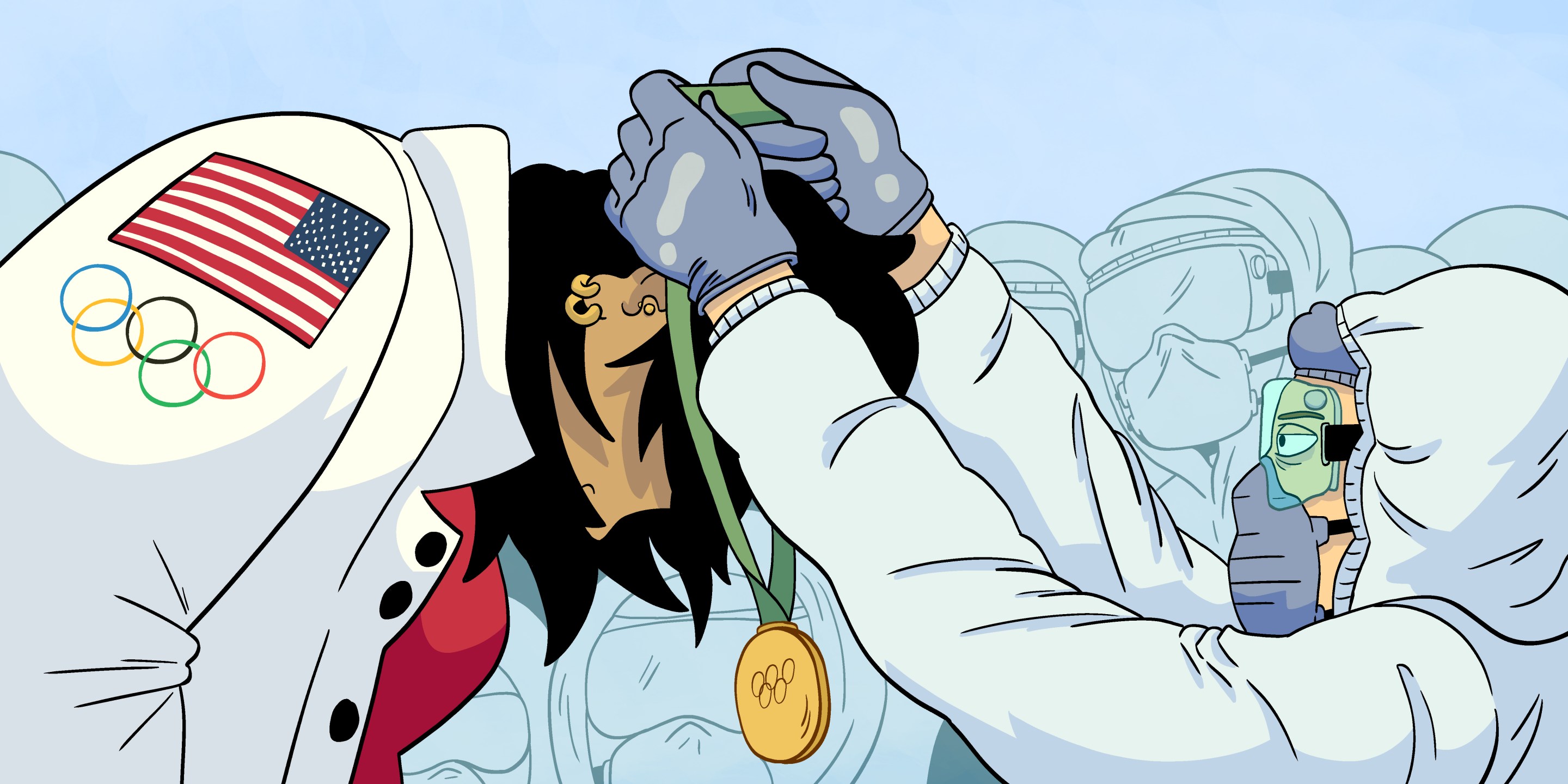
It wasn't until the late 1960s, as women from the USSR swept Olympic competitions and drew accusations of gender fraud, that officials switched from strip-testing athletes to the more “scientific” practice of chromosome-based tests. Comparing these women to a “beef trust,” American commentators called for tests to ensure the Russians weren’t “substituting men for women.” These first tests essentially measured the presence of XX chromosomes, an approach that proved problematic pretty much immediately. In 1967, Poland’s Ewa Kłobukowska was disqualified from sports for having, as a report put it, “one chromosome too many.” Kłobukowska never competed again. Though even at the time the president of the Polish Olympic Committee wrote that these exams “amounted to a form of discrimination,” the Olympics didn’t abandon them. Eventually, they just switched tactics. In 1992, the IOC introduced a test that measures the presence of the SRY gene, which is found on the Y chromosome—but the SRY test just underscored the discriminatory effects of these policies. Four years later, when eight women failed SRY tests during the Atlanta Olympics, a member of the IOC’s medical commission complained, “If we screen for sex by using this test, women will be screened out and men will pass.”
These very same SRY tests, which three decades ago everyone agreed were a farce, are now the crux of the new sex testing regimes of World Athletics, World Boxing, and the International Ski and Snowboarding Federation. Last year, World Athletics noted that SRY tests are “extremely accurate,” but accurate for determining what? Sex is a spectrum: What we call sex is actually a complex interplay between chromosomes, gonads, external genitalia, and more. There is no single way to cleave people into binary categories. Even Andrew Sinclair, the scientist who discovered the SRY gene, has lambasted its use in sports, pointing out that using SRY swabs as proxies for womanhood is discriminatory, and that the SRY gene does not always overlap with sex assigned at birth. About 0.8 percent of people have atypical sex development, and thus might be disqualified from sports under these policies.
To even speak of the contemporary re-embrace of SRY tests in scientific terms is perhaps giving these sports bodies too much credit. While many have cloaked their new policies in the language of chromosomal truth, Joanna Harper, a researcher who studies trans women’s athletic performance, noted that “their motivations are more political than scientific.” Perhaps what is happening here, as Harper has suggested, is that sports officials are using the political hysteria around trans women athletes to tighten their sex testing policies more broadly. Sick of sorting through the messy realities of gender, sex, and the body, many sports federations now seem to have decided that it’s easier to just ban trans and intersex women wholesale. By embracing chromosome exams, they are repudiating their own historic conclusions about the shortcoming of these tests.
More subtly, these federations are sustaining the global right-wing feedback loop on the issue of gender inclusion in sports. As was the case in the 1960s, the reasoning behind administering SRY tests today has nothing to do with what is actually happening on the playing fields. Delirious Cold War panic has been swapped out for noxious trans panic, but the result will be the same: athletes will be punished for no good reason.
Bigots, meanwhile, will make good use of the federations’ willingness to reach back into the dark ages. Last month, when the U.S. Supreme Court heard oral arguments on two state laws banning trans girls from competing in school sports, Justice Brett Kavanaugh cited the Olympics as proof that the backlash to trans women athletes has expertise on its side. Never mind that the Olympics oversee the world’s most elite athletes, and the Supreme Court was assessing state-level policies that impact kids as young as kindergarten; Kavanaugh used these institutions as ideological cover for anti-trans policies. “The NCAA, the Olympic Committee, a lot of states, federal government, that’s a lot of people who are concerned about women's sports and think this raises a big problem,” he told the court.
That all of these institutions adopted anti-trans policies under pressure from the Trump administration was elided. Both the NCAA and the U.S. Olympic and Paralympic Committee banned trans women athletes in the wake of Trump’s executive orders. The IOC itself is no stranger to right-wing pressure; the Trump administration, which will oversee the Los Angeles Olympics in 2028, has made it clear that it will stop trans women from entering the U.S. to compete in the Games. Institutions creating nonsense gender policies in direct response to political pressure and dusting off testing policies that were deemed ridiculous decades ago have somehow become proof of the anti-trans movement’s own legitimacy.
As right-wing leaders pressure sports bodies to ban more and more women from sports, we seem to have stumbled into another era of paranoid rulemaking. Just as in the 1960s, during the height of Cold War anxieties, chromosome tests have arrived, and we have lost track of what exactly all of it is for.