If you are anything like I once was, you moved through life feeling pretty sure you were not going to get scammed. You had an eye for the desperation of a fake Craigslist posting. You were attuned to the strange formatting of a phishing email. You had not even written a book intriguing enough to attract the attention of the mysterious book thief. But then hubris got my ass, as it is wont to do, and somehow I ended up inputting my debit card information into a fake USPS website and losing around $600 in many installments of $19.99 to a man named Maurice in Georgia. (Hey, at least I didn't get scammed by a cat.)
No species is above a scam, or above getting scammed. Two recently published papers bring news of particularly creative scams that, as a bystander, made me chuckle. And now I will share them with you! I recognize my privilege here. Perhaps I would not find these scams so charming if I were the bird or bee in question. As such, the pages of Defector remain open to any victims of said scams who would like to share their stories.
Please direct all pitches to berry@defector.com.
Delicious Scam No. 1: The Black-Bulb Yam Scam
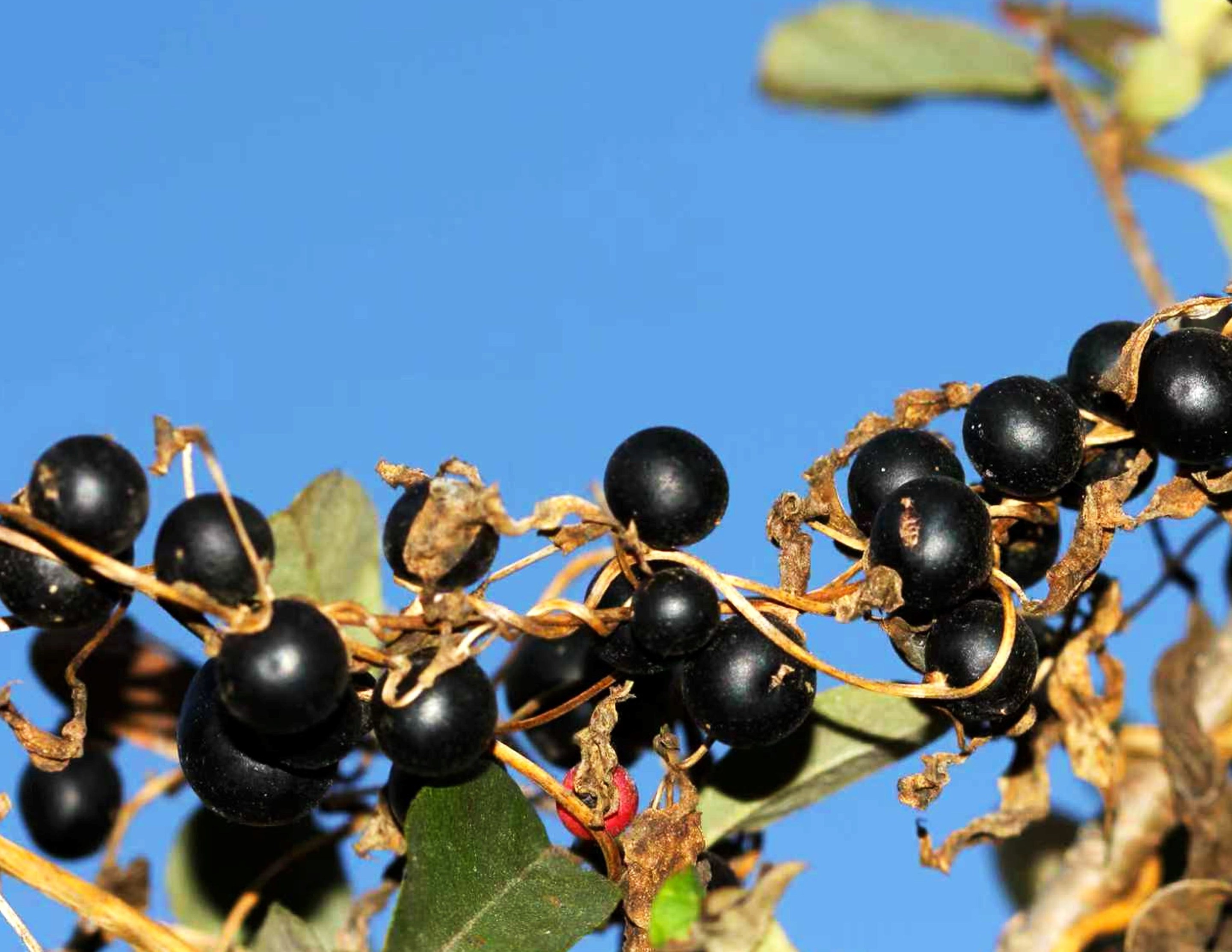
The black-bulb yam Dioscorea melanophyma, which grows in South and Southeast Asia, is a wild relative of our cultivated yams. The plant is a climbing vine, from which sprouts both edible yams and little bulbs called bulbils. The black-bulb yam is asexual, having lost the ability to make seeds and reproduce sexually long ago. Instead, it produces bulbils, which drop from the black-bulb yam to make new, identical black-bulb yams. The bulbils bear an eerie resemblance to real berries, meaning fleshy fruits with seeds inside. Specifically, the black-bulb bulbils resemble other local black berries, such as those of Phytolacca acinosa, or Indian pokeweed.
But, you might be thinking, surely such a sumptuous bulbil still has something to offer a hungry bird! No. It does not. Despite its promising heft, and glossy black finish, a bulbil is not a berry. A bulbil is not even a fruit. A bulbil offers no food reward to the birds who might eat it, instead passing through their gut unharmed in as little as half an hour after the bird has flown as far as 500 yards according to a new paper published in Proceedings of the National Academy of Sciences.
The little buds allow asexual plants to reproduce. Bulbils function similarly to spores, fragmentation, or runners, which allow asexual plants to produce clones of themselves. The black-bulb yam did not invent bulbils. But most bulbils are white or otherwise uninteresting to look it. No other bulbils are known to mimic berries so effectively for a range of creatures. In fact, this paper would never have existed if the researchers weren't also scammed by the black-bulb yam. Gao Chen, an ecological biologist at the Kunming Institute of Botany in Yunnan Province, first picked up a bulbil thinking it was a berry. But when he cut one open, there were no seeds. "They can cheat me, then, I think they can cheat birds," Chen told Elizabeth Pennisi at Science News. Watch as this hapless bird falls for the black-bulb yam's scam! Ha!
Although 22 bird species visit the black-bulb yam's bulbils, one bird stood out for its capacity for cluelessness. That bird is the brown-breasted bulbul, a songbird that visited the yam the most frequently to feast on bulbils. In these duels of bulbul v. bulbil, bulbils won by a landslide, at least in nature. In the lab, the brown-breasted bulbul was not such a fool, and would generally bite into a berry over a bulbil. But in the winter, when the trees are depauperate in berries, the bulbuls will settle for bulbils. Got it? Good.
The end goal of the black-bulb yam's scam is not just to pull a fast one on some hoity-toity birds, but to ensure their bulbils drop and sprout at a fair distance, ensuring the young yams will not have to compete with their parents. Now, please enjoy another clip of a brown-breasted bulbul falling hook line and sinker for this classic bulbil scam, which the researchers dub "deceptive vegetative propagules."
Oh, are you not enjoying this clip as much? Scams aren't so funny when babies are involved, you say? Well, you're wrong.
Delicious Scam No. 2: The Blister Beetle Boondoggle
If you looked from a distance—or simply took off your glasses, you old fart!—you might see in the above photo a beautiful orange flower. What a little wonder to unfurl in the early spring! What a precious reminder of the shifting of the seasons, how life crackles back to life after winter's thaw! What a gift from Mother Earth!
If you were a bee, whirring around a newly green meadow in search of the season's first flowers, you might glimpse this orange inflorescence and hover on over. You might pick up a whiff of its intoxicating floral scent, a surefire sign that this flower will hold the nectar and pollen you desire. Upon landing on this orange flower and letting the blur of your wings settle, you poke around for the pollen that surely must be here. But there is no pollen, no nectar, and just before you realize this, the orange flower comes apart into small wriggling orange flecks that leap atop your back. The flower has betrayed you; its clump of petals was no plant, but rather a wriggling mass of larvae of the European oil beetle Meloe proscarabaeus. In other words, you got pranked by babies! Humiliating.
To make matters worse, when you fly back to your humble bee nest, which ensconces the precious eggs soon to hatch into your young, those orange larvae seize the opportunity to hop off your back and parasitize your eggs. It is unclear if you realize any of this is happening, as you are but a bee, but it is certainly less than ideal.
These are the conclusions of a preprint published on biorXiv.org, which reveals the beetle larvae emanate a very convincing cocktail of scents associated with flowers. These molecules included linalool oxide, a compound found in plants like lavender, and lilac aldehyde, a compound found in lilacs, obviously. This signature perfume is an effective lure not just for bees and other pollinators, but also for other blister beetle larvae, so the little orange babies know to flock together in a vaguely floral mass. This way, their scents comingle into a veritable bouquet.
A brief, tragic footnote: To whiff the scent of the beetle larvae, the researchers collected a batch of the babies and ground them up into a puree. Sad! This puree then went into a gas chromatography-mass spectrometer, a tool that can isolate chemicals in a mixture. The resulting data looked just like you would expect from a flower, and certainly not a beetle.
When grown, the European oil beetle is a stolid sort of fellow: leggy, shiny black, and lacking hind wings. The adults are unrecognizable from the marmalade of their youth, and it remains unclear if adult European oil beetles are capable of any scams. Perhaps it is something the beetles grow out of, as pranks are often reserved for the youth. Or maybe adult European oil beetles graduate to shilling some bug cryptocurrency (thripscoin, perhaps).