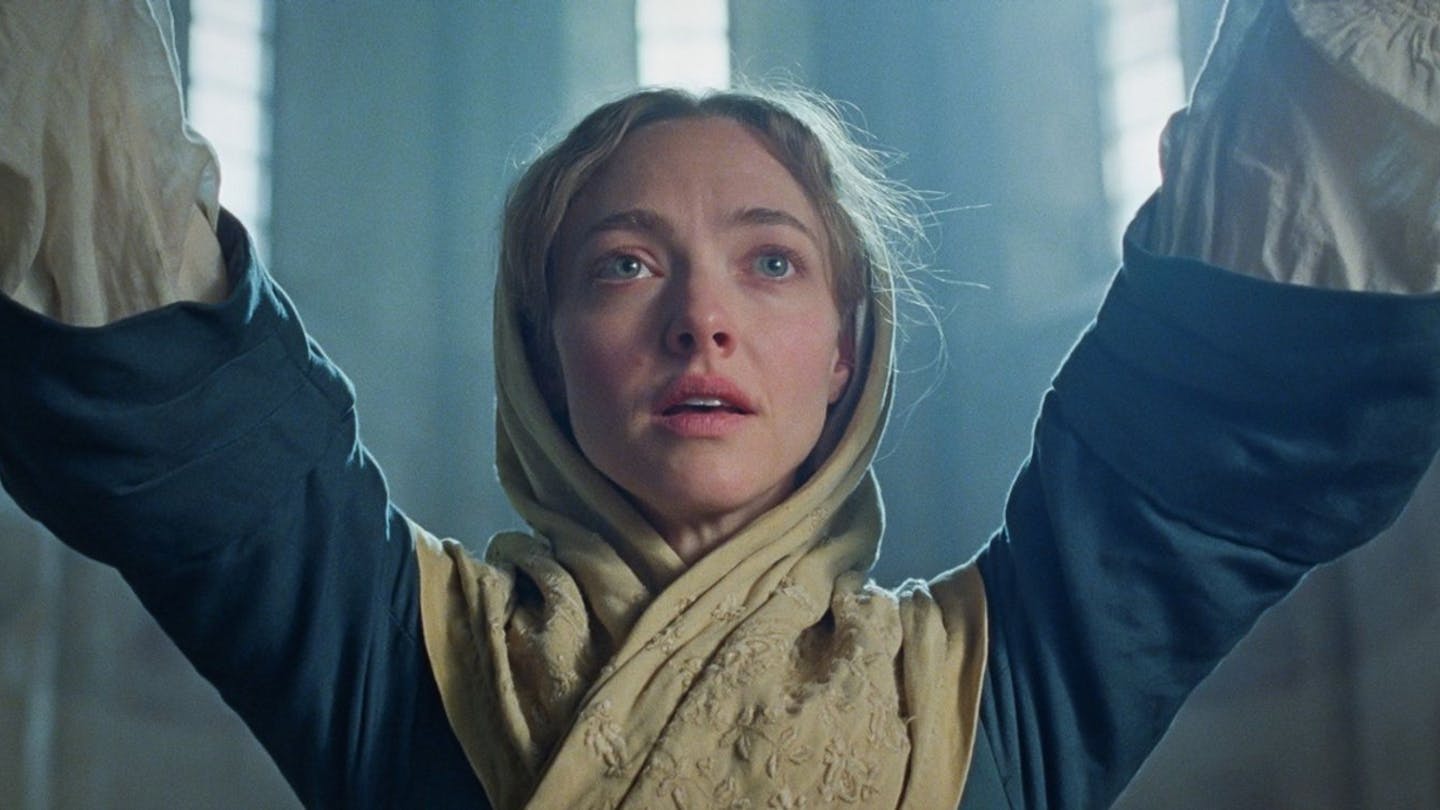
In close-up for much of The Testament of Ann Lee, her eyes brimming with light, Ann Lee seems to be in a persistent state of shuddering. The founder of the Shaker religious sect, played by Amanda Seyfried, shimmers and rarely stays still, yet Seyfried’s performance manages to be deeply solid and earthbound at the same time. Early in the film, she crawls across a floor singing “I hunger and thirst / after true righteousness.” Her voice sounds like cold water, as she bathes on the floor in the light of the Lord.
To perform is to desire, and desire is a productive force. It makes something happen. Seyfried’s performance as Ann Lee lets the viewer in on the production of faith—particularly, an overt faith. In the theater while I was watching the movie, I noticed a little nervous laughter sometimes, especially when the actors were performing devotion through song and movement. Bearing witness to such performance leads to basic questions about people and the way that we live that Americans in particular are usually trying to suppress. Are we doing life wrong? Is our world not the only world, or our way of living not the preferred way of living? If Ann Lee cares so much, do I not care enough? Is she just attention-seeking? Is she putting one over on me? Am I being conned?
There is a scene in the film that stages this dilemma, when Ann and her acolytes are on a ship in high seas and snow on their way to spread the gospel in America. What Ann Lee does in this scene is enact the original meaning of “performative,” the definition from speech act theory, where what is called a “performative utterance” enacts—or attempts—the very thing that it describes. The most famous example is the “I do” in a marriage ceremony, where, through the very proclamation of the will to marry, people’s relationships are transformed legally, and therefore literally. But Ann Lee doesn’t wish to marry; she proclaims the inevitability of her salvation, willing it into effect:
High o’er the billows we are wafted along
Angel wing carry us
Not one ripple to break on our song
All is peace before us
While she and her comrades in faith sing and rock with and against the stormy seas, the ship’s crew mocks and derides them. In this scene, the characters of the ship’s crew are not performing, they are laboring, keeping the ship afloat. They are not wishing to inaugurate or produce anything new. Ann Lee is desiring, and she is performing that desire through song in order to herald it into her present and future. If she asks the good angel to carry her, surely, the creature of God will carry her. What is discomfiting here is not merely the call to attention any performance of desire necessarily entails, but also the fact of activity that is in excess of labor. She is making art.
The annoyance and disbelief that the crew exhibits is both reasonable (it must be genuinely annoying when you are trying to sail a massive ship, and a bunch of people are singing and dancing all around you) and has a long historical precedence. In ancient Greece, Plato decried the falsity of imitation of real life—called “mimesis”—specifically in the arts. If someone can just pretend to be somebody else, what does it even mean to be a someone? What makes you “you” or the world the “world” if artists can just depict a facsimile and receive recognition from an audience?
The Testament of Ann Lee brilliantly plays with and provokes many overlapping anxieties we have about what makes us human, what it means to believe, and the purposes of art. It also happens to arrive in a moment captured by a new sort of evangelism: the AI true believers, who are eager to tell you that the role of Ann Lee could be played just as movingly and convincingly by something called Tilly Norwood.
If the ship’s crew demonstrate a gentle suspicion of performance, the concept of AI actors reveals a malevolent paranoia. Rather than risk being confronted by a work of art that throws into question your way of living, you can have a lithe and large-eyed AI gyrate on the floor in exactly the way you have prompted her to. You will never be tricked into believing something you have not decided in advance you want to believe. AI is compelling to tech billionaires and their minions because it offers the fantasy of total control. They have found a way to conquer their phobia of humanity, which is by turning it into a malleable simulacrum. Of course, it looks like total shit and has, thus far, mainly been used to facilitate taking selfies with various action-movie characters. The imagination of the average AI booster is so impoverished that they do not even dream of going on a high seas adventure with Captain Jack Sparrow, or assisting a heist with Ethan Hunt from the Mission: Impossible movies, or doing blow with Leonardo DiCaprio as whatever character they wish. The most they dream of is a selfie, a gesture to feeling included in a creative community they do not have the intellectual or creative capacity to ever really belong to. And so their greatest dreams look like total ass, because they lack the theory of mind to imagine anything but ass. It can’t create anything new, and therefore what these people are trying to call “AI performance” isn’t that, it's a failed and abject imitation.
AI cannot hunger or thirst. It can only regurgitate. Seyfried’s performance is mimetic in that it corresponds to a truth, it emits a truth of a life revealed. AI, on the other hand, is emetic: It pukes up data harnessed from everywhere and nowhere. It cannot shudder, it can only move eel-like, slippery and glitchy, like vomit. Just look at this AI video depicting the cast members from Stranger Things, with a digitized version of Millie Bobby Brown and the rest of the cast smiling these smooth weird smiles with nothing behind the eyes. These videos seem to both move too slowly as well as too fast, I think because the emotion depicted in the image is essentially sourceless in its lack of motivation. The AI creator making the facial expressions is doing so as part of a technological experiment instead of an artistic or human experience. Have you ever noticed how yellow and orange a lot of AI images are? As it draws from the slop of the contextless masses, the data churned out becomes yellow and orange as all the colors and gradients of that data merge into a too-muchness of nothingness.
What makes Seyfried’s performance of Ann Lee feel so human is the narrative context—she is largely driven to her faith but the all-encompassing grief for her four dead children—combined with the sheer corporeal power of her voice and gestures. When she is singing on the ship, you can hear the movement of her cloak against the snowy wind, the sound of the cloth a reminder of the materiality of her faith’s origins. The fact that this effect was almost certainly added in post does not make the totality of this performance feel any less “real” or human, because the fact that it is included in the first place is the product of a human mind–a sound designer—with a will to make something beautiful. It’s the process that makes art human, and AI cannot process, because it cannot experience. While Seyfried’s performance is about the act of creation amid unspeakable death, the act of performance itself is as much about creation as it is reception. Listening completes the speech act. Ann Lee listens to the pain of her flock, and sings and dances with them to give them and herself solace. These tech guys walk around everywhere with fucking Airpods listening to Joe Rogan.
On March 11, a new official music video by Tilly Norwood was released. Called “Take the Lead,” the song’s lyrics are an attempt at an ode to creativity. Tilly Norwood wanders around an orange-ish London and appears on talk shows and takes selfies with fans. A little girl walks along the street with a Tilly doll. The ending is an explosion of flamingos and pink dolphins swimming in the sky. It’s one of the worst things I have ever seen or heard in my life. To compare it to Ann Lee’s “I hunger and thirst” is to compare a pile of shit to the sound of a baby’s first laugh. Ann Lee hungers and thirsts and uses that desire to create art, as well as a community of believers. Now, in 2026, with the Trump administration’s propaganda catapulting to staggering proportions, spurred on by AI’s necropolitical agenda, figuring out what and who to believe is harder than it has ever been. If we are to find it, we have to do it together. Typing “make a pop song sung by a beautiful woman” into a prompt window, to the AI booster, is equivalent to writing “Call Me Maybe” by Carly Rae Jepsen. “Call Me Maybe” is a miracle of God. The reason these two things are equivalent to them is because they do not actually like pop music, because AI guys don’t actually like anything. They are anti-life. If art is to survive at all, we cannot cede an inch of ground to these fascist idiots. It’s a shame that the figure of the sociopath in popular culture is genius-coded, because the sociopaths who are attempting to structure our reality—art included—have rocks for brains. We have to remember this at all times.
Performance offers the opportunity for redress. We attempt to rewrite our past transgressions and rehearse for the future. Ritual is a constitutive human activity; performance enacts it. You cannot outsource ritual. A computer cannot pray. It cannot grieve. It cannot rejoice. Performance, on the other hand, offers the chance to reconcile the material with what might be.