

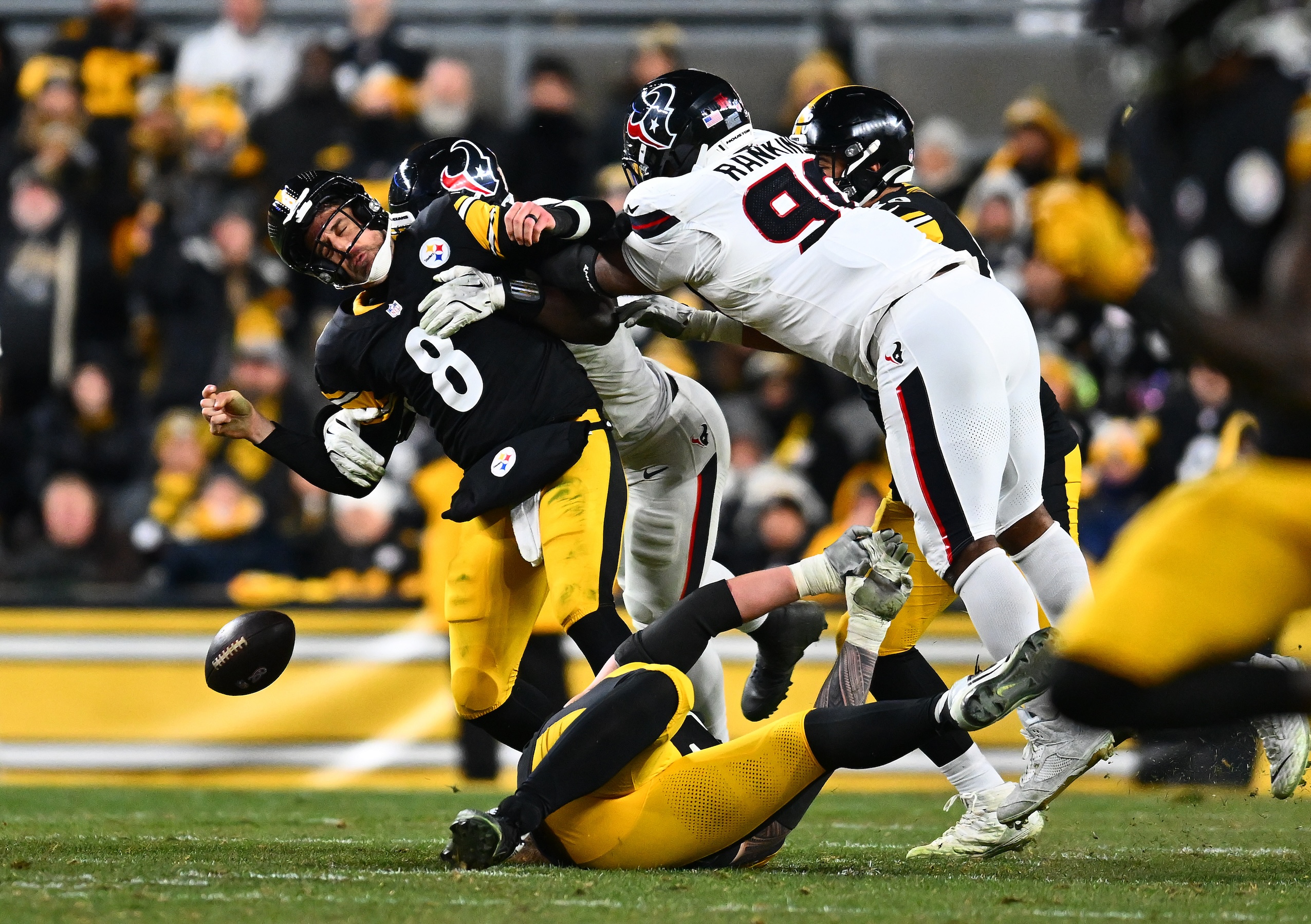
With the football world's sudden fixation on Mike Tomlin's future or lack of same in Pittsburgh raising the question of why coaching longevity is suddenly a bad thing, we have completely forgotten the more obvious reason for caring about the Steelers—the end of Aaron Rodgers' career. Which is fair enough: Tomlin's annual flirtation with unemployment is familiar by now, but Rodgers' career has been ending, gratingly and in public, for just as long. What's one more indignity?
Tomlin was booed by home fans for still having his job during the dying stages of Monday night's 30-6 throttling at the hands of the otherwise unimpressive Houston Texans, which was a reasonable response to his team's performance but otherwise no indication of anything in particular. The NFL is going through one of its occasional firing binges, only with more big names that ever before and no longer limited to teams that don't make the playoffs. Why, you can still hear the sighs of disappointment from the Green Bay Packers' announcement that they intended to work out a new contract with Matt LaFleur.
But the larger issue in Yinzerville Heights this season has been Rodgers, the 42-year-old future Hall of Famer whose last few seasons have been so marked by physical and reputational injury that they've served almost as a repudiation of the previous 14. The whomping he took on Monday night will make for a melodramatic coda to all of it if he decides (or has decided for him) that football is now a thing he used to do. Rodgers threw a melodramatic but meaningless-but-for-the-storyline pick-six to Calen Bullock for the final score in a game long since lost, and dramaturgists across the sport saw that as the telling end to his end. And this was after Rodgers had been pounded into a fumble that was housed by Texans defensive tackle Sheldon Rankins. The Houston defense outscored everyone on the field except Houston kicker Ka'imi Fairbairn, and Rodgers' age was the statistic most referenced by Joe Buck and Troy Aikman the entire night.
But Rodgers, who had strongly hinted that this would be his final season back in the summer, offered no further clues last night above his general play, preferring after the game to defend and support Tomlin and his value as part of a greater theme of enjoying his year in Pittsburgh. He also defended LaFleur, so either out of chronological loyalty or a hat-tip to the good old days, he was in a magnanimous mood. Then again, his last stop was with the New York Jets, so Rodgers could hardly find fault with this year by comparison.
And in fairness, even during a season in which he largely looked every day of his age, Rodgers was less polarizing as a player and a regular citizen than he had been since pre-pandemic times, before he started doing his own research and lent his support to shameless charlatans like Robert F. Kennedy Jr., and when he was still one of the best quarterbacks in the game. For much of the year, Rodgers looked and acted as if he had finally taken stock of his place in the mutual diaspora of the NFL and larger culture and decided that being a serial annoyance was something he had gotten out of his system. He also, in a way he never quite did with the Jets, looked like a NFL quarterback—a much diminished one, but not quite a dead letter.
That sense of late-career renewal ran headlong into a stifling Texans defense that had no such romantic notions about either Rodgers or his career arc, and they terrorized him to the point where his two turnovers resulted in more Houston points than his own team could score the entire night. Whatever magical ending Rodgers might have imagined for himself ran headlong into a televised shot of him yelling "Do your fucking job" to one of his offensive linemen.
Now, if we know Rodgers based on his prior behavior—as opposed to knowing him as a person, which very few people do—he will let the decision on his future linger in the air awhile, if only to irritate folks who want their plot points wrapped up quickly. See: John Harbaugh's search for his next job as the latest irritant for the NFL punditocracy. Rodgers has always liked making other people wait on his decisions and watching their exasperation grow the longer he makes them wait, and even this new, mellower uncle-without-nephews version of the man is likely to do so again.
But unlike his two purgatorial years in New York or his last days in Green Bay, the animosity Rodgers once engendered seems no longer to be there—it's as though he figured out that he could outlast the outrage he so persistently generated against himself. Whatever demons traversed his brain and made him think that playing for the New York Jets was a good idea now seem to be exorcised, though we emphasize "seem" because the man's word is not entirely bankable. It's as though signing with the Jets was actually a cry for help that went unheeded from the fifth play of his time there to the day he finally left. He was something like a normal football player this year, and if he went out sad, it's worth noting that plenty of normal football players do.
Your mileage on Rodgers' rehabilitation may vary, though. The caustic online-poisoned skeptic act he trafficked in during the pandemic played poorly in our new pick-a-side-so-I-can-hate-you politics, and he found out what national schadenfreude feels like when his leg accordioned and he was forced into full-time public personality status. In that role, Rodgers learned face-first that trying to be Larry David doesn't work if you don't set up the premise of being Larry David by having Larry David as your head writer; some people will not let that go, nor should they have to. Rodgers' name was once floated as a vice presidential candidate and, less degradingly, a possible Jeopardy! host. Now nobody can muster the strength to suggest him as a potential Indianapolis Colt.
So the real question here may not be about Rodgers but about you, and whether you believe his 2020 villain turn was the man revealing his truest self, or just flashing his weird and sometimes misshapen sense of whimsy and curdling when the public didn't laugh along. Or maybe that is a difference without distinction. When you step in it, it is often hard to convince anyone that your shoes are still usable.
As a practical truth, it is hard to see how the Steelers would want to run this back for another year, Tomlin or no Tomlin. Rodgers at 43 seems unlikely to be materially better than Rodgers at 42, and even though he was originally meant as a bridge toward whatever quarterback isn't Mason Rudolph, but the Steelers have the 21st pick in the upcoming draft, which puts them behind six teams that also will be try to select their quarterback of the future from the three quarterbacks worth drafting. There is, in that sense, a reason for Rodgers to think he might be asked to stay.
On the other hand, there was last night and the Texans, who applied force to scheme and rendered Rodgers and his offense utterly inert. The crowd may have wearied of Tomlin after 18 years; the league seems to have come around to the position that having a coach succeed for years is actually a bad thing, and yes, that means you too, Andy Reid. Rodgers falls into that maelstrom of resentment by default because he's been a player even longer than Tomlin has been a coach, and even though he's only been a Steeler for one year, Monday was proof that he already does a great late-stage Ben Roethlisberger imitation. The new-age Steeler fan doesn't like to remember that bit of recent history very much, with good reason.
So I guess we wait, or more likely just watch some other games between the teams that remain. Unlike his previous will-I-or-won't-I's, Rodgers is now beyond the point of our caring. It's been too long since he was quarterback-relevant, and even some distance since he was stage-managed irksome. The Houston Texans made it clear beyond the point of all dispute that he is yesterday's special, and whether he returns for a 22nd season is almost beside the point. We hunt coaches now, whether it's in Manchester or Madrid or Miami, and it has already been a banner year for skulls on pikes. Of all the things Aaron Rodgers might want to be in his next incarnation, coaching other adults wouldn't be any more interesting for him than playing at toxic politics was for those few minutes. He ends his career as he began it—as a quarterback whose career was controlled by others, going out as football players do.