

Listening to Jeff Peterson, president of basketball operations for the Charlotte Hornets, talk about the recent LaMelo Ball trade, you get a pretty good idea of what he thinks about last season's team. "There's no doubt in my mind that we had a successful season last year, by a lot of people's standards, and of course LaMelo was a huge part of that," Peterson said, from Las Vegas, upon the formal completion of a deal announced nearly two weeks ago. Eager to sing the praises of the incoming Naz Reid, Peterson was also about as clear as decency could permit about what he seems to think of as the realistic limits of a Ball-led team. "These decisions are challenging, at times, but when you look at the totality of the season, and everything, of where we were, it's important to take an honest look in the mirror. The goal is never to compete for a play-in spot. The goal isn't to get to the play-in, or even to the playoffs for one year."
The Hornets recovered from a wobbly start last season to finish with a winning record and make the East's play-in. They went on a tear after the All-Star break, finishing their campaign on a bonkers 30–12 run; Cleaning the Glass says they posted the NBA's seventh-best point differential on the season. Ball, healthy for the first time since his sophomore season in 2022, finished third on the team in minutes played, and the Hornets were about 7.5 points better by net rating when he was on the court, powered by an improvement in offensive efficiency of nearly 13 points per 100 possessions. It was Charlotte's best season by record since 2016; by Basketball Reference's dopey Simple Rating System, which combines point differential and strength of schedule, this was Charlotte's best season literally in franchise history.
That accounts for the first part of Peterson's quote up there, the part about the Hornets having had a successful season "by a lot of people's standards" and LaMelo being a big contributor. As for the second part: The Hornets failed to sustain their momentum through the play-in, and their season ended in embarrassment. They needed a last-second go-ahead bucket in overtime to squeeze past a decimated Heat squad, and then three nights later they were summarily be-gibletted in Orlando by a Magic team so desperate to flush their season, fire their head coach, and hit the beach that they might as well have been playing in flip-flops and swim floaties.
It has now been a gut-churning 24 years since the Hornets last won a playoff series. "The goal is to get to the playoffs and stay there, for a long time," Peterson said on Saturday. He means returning to the playoffs year after year, but probably also spending more than one dismal, humiliating half-week per appearance in the coatroom, sort of hoping to be confused for a real playoff team. The Hornets had Ball as the face of their franchise for six seasons, and in that time they played zero real-deal playoff games. You can understand anyone's reluctance to commit any further to that particular project.
It seems evident now, from the trade and from Peterson's explanation, that he considers Charlotte's rotten start, LaMelo's season-long minutes limit, and the team's heinous play-in flameout to be more real and representative of the state of things than were those blissful few months of sustained excellence. He has a closer view of these things than you or me, but that is still one hell of a wager. Charlotte's basketball history weighs on these evaluations. On the one hand, I would not want to talk hoops with a long-suffering Hornets fan who would rather have a draft pick in 2033 than a team today that wins more than half of its games. On the other hand, keep away from me the lunatic homer who is willing to believe that 42 games in an otherwise ho-hum campaign prove convincingly that this crummy organization has finally emerged from the wilderness. I can relate to skepticism, even cynicism; my heart also goes out to any poor Charlotte-area goober with a TV remote control in his hand some March evening, who just for the love of God wants to believe that there is any reason for him to turn on that night's basketball game.
Peterson seems to want bites at an apple. He talked a lot on Saturday about flexibility and "draft capital," the picks and pick swaps they're getting from the Timberwolves, plus a huge trade exception that can be used to add salary. The Hornets are making themselves rich in this sort of thing. The formula that has worked for Sam Presti in Oklahoma City, that has seemed to turn his Thunder into a self-sustaining Dominance Engine and the envy of the rest of the league, is to hold onto young core players but to otherwise take every opportunity to beef up the organization's store of draft picks. The Hornets are now loaded down with picks: Per RealGM, Peterson has at least nine and as many as 12 first-round picks at his disposal over the next seven years, plus another 21 potential second-round picks. The asset haul from the Ball trade might seem paltry to Hornets fans, but in its aftermath it really clarifies the short- and medium-term goals in Charlotte: Peterson doesn't want to tank, but he does not view the core he just broke up as good enough to back him off of an asset-accumulation project.
How good would the team have to be? This is where things get worrying. Charlotte's back-half ascension doesn't have to be entirely real—they do not have to be a 59-win team—for Peterson to be breaking up something authentically contender-ish. NBA general managers seem sometimes to prefer bites at the draft apple to bites at the 50-win apple, but I think it's easy to forget that the point of draft picks is, you know, to acquire good basketball players. The Hornets inarguably already had some of those. It can feel sometimes like the league's executives—the ones who are considered good at their jobs, anyway—view the stockpiling of draft picks as no worse than the third-best thing that can be accomplished in a given season, after losing a title and winning a title. But if the apocalyptic garment-rending in the Hornets subreddit is any indication, the team's fans largely do not share this perspective. I'm sure they will enjoy getting to the playoffs and staying there, if it ever happens, but I think many of them are desperate in the meantime for a team that wins more than it loses, that hangs on to the good players they've grown to love, and that behaves normally for consecutive seasons.
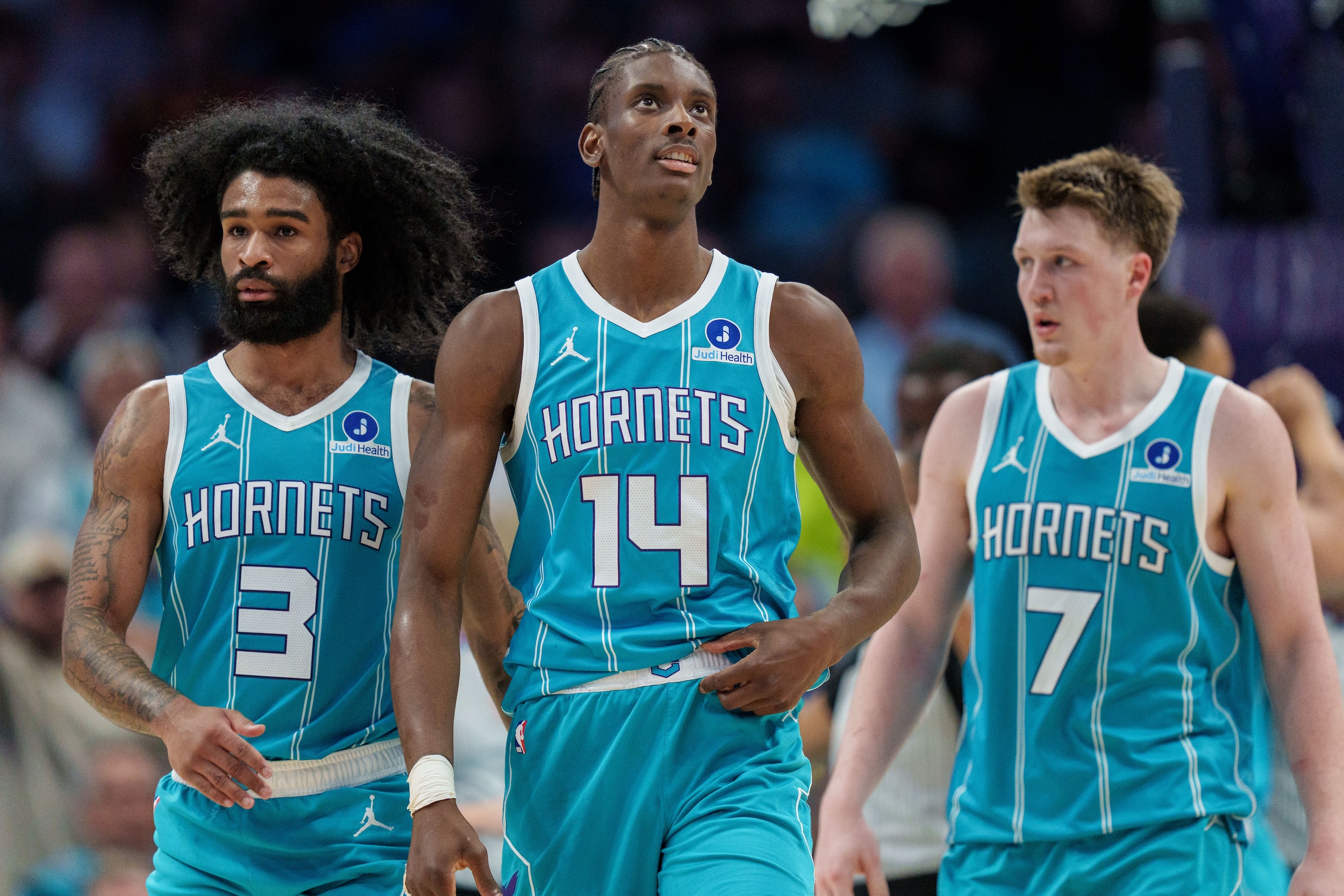
The Hornets do have cool players. Kon Knueppel and Brandon Miller might be stars. Reid showed dimensions to his game during these last playoffs that a casual fan might not have believed possible earlier in his career, when it was still sort of thrilling to see him popping to the perimeter and yanking opposing defenses out of alignment. Coby White is zippy and a good shooter and a willing defender; he might not be in Ball's class as a playmaker but he is a perfectly solid starting point guard, and is capable of playing fun basketball. To Peterson's credit, he did not wipe out the team—he just kind of scrubbed away their identity.
Still, it's hard to trust a general manager who breaks up a good thing, and it's even harder when the good thing being broken up is the first good thing encountered in decades of pain. Peterson wasn't sold on the Ball-era Hornets, and that's defensible, but there was no immediate deadline or approaching point of no return. Miller will pass through restricted free agency, which overwhelmingly favors the team. Knueppel is on a rookie contract. Ball might prefer a huge contract extension, but seeing as his existing deal runs through 2029, Peterson would've been safe telling him to go screw. What seems to have motivated the move at this particular moment was less an opportunity to improve the team than an opportunity to have the same sort of team, but with a richer stockpile of math things. That can be good business, and is maybe the right framework for understanding the trade: If your team is going to be nothing special, wouldn't it be better to be nothing special plus draft picks?
The thing left unaccounted, there, is the patience of Hornets fans, who've endured generations and lifetimes of nothing special. After all that, it sucks to be reminded that what you cherish amounts to not enough. Speaking as a fan of another of the league's truly horrendous franchises, a not-special 45-win team can feel extremely special to one parched from years of wandering. "I do empathize with the fans, and where they're coming from," Peterson said. "I would just hope that they understand that I have the best interests of the Hornets organization, I truly do. It's not about one year, two years, it's about—I keep saying it—sustained success." Cool, yes, that sounds great. It always does. But can they also have one year, two years, just for a little treat?