It is hard to say what mood I need to be in to have the urge to put on The Disintegration Loops, because it is hard to say what mood they express. The same five- or 10-second loop, so obviously mournful and defeated, can sound at another another time—10 minutes later, or 10 years later—just as obviously inspiring or triumphant. They say that what you get from a piece of art depends on what you bring to it. There's maybe no better example.
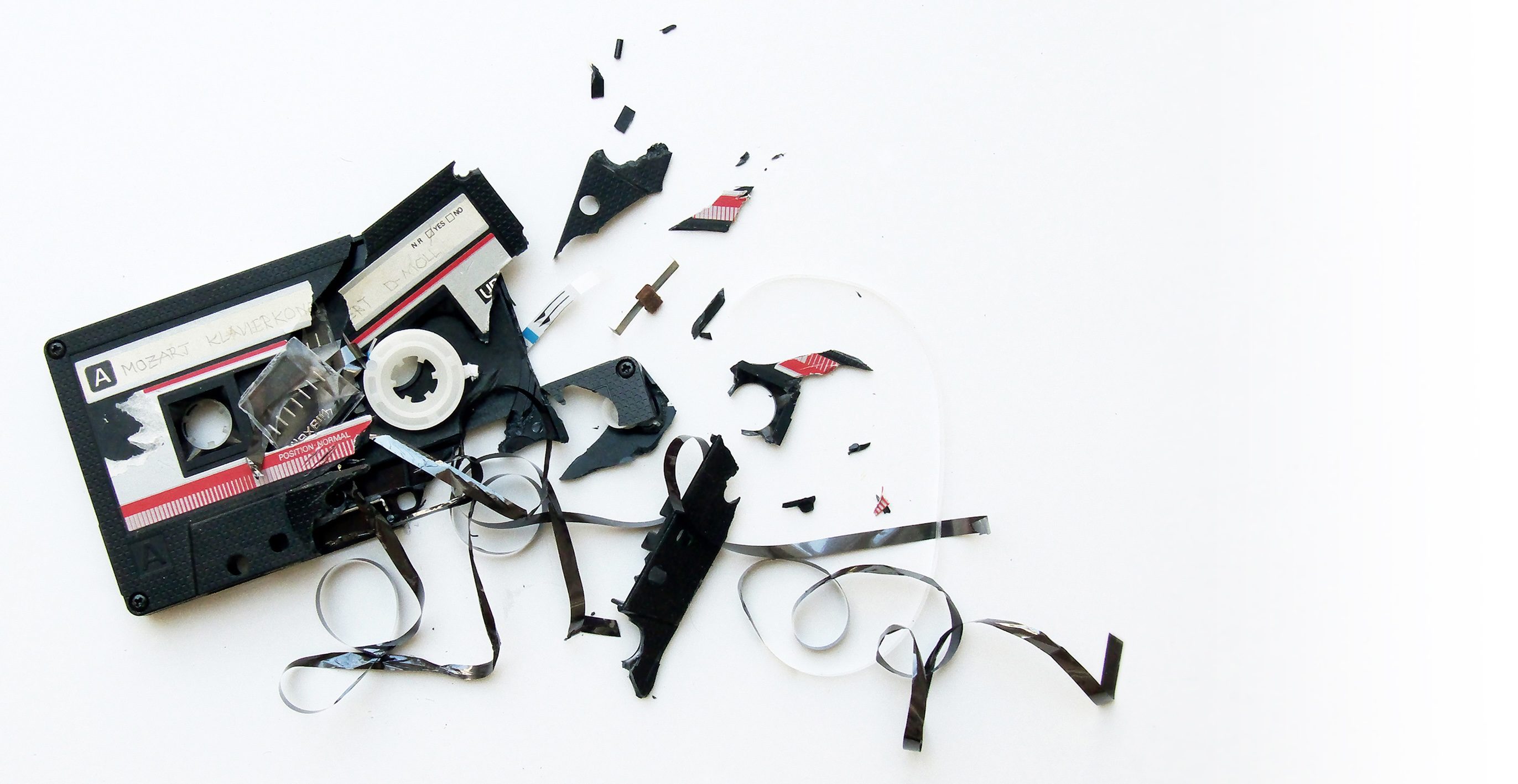
The Loops are as much an experiment as a composition. In 2001, the ambient artist William Basinski was attempting to digitize an old collection of audio tape loops he'd recorded decades earlier. During the transfer process, he saw that the magnetized tape was literally flaking off the reels—the integrity of the recording coming apart a little more each time it played. As he played them over and over again, he noticed something interesting happening with the audio itself: It was decaying, imperceptibly with each repetition, but obvious after several hundred, several thousand.
The Disintegration Loops, four albums with individual tracks running as long as an hour, are no more than they promise. Each track is a single melody, a few seconds long, repeated ad nihilum. If you go into it expecting to hear the melody change, you will be disappointed. The decay is so slow and subtle that each repetition is seemingly identical. But as the track goes on and on, you gradually become aware of cracks and pops where there weren't before. Voices have faded. It echoes, as if from the bottom of a pit. The loop has become less a snatch of music than a memory of one. "I’m recording the life and death of a melody,” Basinski said.
With the magic of digital audio, you can hear just how much it deteriorates. Listen to a minute of one track near its beginning, then scrub to the back end. It is barely recognizable as the same loop. But it is the same—isn't it? This is sort of a degenerative Ship of Theseus situation. If in falling apart a melody has lost most of itself, is it still itself? Is anything?
It is hard not to play with metaphor when listening to The Disintegration Loops. It is about loss, and transience: the tapes are literally crumbling into dust, never to be heard again in their original forms. It is about transformation: the music becomes something else entirely by the time its shadow engineer, time, has had its way. It is, I often think, about life and death—how each one of us is nominally the same from minute to minute, but infinitesimally altered by life, to the point of ultimate unrecognizability. Me, my identity as a person, who I am, is with each passing year copied over into a new me, but with a constant and inevitable loss of fidelity in each copy, a loss that isn't apparent in the moment, but is monstrous with enough hindsight. We age, we come apart, we die.
This demonstration would be art on its own, but still a sort of bloodless, academic installation. What makes the Loops worth returning to is, undeniably, the music itself. It is beautiful. There is something almost spiritual to the sound, and not just the ones that resemble Gregorian chant. The loops are gorgeous, textured swellings. They rise and fall like the tide. This, I think, explains how the same loop can sound alternately forlorn and exultant, crushing and weightless. It is a sine wave of mood, and you are free to ride it up or down as the moment suits you.
The Disintegration Loops, already by dint of its conception a more physical sort of project than any pure audio, also has a backstory that informs listeners of, if nothing else, the artist's intentions. Basinski was finishing up the transfers in the fall of 2001, when the World Trade Center fell. On the evening of September 11, as the last light left the sky, Basinski filmed the smoke of lower Manhattan from his Brooklyn rooftop. Stills from that film make up the artwork to the Loops.
I was a firsthand witness to the fall of the Towers, and it's impossible for me to listen to the Loops without thinking of that magnific loss—of, specifically, that moment when the smoke cleared enough to see the blanks in the skyline. It conjures up that same sense of something going away, of the void swallowing substance until only spectral outlines remain, and we are forced to fill in the gaps with memory. The absence is the elegy.
But the elegy is really for us, its hearers. When I listen to The Disintegration Loops I am invariably, if unexpectedly, left with a sense of hopefulness. Nothing is truly gone, not a building or a person or a song, as long as its threnody survives to be sung. The tracks in Loops stop before they are allowed to fully evaporate. While it's certain that if allowed to continue they would vanish entirely, they don't, not yet.