
Monty McCutchen remembers the play unfolding in front of him.
With just under two minutes left in Game 7 of the 2016 NBA Finals, the game tied at 89, Golden State's Andre Iguodala grabbed a rebound and dribbled up the floor. He was coming right at McCutchen, who was backpedaling and would end up as the "lead" official positioned underneath the basket Iguodala was sprinting toward. Iguodala and teammate Steph Curry bore down on J.R. Smith, the only Cleveland Cavalier back on defense; Iguodala passed it off to Curry, who skipped it straight back. As the closest referee, McCutchen prepared for a contested attempt at the rim.
"I was refereeing J.R. Smith," said McCutchen, one of three officials on the game and now the NBA's senior VP of referee development and training. "I remember thinking, 'You got J.R. Get J.R. Get J.R.'"
At the last moment, though, he saw something else in his peripheral vision.
"LeBron's coming."
You know what happened next.
Blocked shots happen in basically every NBA game. They're a box score category. But reference "The Block" to any fan of the league over the last decade and you're instantly colingual.
The play has its own Wikipedia page and is generally remembered as the greatest moment from the career of arguably the game's greatest player. It also preceded one of the league's iconic broadcast calls by its preeminent voice, etching Mike Breen's incredulous "Blocked by James!" into NBA history.
The Block turns 10 in a few months. LeBron's fuckery has, somehow, continued. But the play still feels like the capper on his career. Just ask the people who were closest to it.
If you subscribe to Bill Simmons's theory that NBA titles should be assigned varying historical weights, 2016 was a Looney Tunes anvil. A Finals rematch. A 73-win season. A unanimous MVP versus the game's consensus Best Player. A hometown hero trying to bring Cleveland its first title after half a century. The Warriors infamously went up 3-1 headed back to the Bay before one of those pesky, ill-timed Draymond Green nutshots changed the tenor of the series. Cleveland won Games 5 and 6 by 29 points combined.
The atmosphere for Game 7 was predictably tight.
"There was an electricity, there was an excitement, but there was also a tension," Breen recalled. "All these athletes, what they've put in, obviously for their whole career, but this particular season, to come down to that.
"You can feel it. You can feel excitement, you can feel anxiety. And the crowd was like that as well. You're making me think back at what a special game and a special moment that was."
Neither team led by more than seven points all night; this was a one-possession game for all but the final 11 seconds of the fourth quarter. The teams were tied for 8:35 of game time and the lead changed 20 times, both highs for the series. The truest sign of the moment's enormity as the game wore on? Some of the NBA's most notorious whiners mostly shut the fuck up for once.
"I remember one thing very distinctly, that there was very little complaining," McCutchen said. "Everyone was so intensely focused."
Tension peaked midway through the fourth. After a Klay Thompson layup with 4:39 left, the teams went nearly four straight minutes without scoring.
It's a stretch worth rewatching, an unfiltered display of athletic desperation. It wasn't pretty, unless you love optimal closeouts and immaculate defensive rotations. Jeff Van Gundy, sitting next to Breen on color commentary, repeatedly urged the Cavaliers to get into their offense faster instead of walking the ball up the floor. They honestly just seemed too tired.
"You have one of the greatest offensive players of all time and one of the greatest offensive teams of all time," Breen said. "And so much of who won that championship came down to who played defense and how good the defense was."
That was especially true on one play in particular.
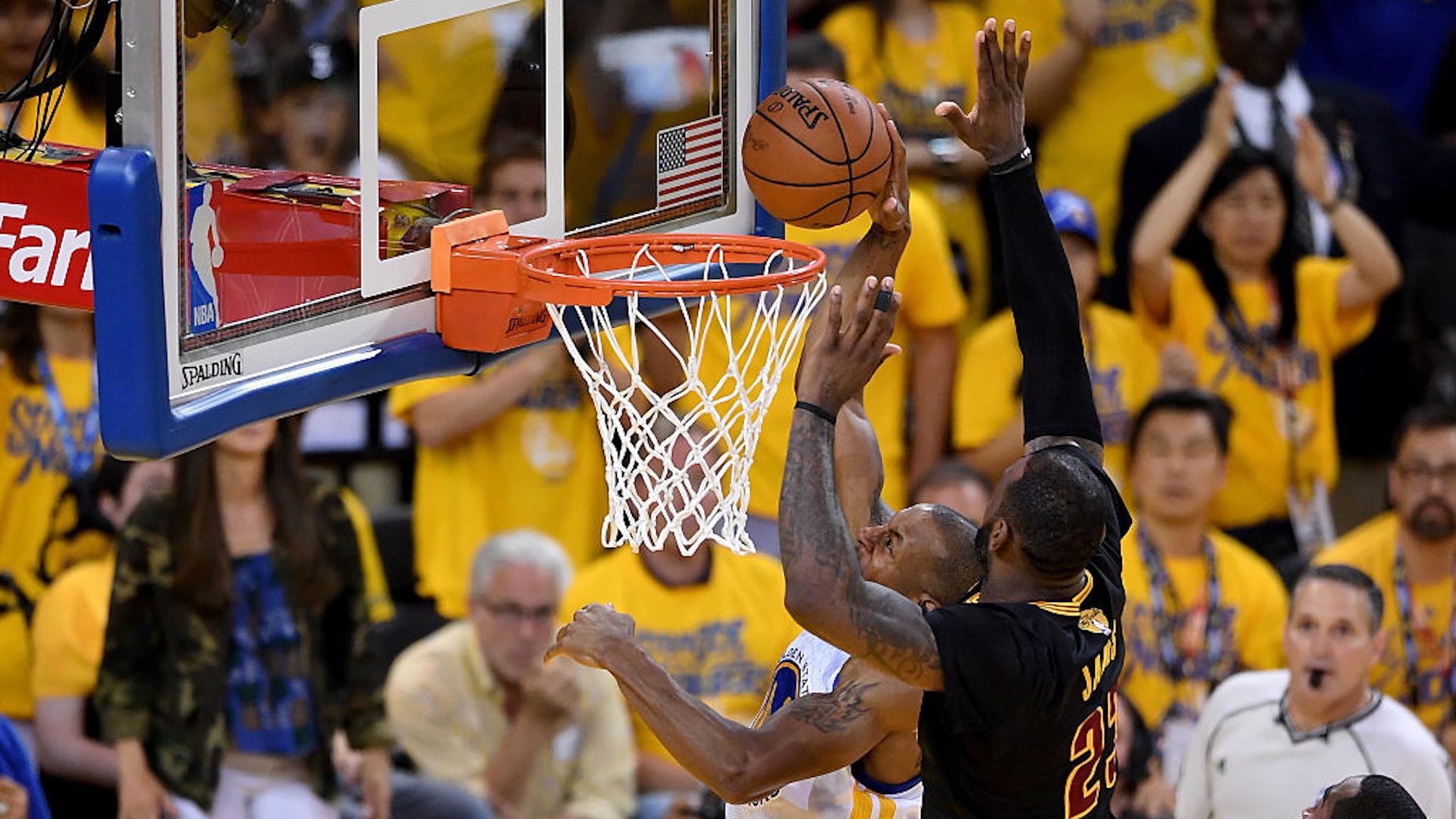
As the clock hit two minutes remaining in the fourth quarter, Kyrie Irving missed a running floater. Andre Iguodala rebounded and dribbled to halfcourt, then passed it off to Curry streaking ahead, with only Smith back for the Cavs. As Curry passed it back to Iguodala near the Cavs’ free-throw line, with Smith trailing him by a half-step, the result seemed inevitable.
"It looked to me that he was going to score, like there was no problem," Breen recalled. "He was going to score, and the Warriors were going to go up two.
"And then James just comes out of nowhere."
Some hard-hitting analysis: Most players in NBA history could not have made this play.
There's the raw speed for starters: ESPN's Sports Science determined that James reached 20.1 mph while covering 88 feet of ground to catch Iguodala. Usain Bolt holds the world footspeed record of 27.8 mph in 2009; LeBron came within ~25 percent of that figure despite already having played over 44 minutes of some of the highest-intensity basketball we've ever seen, and despite being much heavier than Bolt.
Even once he closed the gap, though, James still needed to time things perfectly.
"LeBron has these rare athletic gifts, but he also, even to this day, has a great sense of anticipation and timing," Van Gundy said. "Some guys, they never learn to anticipate. Other guys just understand angles and timing. And James has had that since he came into the NBA, and it's just gotten better and better. That play probably epitomized his sense of timing and anticipation."
Sports Science said James's hand was 11 feet, 5 inches off the ground when he blocked the ball.
LeBron had just a little help, in fairness. Smith was maybe more well known for his various escapades than anything he did on the floor, especially on defense, but he came up big here: The extra effort to turn and contest the shot made Iguodala double-pump on his layup, delaying it by 0.15 seconds, according to Sports Science.
"[That] difference enabled James to get that extra step to be able to make the play," Breen said, before comparing the sequence to another legendary LeBron moment. "It's like the Ray Allen shot in Miami. There had to be six things happening on that play for Ray Allen to be open to hit that three-pointer. And all six happened."
Even so, the ball was only inches from hitting glass and becoming goaltending before LeBron got his fingers on it.
McCutchen and fellow refs Danny Crawford (crew chief) and Mike Callahan would have been justified in calling one, in fact. The NBA had added automatic video reviews of goaltending calls in the final two minutes of games a few years earlier, a move that naturally led to officials calling anything that even looked close so they could hit the monitor and review (yippee, we all love that). And even though the officials he now presides over are indeed trained to call a goaltend in those spots if they have any doubt, McCutchen isn't a fan of that approach in moments like these.
"If you referee as a crutch, using replay as a crutch—'Oh, it's close, let me bang that home so we can look at it'—it's very hard to turn that on and off, be a confident referee everywhere else," McCutchen said.
He also raises the obvious fork-in-the-road scenario: James's block would still have counted if they'd called a goaltend and reviewed it, but it wouldn't have been The Block. And if you project the butterfly effect out further, what about the other heroics that helped Cleveland win the game? "The potential is that we don't see the three from Kyrie through the flow of play," McCutchen said.
NBA officiating crews do a video review after every game that includes a look back at certain close calls (or plays their supervisors think they screwed up). McCutchen said no one brought up a potential goaltend on the James block during their Game 7 review session.
"We were just that confident in it," he said. "To referee Game 7 with a sense of insecurity and a lack of confidence, maybe you shouldn't be on that game."
Breen loves giving compliments, like many of the greats in his field. (Also just like them, he hates receiving praise and resists even the tacit suggestion that perhaps he's an important figure in league history.) He gave McCutchen and crew the ultimate kudos here. "If you want to say it's maybe the greatest block of all time, you could also say it might be the greatest non-call of all time," Breen said.
McCutchen didn't try to hide his pride at having worked this Game 7 or the impact it had on him. There's no just another game bullshit.
He told me that after the game, already cognizant of how special it was, the entire officiating crew and their significant others drove out to a scenic spot in San Francisco and took in the Golden Gate Bridge for an hour or so. As three of the league's most accomplished officials, McCutchen, Crawford, and Callahan had a long history together that felt like it culminated in that night.
"We were just sort of soaking up this event. We didn't talk much about it. We were sort of laughing with one another about our history together," McCutchen said. "And there was a sort of existential joy at not only having been a part of that, but having done that together as people who had been there for one another over many years."
He said his wife claims it took him almost a week to "return to myself" after the game, that he was in a different mental place. McCutchen even earnestly choked up at one point during our conversation while reflecting on the moment.
"A lot of my career's in that game," he said.
Yet he said he's never rewatched Game 7 and has no intention to—especially not for any kind of performance review. The fact that "no one talked about the refereeing that night" is proof enough to him of the job they did. It's a fair point; someone always whines about the refs.
Even if he hasn't watched the game, though, McCutchen has obviously heard the call everyone associates with it.
Breen had given the "Blocked by James!" call dozens of times in LeBron's career before that Game 7. "Blocked by" has long been a signature phrase of his, maybe only trailing "Bang!" in notoriety. But any fan remembers this version above all others.
"That's one of the brilliant things about Mike as a broadcaster: His voice," Van Gundy said. "You sense time and score and importance of the game by how he calls the game. He doesn't overdo his signature call. He's not one of the announcers who hyperventilate at a second-quarter play.
"It always takes me back to when I started with Mike. I think I said 'Great pass.' He said off the air, 'Was that a great pass?' And I'm like, 'That was a good pass.' He goes, 'Well, then just use the language that fits, because you don't have much place to go from great if there actually is a great pass.'"
Breen counts Marv Albert as his GOAT basketball broadcaster (again, he dismisses even the mere suggestion that he might be a candidate for that title). Naturally, that's where he got his style from.
"[Marv's] signature call was 'Yes!' But Marv had like four different versions of 'yes,'" Breen said. "He wasn't saying 'yes' in the first quarter the same way he was saying it in the final minute of a big game. And you learn from that and how that extra intensity in the call, that's what to me signals OK, this is a special moment deserving of that.
"It's like with me, with 'bang.' I try not to overuse the word 'bang,' to the point where I've actually been criticized for not saying 'bang' on Kyrie Irving's three pointer that he hit that turned out to be the game-winner. Because I don't want to overdo it."
Breen said the "blocked by" call was born in part from an adage he'd heard decades ago: Words with ck and ch sounds just have an extra oomph.
"It's just such a hard sound, blocked," Breen said. "Like, you can say, 'Rejected by James,' and that's good. 'Denied by James,' that's good. But there's something about a hard sound with the word block that I think, just for me, it sounds better than the other ones."
Van Gundy can't remember the immediate aftermath of the play. "I don't remember my name half the time," he deadpanned.
Breen does, and the reactions of his fellow broadcasters stick with him. He said both Van Gundy and Mark Jackson, even in the heat of that game, immediately recognized the gravity of what they'd just seen.
"It takes a lot to have Mark and Jeff be like, 'Wow, we just saw something special,'" Breen said. "And I do remember thinking, man, even these guys are blown away by it."
Breen, who has sat courtside for every Finals game James has played, called it a privilege to have documented LeBron's career. He said they have a good relationship, but have never actually talked about The Block or that game.
He'd like to someday.
"It's a connection that I'm very proud of."