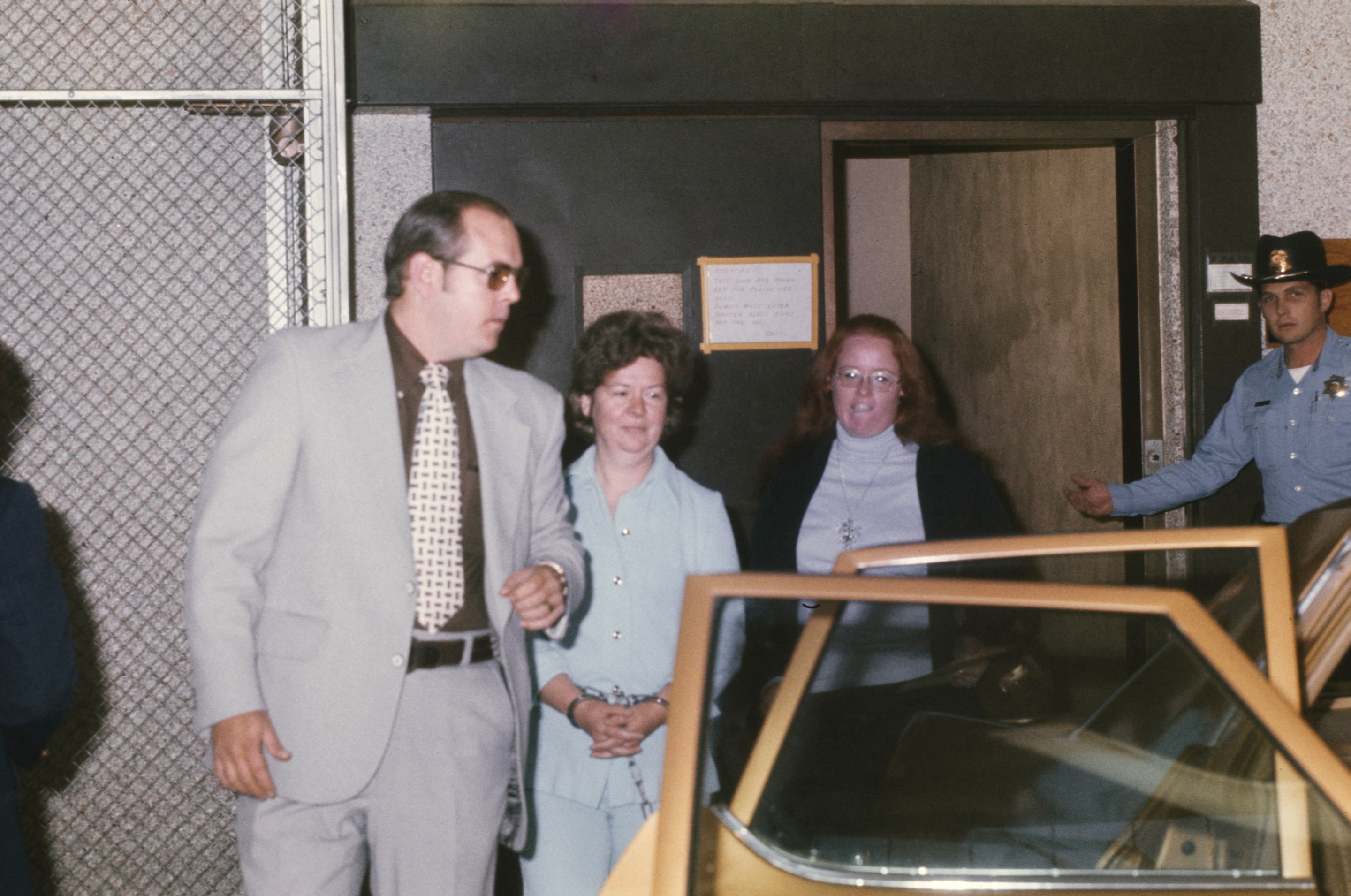
On Sept. 22, 1975, 45-year-old Sara Jane Moore fired two bullets at then-President Gerald Ford. They were in San Francisco, outside a hotel. Moore missed her first shot, but seeing an opportunity, took another. She missed that one, too. An ex-Marine named Oliver Sipple, who was behind her in the crowd, tackled Moore before she could try for a third. “I said, the bitch has got a gun,” he later recounted.
Forty years later, after serving 32 years of her life sentence in federal prison and being released on parole, a CNN journalist asked Moore, “What drove you to try to assassinate President Ford?” The same question is at the heart of Robinson Devor’s documentary Suburban Fury, which premiered at the New York Film Festival in 2024 and is slated for a wider theatrical release this year. Over the course of several interviews with Moore, the film aims to illuminate the particular set of conditions—state of mind, political belief, personal history, sense of purpose—that drove Moore, who died last year at the age of 95, to pick up a gun and fire it at the president.
Suburban Fury opens with a title card informing us that Moore agreed to participate on the condition that no other interviews were conducted. From the first, we are trapped in her claustrophobic perspective, on which Devor leans to evoke the atmosphere of paranoia that accompanies Moore’s narration. He shoots her through panes of glass, alone in the backseat of a car, in an empty living room. Revisiting important landmarks of the assassination attempt, such as the hotel ballroom where Moore was interrogated after being caught, Devor explicitly borrows from the master of the American paranoid political thriller, Alan J. Pakula: Moore’s diminished figure, a speck against austere right angles, is reminiscent of Woodward and Bernstein clambering up the steps to the Library of Congress in All the President’s Men (1976). These framings contrast with Moore’s labyrinthine, even incoherent, description of her journey from every-woman to would-be assassin. The film announces, basically, that any semblance of order is just that.
As an interviewer and as a director, Devor is in the unique position of being powerless to shape the story he is telling. Rather than follow point A to point B, he is stuck in the circularity of Moore’s thinking. He structures her story in brief chapters that count up to 10, then back down to one. In broad strokes, we can discern that Moore—who was allegedly born into an affluent family in Charleston, W.V., though her claim to inherited wealth was disputed in her New York Times obituary—became involved in the Bay Area’s political scene after Patty Hearst was kidnapped by the Symbionese Liberation Army in 1974. Moore felt moved to volunteer at the Hearst Food Program, which the family had set up in accordance with the SLA’s ransom demands, apparently because she was friendly with the Hearsts, though it’s impossible to know if that was really true. Sometime around then, she claims she was approached by the FBI to infiltrate the SLA and sympathizing groups and inform on their goings-on. Along this process, she struck up an important relationship with her FBI handler, Bertram Worthington, or Bert. He emerges as an abstract figure, like a faraway pen pal or an imaginary friend. In her capacity as an informer, Moore had to write and file reports, a task to which she was zealously devoted. Based on her recollections, Devor scripts and narrates what would have been Bert’s own report-writing, through which he would have processed Moore’s contributions.
These voiceovers are one way Devor finds to include a perspective other than Moore’s own. At points, he uses it to go over details about Moore’s biography that, though stated, remain oblique: Exactly how many kids she had, with whom, where, and when are as unclear points of her life as her passage through the military or the Actor’s Studio. The only concrete resource Devor has to check Moore’s perspective is archival footage, of which he makes ample use. He illustrates the mood of the Bay Area in 1975 through striking footage of riots, protests, gatherings, and rallies; he confirms parts of Moore’s story through news clips. The brief appearance of a character not involved in the political conspiracy can feel like a sudden draft of air in a windowless room. The sight of the neighbor who sold Moore the gun with which she shot Ford is almost jarring: Here is a guy from the real world, or at least one with whom we share a sense of reality. He is shocked that Moore would have done any such thing. It doesn’t make sense.
That disbelief might have had something to do with the fact that Moore was a woman, one of only two—in a bizarre turn of events, 17 days before Moore’s attempt, former Manson girl Lynette “Squeaky” Fromme also tried to assassinate Ford—in the long American roster of would-be or actual presidential assassins. In fact, that she was a “white, middle-aged lady with curly hair,” as her biographer Geri Spieler put it, is one of the reasons Moore volunteered for the risky task: No one would suspect her. On the day before the attempt, the Secret Service apprehended Moore on a tip from the San Francisco Police, who also took her gun. It’s unclear exactly what led the SFPD or the Secret Service to “check her,” but in the end, it didn’t matter. Both authorities released Moore, figuring she was no threat. Undeterred, she went out and bought another gun from that incredulous Danville neighbor, who thought “there was nothing about her demeanor that would’ve in any way indicated that she had such a terrible thing on her mind.”
Most men who have tried to kill presidents were motivated by visions of grandeur. The desire to make a mark in the forgetful arc of history is what drove the hapless Charles Guiteau to shoot President James Garfield in 1881. Netflix’s recent miniseries Death by Lightning depicts Guiteau (Matthew Macfadyen) as a con man of various stripes, devoted foremost to his own potential for greatness. It’s a vague ambition, all the more gripping for being boundless: racked by the need to be known for something, Guiteau will do anything. Convinced that in ushering into office Garfield’s vice president, the racketeering Chester Arthur (Nick Offerman), he will finally fulfill his potential, Guiteau resorts to assassination. Later, after the deed has been done, Garfield’s wife Lucretia (Betty Gilpin) tells him that, having been killed three months into office, before he could enact any of the ambitious reforms he had planned, history would forget James Garfield (Michael Shannon). By proxy, it would forget Guiteau, too. His face falls. “It’s not true,” he pleads.
Throughout the series, Guiteau goes from being a supporter of Garfield’s presidency to becoming murderously intent on ending it. Who the president is and what he stands for hardly matters. This is a common thread in American presidential assassins. In a 2024 profile of John Hinckley Jr.—who shot Ronald Reagan in 1981, exactly 100 years after Guiteau pursued the same act—Mark O’Connell writes that “the presiding archetype of such violence in American life is not a revolutionary in a balaclava, backed by a paramilitary organization, but a lonely oddball with a firearm fixation and a complex of conspiratorial grievances, whose relationship to the political dynamics of his country is often highly inscrutable or, in any case, disconnected from any organized political project.”
The presence of a political agenda—however confused—is the other striking difference, along with her being a woman, that separates Moore from her compatriots. Unlike Hinckley, who was ruled not guilty by reason of insanity, Moore pleaded guilty and resolutely sane at trial. She had her reasons; they were clear as day. In her statement, she said that no one was on trial for plotting to assassinate Fidel Castro, just as no one had been tried for assassinating the Black Panther and NAACP leader Fred Hampton. By shooting Ford—who, she made sure to point out even decades after the event, was appointed rather than elected—she meant to turn the state’s tools of violence onto itself. She hoped that her act would either spark a revolution or that it would demonstrate, to the non-San-Francisco parts of America, that revolution was already here.
In moments like those, there is a startling lucidity to Moore’s logic—until you remember that no one who is thinking clearly attempts to kill a president in broad daylight. The insistence that nobody else understands what is blindingly clear to you is the tell-tale sign of a conspiracy-addled mind, at least the kind we have come to know over the past decade. Lost in the thick of spiraling beliefs, the conspiracist’s logic is impenetrable. Last year’s “Alternate Realities” season of NPR’s narrative podcast Embedded told the heartbreaking story of a son who lost his father to the certainty of his own perspective above their shared reality; in recent films like Yorgos Lanthimos’s Bugonia and Ari Aster’s Eddington, a sense of horror emerges from how a conspiracist can twist a common agreement into something unrecognizable. We can agree that corporations are ruining the planet. OK, can we agree that they are being run by aliens?
In one of Suburban Fury’s most significant exchanges, Devor tries to get some details straight. Moore explains that the more she became involved with the revolutionary groups on which she was meant to rat, the more deeply she felt for the people that composed them and for the causes for which they were fighting. For that reason, when the FBI assigned her a “target,” a man named Tom, she confessed to him that she was “a pig.” Tom, in cahoots with some other revolutionaries, promised not to reveal Moore’s identity to anyone else. Unable to bear the strain of being a snitch on either side of her loyalties, Moore then confessed her own confession to the FBI. At this point, Devor and Moore engage in a back-and-forth about the exact definition of a “blown source.” Moore raises her voice; she holds her head in frustration; and she asks Devor to let her go on, telling her story her own way. She even cries out for him to shut up.
Letting this moment play out is the closest Devor gets to being able to develop Moore as a character. By leaving his voice in, we get to see—just this one time—Moore interacting with an outside perspective, which teaches us something about her: She can’t engage with difference, however slight. Moore fought for the supremacy of her own interpretations. When, in that CNN interview, the journalist touches on the matter of Moore’s delayed release from parole, she frames Moore’s life outside of prison as the “turning of a new leaf” by a person who had found her way back to society. “I was always a citizen in good standing,” Moore bites back. “Let’s not talk about turning a new leaf.”
Moore insists throughout on her own sanity, her own sense of purpose, and her own legible subjectivity. Yet she can’t explain with any real clarity who she is. Because Moore refuses to speak of her varied, seemingly extraordinary biography—even her name, it emerges, is an alias—or to discuss her feelings, the make-up of her mind remains obstructed as if by frosted glass. If Moore is different from other perpetrators of political violence, she is like them in at least this one way: Her attempt to explain herself only makes her harder to understand.