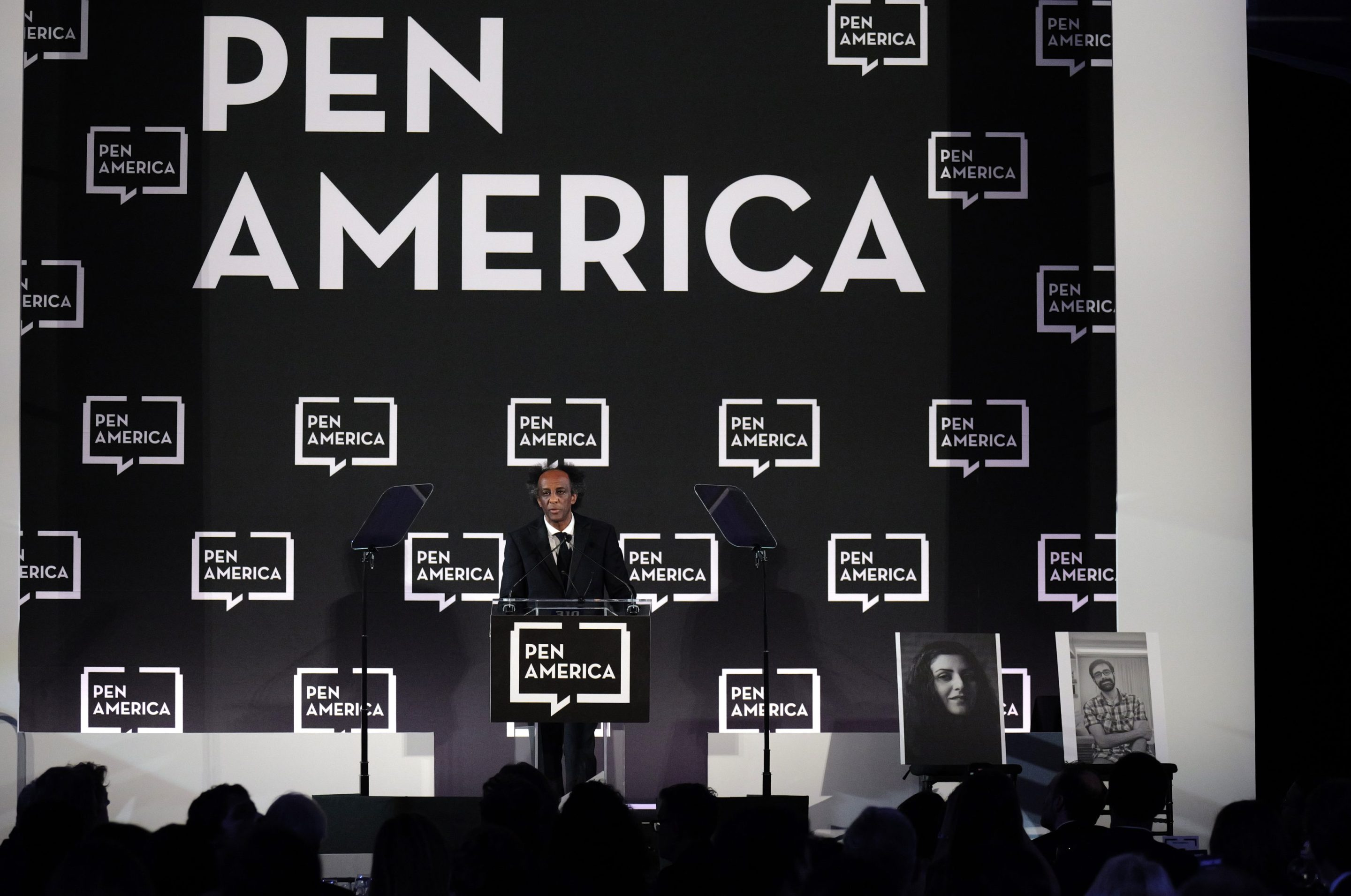
PEN America president Dinaw Mengestu resigned from his position this past Thursday after the troubled free-expression organization published a report reaffirming its opposition to cultural boycotts. The report, titled "A Silent Moratorium," recounts anecdotes from editors, agents, and writers who describe "rising isolation and exclusion" faced by Israeli and Jewish authors.
Mengestu saw the report as dangerously and falsely categorizing the Boycott, Divest, Sanctions (BDS) movement—which seeks to impose financial and cultural costs on Israeli occupation and genocide—as discrimination. "What PEN America fails to understand is that a boycott is a form of dialogue," Mengestu wrote in a statement posted to Instagram on Monday.
"A Silent Moratorium" took unusually long to produce because of the scrutiny PEN America knew it would face. The report relies heavily on secondhand anecdotes; of the handful of writers who speak directly about their own experiences, one is an English professor at an Israeli university who says his creative writing students are wondering, "What am I going to do with my manuscript?" Another is a creative writing PhD student at the same university, who hasn't submitted her finished novel to publishers because she's afraid it will be rejected. When it turns to data, "A Silent Moratorium" refers to 350 self-reports to a hotline for "antisemitic literary-related incidents." We are not given specifics about any of these incidents. One major piece of evidence in the report is the existence of a spreadsheet titled "Is your fav author a zionist???" that went viral on Twitter in May 2024 and targets writers of all races; the report tuts its tongue at chilling epithets in the spreadsheet like "also zionist lowkey."
This Tumblresque spreadsheet and an unsubmitted novel, we're told, belong in a conversation about free expression alongside rampant book banning and the arrest, detention, and deportation of people for their political beliefs. "Palestinian and pro-Palestinian writers, artists, and activists have faced dire consequences for their expression including arrests, harassment and threats, deportation attempts, and detention, in addition to cancellations and exclusion in the literary and cultural spheres," the report reads. "Israeli and Jewish writers and artists on all sides of the conflict have been silenced and faced a range of threats and repercussions."
On the one hand, 38 states have adopted laws, executive orders, and resolutions designed to criminalize or otherwise undermine BDS. More than 3,000 protestors were arrested for taking part in student encampments in 2024. Hundreds of students like Mahmoud Khalil, Leqaa Kordia, and Rumeysa Ozturk have been subjected to ICE detention and deportation proceedings for pro-Palestine speech ranging from participating in a protest to writing an op-ed. And 2024 and 2025 were the deadliest years on record for journalists, because Israel has killed more than 260 since its assault on Gaza began. If this report's purpose was to give insight into the "range of threats and repercussions" on the supposed other side of this equation, it failed.
PEN America denies that the report makes "boycott" synonymous with "discrimination." But by misrepresenting what a cultural boycott is, that's exactly what "A Silent Moratorium" does. Critics of BDS—who often don't particularly care whether Israel stops committing genocide—weaponize the claim that the boycott will ooze out into a refusal to engage with the work of any Jewish person anywhere. The report gives credence to this cynical muddling when it suggests the strategic, targeted boycott of complicit institutions and genocide normalizers is responsible for aspiring novelists being "told it's not the right time for a Jewish book." BDS does not focus on silencing random individual authors, and anyway the market seems very open to Jewish books. As the report itself half-acknowledges, a memoir written by the mother of someone held hostage in Gaza was No. 1 on the New York Times Bestseller list in April. Molly Crabapple's history of the Jewish Labour Bund debuted at No. 4 on the same list, also in April. Allegra Goodman's multigenerational Jewish family drama, This Is Not About Us, was a national bestseller earlier this year. And toward the end of last year, a personalized history of antisemitism by former Obama speechwriter Sarah Hurwitz also became a bestseller. (You might recognize her as the person who said Holocaust education backfired because it made young people too sympathetic to Palestinians.) "A Silent Moratorium" suggests that it's impossibly difficult to get a Jewish book published right now; a 30-second search online confirms this is simply not true.
Mengestu declined to get bogged down in these tedious details, saying the issue cannot be reduced to a matter of differing opinions or personal experiences. For him, it's about "PEN America's ongoing failure to defend free expression fairly and equitably, and about its production of work that supports suppression." He traced the start of this failure to 2016, when the organization characterized BDS as an "assault on the identity of Jewish students" and added fuel to the growing legislative attacks on the boycott movement.
Perhaps PEN America's continued opposition to the tactic comes from direct experience; nobody knows better that cultural boycotts work. After helping transform the century-old nonprofit from a niche literary society into a Trump-defying, book ban-challenging civil rights powerhouse, former PEN America CEO Suzanne Nossel took a wrecking ball to its credibility by refusing to condemn the genocide in Gaza, outright ignoring Israel's targeted killing of hundreds of Palestinian journalists and writers, and blacklisting those who support BDS. Things came to a head when PEN America forcibly removed Palestinian American writer Randa Jarrar for protesting an event featuring pro-Israel celebrity Mayim Bialik.
Grassroots opposition to this free-expression hypocrisy swelled into a formal boycott in 2024, organized by Writers Against the War on Gaza. That year, PEN America had to cancel its prestigious awards ceremony after nearly half of the 61 authors and translators nominated dropped out of the event. Nine out of the 10 authors nominated for its $75,000 PEN/Jean Stein book award withdrew from consideration. The literary organization also had to cancel the PEN World Voices Festival after writers like Naomi Klein, Michelle Alexander, and Isabella Hammad refused to attend. Eventually, more than 1,300 writers signed an open letter to PEN demanding they "respond to the extraordinary threat that Israel’s genocide of Palestinians represents for the lives of writers in Palestine and to freedom of expression everywhere" and "find the same zeal and passion that they have for banned books in the U.S. to speak out about actual human beings in Palestine."
It wasn't long before PEN America began bowing to the demands of the boycott. By the end of 2024, Nossel stepped down as CEO. On June 6, 2025, the organization called for an arms embargo against Israel. This past September, it began to use "genocide" to describe Israel's campaign of mass death in Gaza. PEN America also finally acknowledged the targeted murder of journalists by Israel, and released a report detailing the enormous loss of cultural sites, libraries, museums, and universities in Gaza over the last few years. The organization even claims to have donated more than $500,000 in aid to Palestinian writers and artists, in Gaza and in exile. In response to these concessions, the organizers of the boycott declared victory, and concluded it at the end of last year.
Full-throated support for BDS, though, was not one of PEN America's concessions. Before "A Silent Moratorium" recounts anecdotes of isolation, it offers a preface on "The Role of Cultural Boycotts," which begins with the following: "Calls to boycott Israeli cultural institutions have had an impact across the international literary and creative communities." Well … yes! That is the point.
The preface goes on to uphold PEN America's "long-standing position opposing any efforts to inhibit the free international exchange of literature, art, knowledge, or culture, including cultural and academic boycotts." At the same time the report was published, the organization updated its boycott policy to say that it both opposes cultural boycotts as an organization and upholds the right to participate in or advocate for such boycotts. Therein lies the cowardice.
The preface concludes, "As an organization fundamentally dedicated to the power of literature and ideas to foster empathy and understanding, we believe that, particularly in times of conflict and division, writers must be able to speak and write freely." Like plenty of other bird-brained literarios, the authors of this report have a child's understanding of violence. If only someone could just write the To Kill a Mockingbird of the Levant, maybe this whole thing could be solved. Three years into a thoroughly documented genocide, you'd think it would be incontrovertible that the problem is not a lack of empathy or literary exchange, but a unidirectional, colonial ability to starve, dominate, dispossess, and murder en masse.
This tension between literature on the one hand and politics on the other has been present since the beginnings of PEN. After PEN International expelled German PEN for refusing to disavow book burning and Nazism in 1933, then-PEN president H.G. Wells justified the expulsion with a damning vision of PEN America's future. "When Politics reaches up and assaults Literature and the liberty of human thought and expression, we have to take notice of Politics," said the British novelist. "If not, what will the PEN Club become? A tourist agency – an organisation for introducing respectable writers to useful scenery – a special branch of the hotel industry?" Well.
PEN America isn't alone in conflating government censorship with boycotts, and muddying the specific political project of BDS; media coverage of the report and Mengestu's resignation has credulously accepted the organization's framing. Atlantic staff writer Gal Beckerman wrote that Mengestu's resignation "tells us all a great deal about the hair-trigger moment we live in, and about the precarity of the liberal principles on which PEN America was founded." Interestingly enough, Beckerman himself just recently wrote the kind of book that "A Silent Moratorium" contends is not welcome in today's publishing industry. In How to Be a Dissident, Beckerman draws "on the stories of dissidents from around the globe" and "reveals the defining characteristics these extraordinary figures share, a set of attributes and practices for anyone navigating the pressures of modern tyranny." Jewish history features prominently in the book.
Beckerman prefers to reflect on dissident ghosts of tyranny past, but in the epilogue he briefly considers the present, including what to make of Israel's "unrelenting gruesome war." His parents were born in Israel, and his cousin is currently a soldier in the Israeli army. Should he join a protest, he wonders, "even if it means standing next to someone calling for an end to Israel itself?" Beckerman also considers whether he has a responsibility to join the ranks of those disrupting the mass deportation machine, asking, "Should I join them? Should I risk it myself? Should I send my children?" In a review of the book for CounterPunch, Brian Terrell writes, "While commending the active dissent of Etty Hillesum in Nazi-occupied Amsterdam and that of Diogenes in 336 BC Corinth, Beckerman seems unsure if opposing ICE in Minnesota in 2026 is such a good idea." For Beckerman, it seems that the only legitimate way to be a dissident is to build a time machine.
Beckerman clearly finds anodyne comfort in the dissent of the past, and unresolvable depravity in the politics of the present. His Atlantic article is no exception. He misses the liberal public square of old, you see: where people could freely engage, where ideas could strike against each other and spark empathy! And insight! And change!
Well, look around. This is the public square, the same old squalid one it has been. You're in it. And artists have been telling PEN America that it's full of shit long before this "hair-trigger moment." In 1987, playwright and ACT UP co-founder Larry Kramer sent a blistering letter to then-PEN America president Susan Sontag, excoriating the organization's "intolerable attitude toward anything gay," its failure to "say boo about AIDS," and reversing his membership until such time that the organization ceased shunning gay and lesbian writing.
PEN America now celebrates this letter, from the same safe distance that Beckerman celebrates the dissidents of the past. In 2022, the organization proudly displayed the letter at its "PEN America at 100: A Century of Defending the Written Word" exhibit at the New York Historical Society. In 40 years, who knows how PEN America will reckon with its current cowardice. It's for us in the here and now to decide the fate of liberal institutions of its ilk. For his part, Mengestu is no longer looking to reform it from the inside—or the outside. "I am not boycotting PEN America," he said in his statement. "I am walking away from it permanently, and I will do everything I can now to help make something better."