
For a population that increasingly spends their time and makes their money in the Arab world, tennis players have had almost nothing to say about Palestine. In that respect, they are like most professional athletes in 2026: silent on even the most obvious injustices, possibly out of ignorance or (more likely) a reluctance to endanger any commercial opportunities. When asked about any subject that could have a political dimension, they tend to clam up or dive into the safest of cliches, as our Owen Lewis discovered firsthand at the Australian Open.
At least for the American contingent, there's Coco Gauff, one of the few players who readily acknowledges the existence of a world outside the tennis tournament, and can critically reflect on that world. "For me, it's sometimes troubling to live the life I live, in knowing that so many kids and innocent people are dying on both ends, but especially in what's going on in Gaza and the occupation that’s happening," Gauff said in 2024. Elsewhere, Turkish player Zeynep Sonmez has competed while wearing a watermelon pin. In a 2023 interview with Clay, Egyptian player Mayar Sherif asked good questions about why the WTA threw its support behind Ukraine in its war with Russia, but remained silent on Gaza. Beyond a few isolated cases, commentary on or open support for Palestine is scarce at the highest levels of the sport.
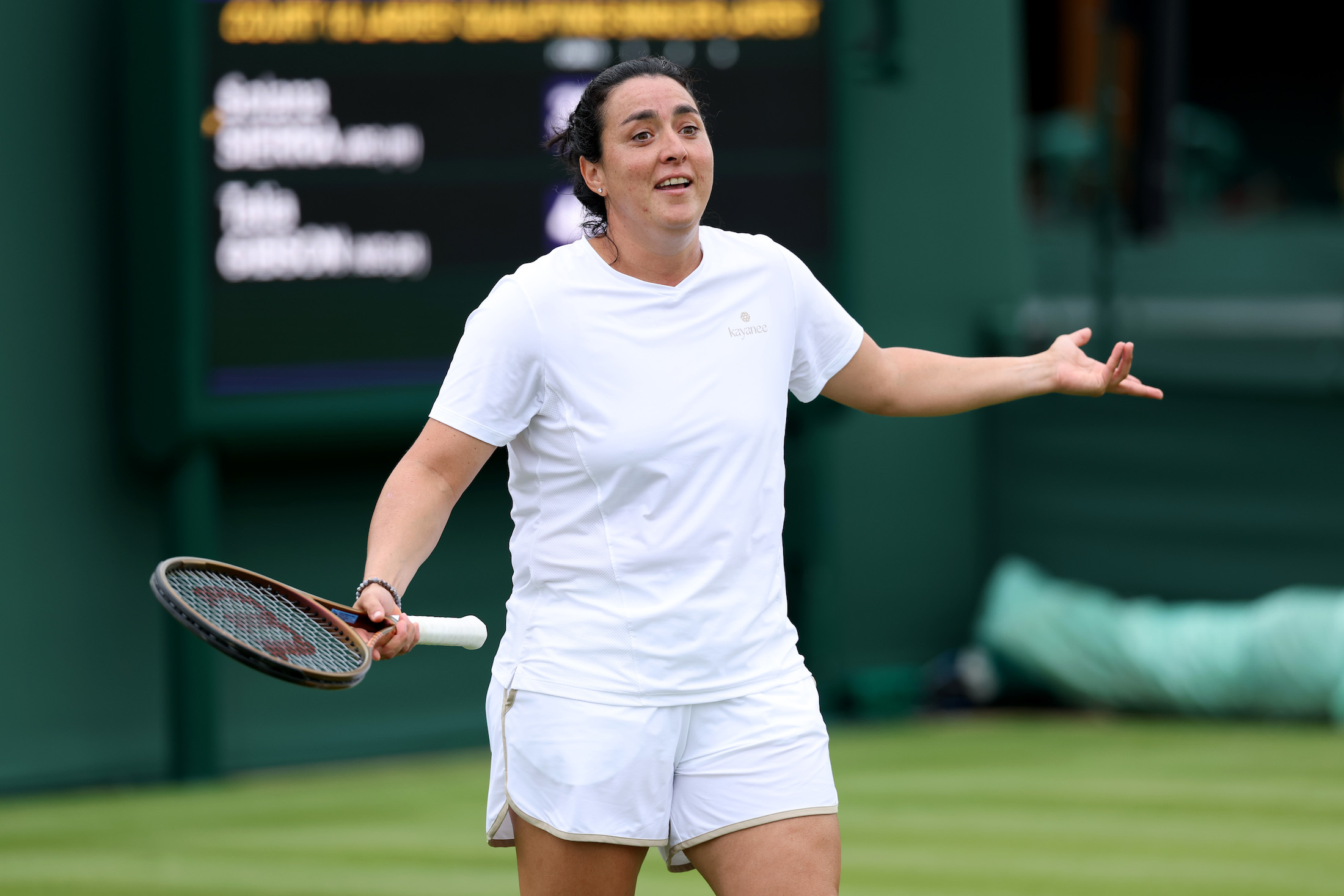
In this environment, Tunisian player Ons Jabeur is conspicuous. Jabeur, the former world No. 2, is an eminent stylist on court, and by some margin the greatest Arab or African tennis player in history. To hear her tell it, Palestine has never been far from her thoughts over the last three years. She pledged some of her prize money to Palestine aid during an on-court speech at the 2023 WTA Finals, and has been raising funds for Gaza as an ambassador for the World Food Programme since 2024.
"I've been called a terrorist so many times," she said in 2024, of her Palestine advocacy. "I don't know how that's even related. I'm trying to help people, and especially kids, who are starving."
Jabeur is currently on leave from the tour as she expects a child this month, and during that time she has evidently been at work on a video interview series. Last week she published her second episode, in which she visits Farah Fares, a 17-year-old swimmer born in Dubai, currently based in Qatar, and competing for the Palestinian national team. In the video, the Fares family presented Jabeur with a keffiyeh bearing the colors of the Palestinian flag, and Fares told Jabeur that her father's side of the family lives in Palestine, where they are now safe, though "not the best conditions they could be in."
"I know you're young and I know probably you don't watch much, but does that motivate you to really fight for Palestine and get the country to be known more, and the history and everything behind it?" Jabeur asked Fares.
"I feel the deepest sense of pride when I represent Palestine," Fares said. "My goal and my aim is to raise the Palestinian flag across all competitions around the world, and I know that I don't only swim for myself, I swim for everyone back home who can't train, who wants to become a swimmer but doesn't have the opportunities or facilities to be able to do that."
"Hopefully they see that I am doing the Palestinian resistance through sport," Fares added. Later in the episode, her mother described an incident at a competition in Romania: The family saw a map of all participating countries, and Palestine was absent. Farah proudly added it in with a marker. When they returned the next day, her mother said, it was wiped away.
Jabeur works in a world that might claim an apolitical point of view, but tennis is an international sport with geopolitical positions baked into its institutional structures. Just ask the Russian and Belarusian players, like world No. 1 Aryna Sabalenka, who were banned from Wimbledon in 2022, and who still compete without a flag next to their names, four years out from the start of the invasion of Ukraine. There was also the WTA's brief skirmish with, then surrender to, China, beginning with former player Peng Shuai, who accused a high-ranking government official of sexual assault. More recently, Daniil Medvedev and other players had to undergo an insane logistical operation to get out of Dubai after the U.S.-Israel war on Iran, prompting retaliatory strikes that interfered with his travel plans.
But as far as tennis is concerned, no matter how many international bodies determine that Israel is conducting a genocide, it has faced no sanctions. Even if most tennis players won't speak out as Jabeur has, the public seems more willing, when they're given a chance: Over 400 scholars, athletes, and sports officials signed a letter calling on Tennis Canada and the International Tennis Federation to boycott Israel out of the Davis Cup last year, though it continued to compete anyway. This past September, it lost 4-0 to Canada in an empty stadium, because fans and media were blocked from attending.


![USA's Ben Shelton celebrates his win against Spain's Carlos Alcaraz during the men's singles quarter-final tennis match on day ten of the US Open tennis tournament at the USTA Billie Jean King National Tennis Center in New York City on September 9, 2026. (Photo by Leonardo MUNOZ / AFP) / “The erroneous mention[s] appearing in the metadata of this photo by Leonardo MUNOZ has been modified in AFP systems in the following manner: [USA's Ben Shelton] instead of [Spain's Carlos Alcaraz]. Please immediately remove the erroneous mention[s] from all your online services and delete it (them) from your servers. If you have been authorized by AFP to distribute it (them) to third parties, please ensure that the same actions are carried out by them. Failure to promptly comply with these instructions will entail liability on your part for any continued or post notification usage. Therefore we thank you very much for all your attention and prompt action. We are sorry for the inconvenience this notification may cause and remain at your disposal for any further information you may require.”](https://lede-admin.defector.com/wp-content/uploads/sites/28/2026/09/GettyImages-2293730421.jpg?resize=2880%2C1920)