
LOS ANGELES — Just off the ninth green at Riviera Country Club, during the first day of this year’s U.S. Women’s Open, a familiar face popped up in the gallery: Owen Wilson.
But as fans milled about this congested space where multiple greens, tee boxes, and the path to the practice range converge, few seemed to notice. “Love your work,” one fan told the star of The Royal Tenenbaums, Zoolander, and the golf-centric series Stick; Wilson graciously thanked the man. But that was about it. Most everyone had their eyes on someone else.
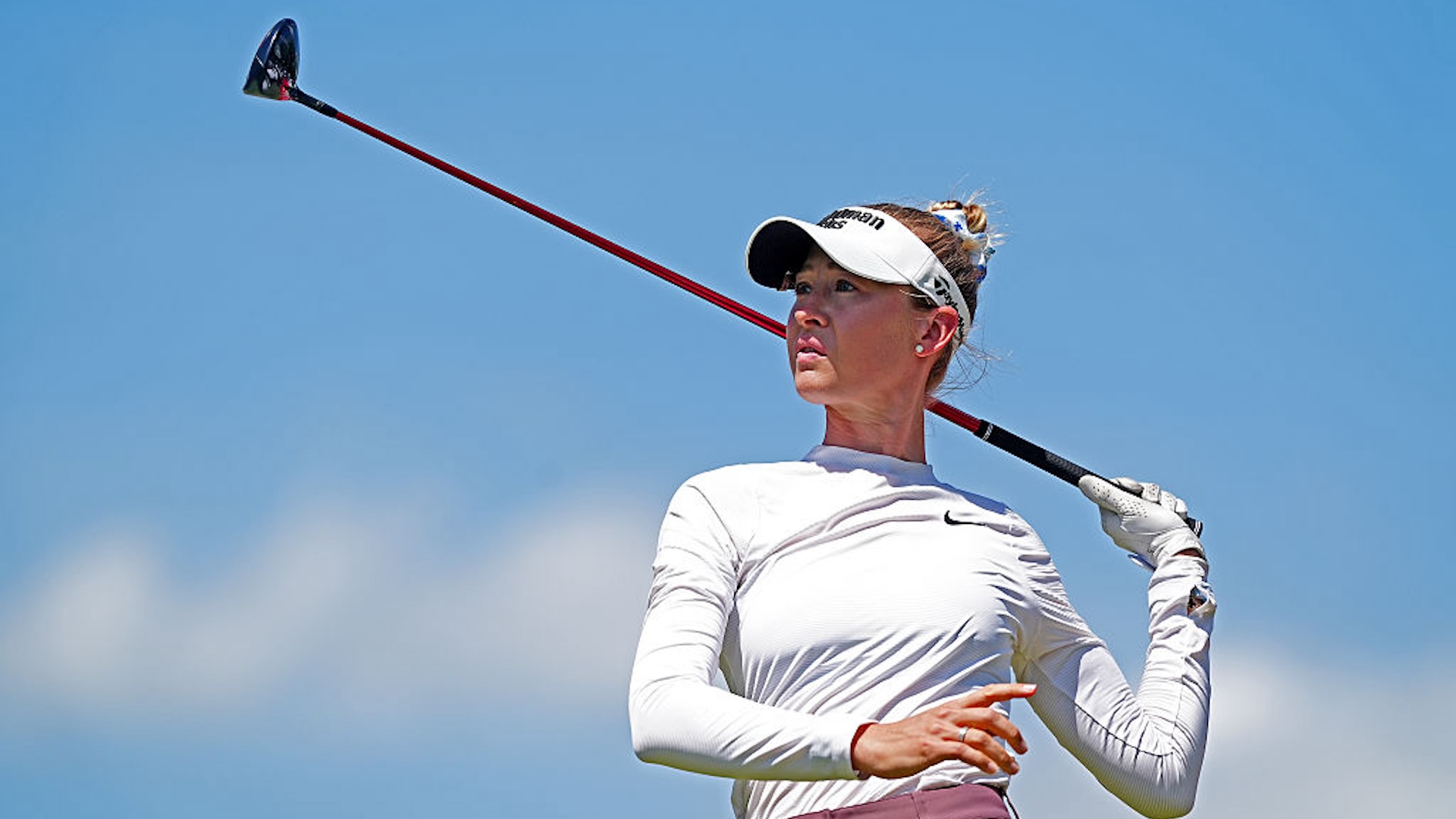
They were there for Nelly Korda.
Korda, a 27-year-old now in her 10th year on the LPGA Tour, had begun her round on the 10th hole and just finished off an underwhelming 2-over 73. “It wasn’t a great day,” she said later. Still, the fans were undeterred. They lined up along the ropes for a glimpse, a video, a selfie, or an autograph. Despite being visibly disappointed with her play, Korda obliged with some signatures and an apology that she couldn’t do more.
Meanwhile, there was Wilson, alone in a corner of the ropes, casually taking it all in. He said nothing to Korda, who didn’t appear to see him as she headed up the hill to sign her scorecard. And when the stewards lifted those ropes, fans followed the golfer.
Nobody is playing better golf than Nelly Korda. She arrived at Riviera earlier this month having won three tournaments already this season. Those wins, combined with her three second-place finishes and zero results outside the top 10, were enough to earn her the world No. 1 ranking. When she won the U.S. Women’s Open by one stroke over Charley Hull and Gaby Lopez, it felt like an announcement. Nelly Korda is, without a doubt, the biggest name in women’s golf.
Korda’s stardom has been building for the last decade. The daughter of pro tennis players Petr Korda (the 1998 Australian Open men’s singles champion) and Regina Rajchrtova, Korda followed her older sister, six-time LPGA Tour winner Jessica Korda, into competitive golf.
“[Our parents] did not want us to play tennis at all,” Korda said last year in a Talks at GS. “They thought that we were going to get compared to them and their careers.” (Incidentally, Korda’s younger brother Sebastian did end up choosing tennis; he has won three ATP events.)
Nelly made her debut at the U.S. Women’s Open in 2013 at age 14, turned pro at 17, and got her first win at 20, when most American golfers are still in college. She jumped up to fifth on the money list in 2019, then in 2021 won her first major, the Women’s PGA, which vaulted her to No. 1 in the world—the first U.S. women’s golfer to hold that ranking in seven years.
But golf careers are rarely linear, and Korda became the latest ascending star to learn as much. In 2022, a blood clot sidelined her for four months. A year later, a back injury kept her off the course for several weeks. She won just one tournament in those two years, and a handful of other players knocked her off her No. 1 pedestal; she fell as low as No. 6 in the world rankings.
She roared back in 2024. In one of the more stunning runs in recent history, Korda won five straight starts and six of seven, including her second major (the Chevron). She totaled seven victories on the season, the most since Yani Tseng in 2011.
Then came another dip. After that six-wins-in-seven stretch, Korda missed three straight cuts, then a neck injury sidelined her for a spell. In 2025, when a record 29 different golfers won LPGA tournaments, Korda stunningly wasn’t one of them. Jeeno Thitikul, the then-22-year-old Thai golfer, took Korda’s No. 1 mantle and seemed like she might run away with it.
Perhaps we shouldn’t be surprised, though, that Korda came back better than she’s ever been.
Once you see her in person, the thing that stands out about Korda is how much her physical build still separates her from nearly all competitors. Most LPGA players, from the U.S. and abroad, can blend into a crowd. (Thitikul, an incredible player with an impeccable swing, stands a very-normal-looking 5-foot-4.). Korda, thin but muscular at a listed 5-foot-10, exudes “athlete.” She isn’t the longest hitter on tour, but she’s up there, and the eight players ahead of her in distance this year have zero combined LPGA wins.
“You watch her hit a drive,” said Morgan Pressel, the former major champion who now serves as an LPGA analyst on NBC Sports and the Golf Channel, “and it’s one of the most impressive golf swings you’re ever going to see.”
All of this has added up to her becoming the face of women’s golf in the U.S. She has a T-Mobile commercial that’s a lot like Zoe Saldana’s ads. She was the first name mentioned in a U.S. Women’s Open promo starring Wilson and Don Cheadle. She made an appearance in Happy Gilmore 2. LeBron James even gave her custom golf shoes before the first round at Riviera—which she switched out of after six holes. (It was meant as no disrespect to James: “I felt like I had a little too much room [in the shoes],” she said.)
It also meant those big galleries at Riviera.
By Sunday, the crowd following Korda was predictably large. As she passed by the suites and grandstands on holes like Nos. 14 and 17, the fans who parked in those places all day erupted in big cheers.
“There are times where [my caddie Jason McDede] and I catch ourselves, and we kind of look around into the crowd and we're like, ‘Wow, it's amazing to see how many people are here on a Thursday,’” Korda said two days before her opening hole at Riviera.
Those fans did not witness her greatness right away. Her first-day struggles, brought about by a mysterious and pesky quirk in her swing that kept pushing her tee shots to the right, saw her tied for 56th after 18 holes, seven shots behind fellow American and major champion Jennifer Kupcho.
But she made a change to her grip suggested by her sister, and on Friday got right back to being Nelly: She shot a 4-under 67, the best round of the day, putting her just two shots behind leaders Alison Lee, a local favorite, and Ruoning Yin, a major champion and former World No. 1.
With buzz growing—she teed off five groups ahead of that final Lee-Yin pairing, but still had by far the biggest following—Korda’s Saturday round felt ordinary for a while. Two early birdies were dampened by a bogey on No. 8, and a long string of pars made it seem like she’d have to hope for some Sunday magic if she wanted to claim her fourth win in eight 2026 starts, as well as the trophy she’d never put her hands on (her career-best finish was a tie for second the year before).
Only she didn’t have to wait.
She birdied the par-3 16th. Then the par-5 17th. On the difficult and iconic par-4 No. 18, Korda stuck her approach shot four feet from the hole and sank the putt, thrusting her into a tie atop the leaderboard with former Women’s PGA Championship winner Sei Young Kim. The game’s biggest player would be in the final group at the game’s biggest tournament with a chance to finally win it.
One reporter at NBC Sports’ pre-U.S. Women’s Open press conference asked about women’s golf having a “Caitlin Clark moment,” where Korda (or another star) might reach a new level of fame outside its fandom. It’s the latest version of the eternal question that swirls around any “niche” sport, often ones played by women, the best of whom are tasked not just with playing well and winning, but with “growing the game.” If Clark didn’t exist, a reporter might have been asking about an “Annika Sorenstam moment.”
Back in 2002, Sorenstam was in a position very similar to Korda’s. She won 11 of 23 starts, including her fourth major. In 2003, she “only” won six tournaments, but two of those were majors. Yet it wasn’t just her winning that made her a household name. It was the fact that, also in 2003, she played against men.
It happened at the Colonial in Fort Worth, Texas, the first time any woman had teed it up in a PGA Tour event in more than 50 years. And it was an absolute frenzy.
“You can't even imagine the media center this week,” then-LPGA manager of communications Laura Neal wrote in her diary, saying more than 600 reporters attended. “Everyone wants to be here, just to witness history, discuss it, speculate on what's going to happen … I've really never seen anything like it.”
The pressure was immense; to this day, I remember Sorenstam’s exaggerated stagger after her opening tee shot. She missed the cut but finished far better than many skeptics expected; her 71-74–145 (+5) beat 11 men who completed both rounds, including Geoff Ogilvy, who went on to win eight PGA Tour events, including the 2006 U.S. Open.
Sorenstam was 32 at the time—old in the world of women’s golf, where the aging curve differs not only from men’s golf, but from other women’s sports like basketball—and never played the men in an official PGA Tour event again. Her star in the mainstream faded, even as she won 10 of 20 LPGA starts in 2005 and eventually pushed her major-championship total to a modern-era-best 10.
Then came Michelle Wie West, another golfer who wasn’t even out of childhood before the expectations to produce her own “moment” arrived.
Known as Michelle Wie at the time, she burst onto the golf scene with a litany of “youngest evers.” At the 2003 Kraft Nabisco Championship, a major, the then-13-year-old not only became the youngest to make an LPGA cut, but shot a 66 in the third round to earn a spot in the final group. Then came the U.S. Women's Amateur Public Links, where she became the youngest player of any gender to win a USGA adult event (it’s notable when a 13-year-old wins a junior tournament).
These results, mixed with Sorenstam’s buzz, Wie’s soon-to-be-6-foot stature, her power off the tee, and her stated goal of playing in the Masters and being a PGA Tour regular, got people dreaming of a woman regularly beating the men.
For a while, it seemed possible; at age 14, Wie missed the cut by just one shot at a PGA Tour event in her native Hawaii. Before she was 16, she reportedly signed multimillion-dollar deals with Nike and Sony. But rare is the athlete-prodigy whose career actually lives up to pre-adult prospects. She never would make a cut against men. After battling injuries, she pivoted back to competing with women.
To her credit, Wie rebounded to win five LPGA Tour events, including the 2014 U.S. Women’s Open. Spared the strange vitriol that came with her rise to mainstream fame as a minor, she has become a highly respected stateswoman within the game and in women’s sports in general. Her galleries over her two rounds at Riviera were almost as big as Korda’s.
So far, few people are calling for Korda to play against men. After Wie West played the last of her eight PGA tournaments, two others (Brittany Lincicome and Lexi Thompson) followed suit. In 2023, 11-time LPGA winner and major champion Thompson did reasonably well, but few outside the golf world noticed. The novelty had worn off.
Korda’s success comes with a quieter, more meaningful novelty. Viewed in lineage with Sorenstam and Wie West, her career starts to look like something that her predecessors hoped to make possible: one that can unfold on its own terms.
The fact is that women’s golf has gotten more popular during Korda’s reign. The purse (total paid out to competitors in a tournament) of this year’s U.S. Women’s Open was a record $12.5 million, nearly three times what it was 10 years ago. The winner of the CME Group Tour Championship, the final of the LPGA’s “playoffs,” takes home $4 million, an eightfold increase from 2016.
As JoAnne Carner, a World Golf Hall of Famer since 1982, put it at a press conference at Riviera, “A player makes right now in one tournament what I made in my whole career.” (It’s true: Carner’s official earnings were $2.3 million; Korda took home $2.5 million for winning the U.S. Women’s Open.)
Another place where growth is visible is venues. The 2023 U.S. Women’s Open was held for the first time at Pebble Beach, one of the most iconic courses in the world. The list of U.S. Women’s Open, AIG Women’s Open, and Women’s PGA future sites is a where’s-where of noteworthy courses. Riviera can’t claim Pebble Beach–level notoriety, but it is widely known and deeply beloved in the golf community; its annual PGA tournament has been hosted by Tiger Woods.
“The more we can have venues like Riviera, I think the more [it] elevates the women's game,” said Wie West, whose 2014 U.S. Women’s Open victory came at one of the earlier “breakthrough” courses, Pinehurst No. 2.
The TV situation is less than ideal; while the weekend rounds of most PGA Tour events play out on major networks, the LPGA is typically relegated to the Golf Channel. Attendance, too, isn’t always high. The first major of the year, the Chevron Championship, has drawn recent criticism from observers and even players for its small galleries.
But this year’s U.S. Women’s Open had the second-highest ratings in a decade. This is the first year every LPGA Tour round will be aired live on TV. And while there still might be sparse crowds at some events—which also could be said about other sports—it certainly wasn’t the case at Riviera.
“It's amazing to see how many dads and little girls come out to our events,” Korda said. “It has grown every single year … Obviously there's always room for improvement in everything that you do, but I've seen a really big trend in the fans coming out.”
There has been international growth, as well. The rise of Korean women’s golfers has been well-documented: Se Ri Pak’s two major wins in 1998 led to a generation of “Se Ri’s kids,” Korean girls who took up the game and went on to dominate it years later. From 2004 to 2020, Korean women won 30 of the available 76 majors; U.S. golfers, who dominated the women’s majors from their inception through the mid-1990s, only won 16 in that span. (By contrast, Korean men have won a total of one major ever.)
Japan is currently enjoying its own golden generation of women’s golfers—six of the top 25 in the world rankings are Japanese, more than any other country—and their supporters are responding accordingly. Thai fans turn out for Thitikul, who was the World No. 1 until Korda’s recent scorching run. Plenty of Mandarin is heard in the gallery for Yin. Flags and accents and soccer jerseys from all over the world are present; more than 25 countries from six continents were represented at this year’s U.S. Women’s Open.
Reaching her peak at this point in the LPGA’s history gives Korda the ability to brush off questions about becoming the face of women’s golf, which she did at the U.S. Women’s Open. She similarly does not speak, or claim to think, much about her legacy. “I've never really thought about the legacy of my career, if I'm being completely honest,” she said. “I just really love competing and I love … sometimes having a big lead going into Sunday and/or being tied for the lead and having to absolutely grind it out.”
At Riviera, grind it out she did.
Favored to win and with that ever-enlargening crowd feeling it, Korda hung tough on Sunday as a few rivals rose and fell throughout the day. Chun In-gee—the beloved three-time major champion whose raucous fans call themselves the Flying Dumbos—got to 9-under before stumbling. Kim, Yin, and seven-time LPGA winner Nasa Hataoka had their chances. Hull, herself a popular Englishwoman, continued her weekend surge by taking the clubhouse lead at 7-under. This was soon tied by another crowd favorite, Mexico’s Lopez, who made an impressive birdie putt on 18 to further put pressure on Korda, who was two groups back.
But at that point, Korda seemed almost inevitable. The situation set up perfectly for her. All she needed to do was birdie that reachable par-5 17th, then ease her way home on 18. Her putt to take care of the first task was a little longer than she might have liked, but she rolled it in with the calm you’d expect of a champion.
“I threw out a double fist pump on that hole because I knew what it meant,” Korda said.
She still had that second job to do, and while her drive and her approach made it look almost easy, she needed two putts to get it done.
She left her first one almost three feet short, giving her what golfers call a “knee-knocker.” Over the second one, her heart started to race as the immense pressure mounted.
“I could barely feel my hands over that putt,” she would tell SportsCenter.
By now, you probably know that she made it. And you might think Korda nailed it with ease. Korda herself certainly wishes she did. But the ball took a long journey to the bottom of the cup, circling almost the entirety of the hole—Korda later called it an “ice cream swirl”—before dropping in. Instead of joy, the first emotion on her face was an endearing look of pure shock.
“Then I was like, ‘Oh! I just won!’” she told SportsCenter.
When the win finally sank in, tears flowed. The crowd, even some of those who had been cheering on their own favorites, rejoiced. Chants of “Nel-ly!” echoed in the amphitheater-style bowl that surrounds the final green.
Regardless of whether a non-fan can drop her name, in these past two-plus calendar years Korda has proven that, when she is healthy and at her best, nobody can compete with her, week in, week out. On a golf course, all eyes look her way. For Korda, that seems like enough.
“I’m just grateful that I get to do this for a living,” she told SportsCenter. “At the end of the day, I get to do what I love every single day.”