It may seem like they’ve been around forever, but the crossword as we know it is barely a century old. They started in the New York World in 1913, where it was originally called a “word-cross.” Going on to obsess writers like T.S. Eliot and Vladimir Nabokov, who reportedly wrote the first Russian-language puzzle as a teenager, the crossword settled into a kind of urbane normalcy over the course of the 20th century, a feature of newspapers and cheap jumbo packs dominated by the editor Will Shortz. More recently, puzzle games, particularly those created and owned by the New York Times, exploded in popularity during the COVID-19 lockdowns, forming an unlikely bedrock alongside other mobile games for the financial vitality of papers of record.
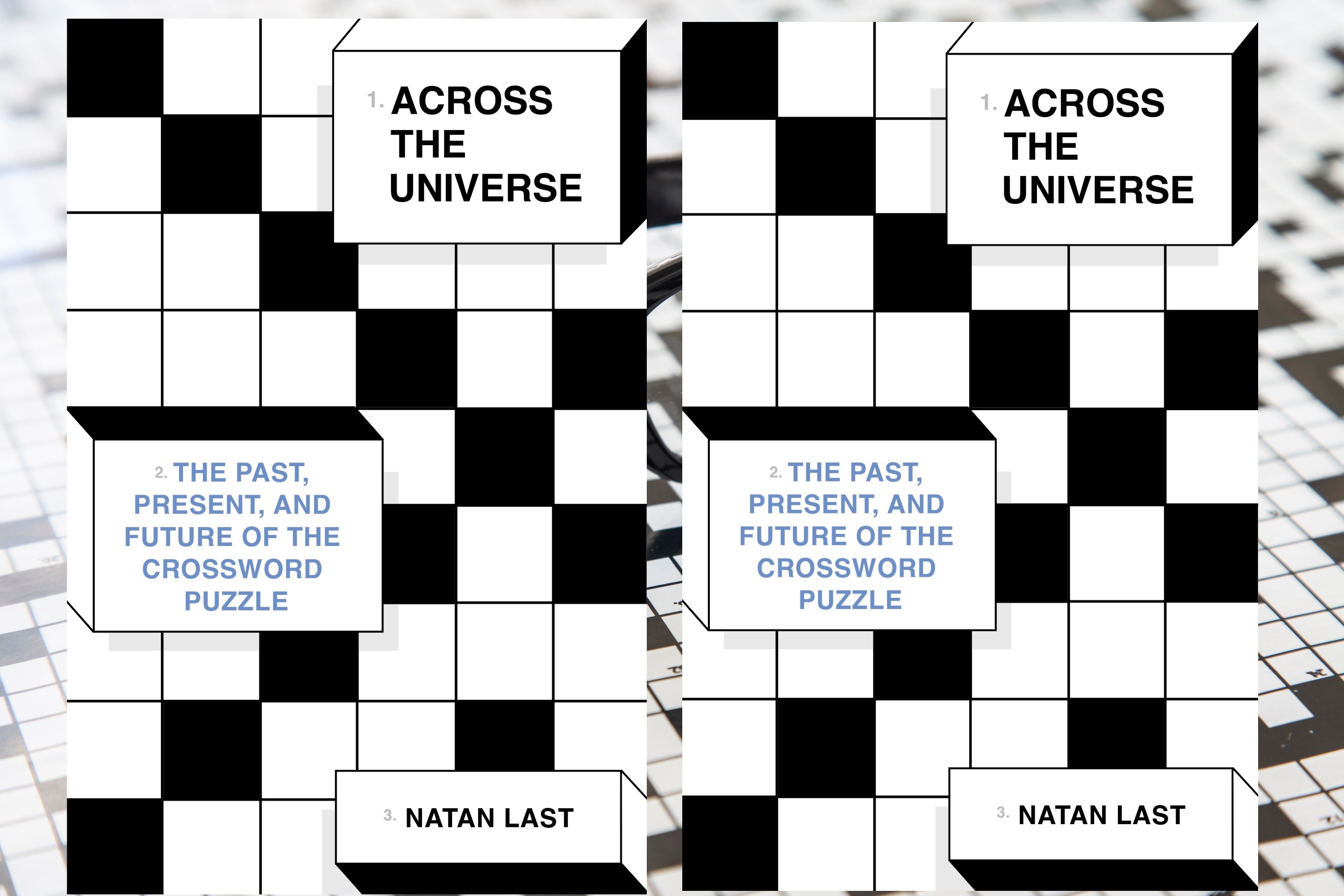
Cruciverbalist and crossword constructor Natan Last’s recent book Across the Universe: The Past, Present, and Future of the Crossword Puzzle supplies a history of the game, but also compelling perspectives on its evolution: From an unlikely early 20th-century American craze the New York Times once compared to disease, to a thriving and idiosyncratic subculture, a point of artistic inspiration, and a forum for politics and social mores. After all, the vocabulary treated as common enough for millions of players to grasp, written in an increasingly globally dominant language, is chosen by a group of biased individuals, each of whom bring their own worldview to the form. As Last writes, “There are puzzle-makers who invest their political essences into the grid; there are those who reject the notion the grid should be anything more than a zone of play, Huizinga’s magic circle become square. The crossword traffics in at least two distinct registers of language: the pun clue’s dad joke, and the trivia clue’s prodding for erudition.”
Recently, Last and I discussed the crossword’s democratization, the labor of both editing and solving, the limits to which the puzzle can be a political tool, and whether we’re playing through a boom-and-bust cycle of digital gaming.
I don’t mean this as an insult at all, but your book is way more engaging and interesting than I ever thought a book about crosswords could be.
[Laughs] Yeah, that's the goal. The goal is to trick the dads into buying it and then have them throw it across the room when there's big words.
There have been other books about crosswords before. What was the central kernel here that felt different to you about what you were bringing to it?
Yeah, there are a couple other books. Adrienne Raphel’s Thinking Inside the Box, which is great and is a kind of outsider-in perspective. As someone who's been writing crosswords for over half my life, this book was very much bottom-up, a behind the curtain view. The other great book is Anna Shechtman’s The Riddles of the Sphinx, which I think is simultaneously more varied and more narrow. It's about the feminist history of the crossword. I think I was trying to do something more comprehensive, to attack it from all angles.
There are two other things to consider. One is that Adrienne’s book comes out right at the beginning of COVID, and so much of the economic explosion in puzzles—the revenue availability and editorship that that's led to and general solvership interest—comes out of COVID. The COVID boom rhymes with what's going on in World War II and World War I with the puzzle and this idea of What do we do with this frivolous but erudite game in a moment of rupture?
I talk about the first time I ever tried the Saturday puzzle, and I couldn’t figure it out. I put it down, go hang out, come back, and the answer has materialized. That’s an experience we've all had, that neurological backburner. I'm also a writer of poetry and prose so, say, loving Nabokov and then finding out he wrote crosswords was a huge explosion.
That’s what’s so fascinating here. I take for granted just how ubiquitous the crossword is and how pedestrian it seems. But you tease out so many facets of its evolution, particularly when it comes to its place in newspapers and how the crossword has been the site of political debate. I’m talking specifically about the New York Times now, not only the content of their crosswords but the paper’s content as well. I’m curious what you think the puzzle can and can’t do politically.
I have lots of friends who refuse to submit to the Times because of its coverage of Gaza, which is not new, of course, this is a long-standing machine of manufacturing consent. The thing that works for me is moving towards convincing myself that the crossword is more of an art form. What that has meant for me is treating it like something I'm making for myself, which I think is a good rule for all art. I work in international migration policy by day. When I first started making puzzles, I lived in East Africa for a year and learned who [Tanzanian anti-colonial politician] Julius Nyerere was. He became my personal hero, so I wanted to put him in a crossword. And the first time someone's like, “Who is this foreign name that's not important?” that kind of radicalizes you into thinking, This is a small everyday moment of education that I think is worth it. I write in the book about the Mau Mau and how their initially quite racist association as a crossword clue changed over time. There's this power in correcting the collective record.
I do think the puzzle has this way of not just confirming what is common knowledge but having a hand in shaping it because it codifies things. It puts them in stone in a way. That being said, revolution doesn't happen at the desk, it happens on the streets, so I feel uncomfortable overstating the political potential of a crossword puzzle.
It’s interesting how crosswords are very much about recontextualizing language, stripping it down into component parts then building it back up. There’s an excerpt from the book in The Nation where you talk about your time working under Will Shortz and being introduced to this wider world behind the scenes. Where does your curiosity about language start?
As a kid growing up in New York, there’s that firecracker of language going off all around you. I was also born deaf in my left ear, so I was taught to lip read. It's like a proto-poetry lesson: When someone's talking, I have to look at them because the sound is coming out of their mouth and their lips are shaping it. Like right now, my internet connection is not 100 percent and I'm looking at you and I'm listening to you, and every now and then, a word cuts out and my brain just knows what the word was. It fills it in. We all do this all the time, it's extremely quotidian. There's the bad forms of this, like what LLMs are doing. But so are our minds.
Those two versions of language—the physical grid and this probabilistic daisy chain of words, that kind of semantic play—were really crucial to me. My Dad is a goofy Eastern European New York Jew who makes bad puns and the way that they were funny but also lowbrow was really interesting to me. And my mother, who's a Moroccan Israeli immigrant, is not a master of English but she is a master storyteller. She's really funny, and I remember watching her tell stories and having rhythm like hitting her beats, it was Chaplin-esque.
When I was a kid, when I was a drummer in my first jazz funk band in high school, we played a bunch of Charles Mingus and I started anagramming “Charles Mingus” to get a new name for the band. I wrote these vignettes that anagrammed other artists’ names. So Eric Clapton's name can be anagrammed to “narcoleptic,” which to me conjured up a sleepy, bluesy tune. The letters dictating meaning felt really unlocking to me. I also love making jokes. I love punning. I'm very interested how people respond when I make a pun, if someone gives me a sort of Elizabethan parlor haughty laugh or someone gives me a big laugh. The aesthetic judgment coming from a person is always interesting to me.
I wonder how your policy work and your crossword work sit together, if at all.
The real answer is that I want them to be separate. A writer I really admire is this guy Sergio De La Pava, who's a public defender by day and writes weird novels by night. The first 50 pages of his first book are basically scenes from depositions. The day job is sort of what matters in the political realm and the night job of writing is where he gets to be totally free. And for me policy and puzzles, I want them to be like that.
That's impossible for lots of reasons, not least because crosswords are now part of my job. This book is about them. I have a puzzle due every month at the New Yorker, which is a privilege but also a freelance burden. When I'm building a grid for the New Yorker crossword, which doesn't have a theme, the stuff that I plan to put in the puzzle, but also stuff that I free-associatively want to clue, show up.
There’s been a democratization of the puzzle over time. More and more people can make their own without that same traditional paternal stewardship. But, and this is the freelancer in me speaking, can you make a living constructing crosswords?
As a constructor, almost certainly not. Mostly because it is freelance. Puzzle submissions are paid pretty well, but they don't appear as often. I talk about this in the book but as an editor, you now can make a living. There's this dual movement where the Times app goes in-house in 2014, so you have people who are on the younger side picking up the crossword who didn't grow up as solvers. Then when COVID hits, there's lots of people who find their jobs aren’t as sustainable or stable as they thought.
One of my good friends, who was a computational chemist and has a postdoc, is now the editor at Puzzmo, which is one of those Hearst properties that's trying to come for the Times. The New Yorker staff keeps expanding. Andy Kravis, who's a big crossword editor there, used to be a lawyer and worked in LGBTQ rights for Lambda Legal. Editing puzzles can be a full-time job for him. Defector has a puzzle, Bloomberg is rolling out these games. You can now make a living on the editorial side, and there's dozens of these jobs whereas there were one, two, or three only five years to a decade ago.
One of the questions I'm interested in is whether this is a boom-and-bust thing. To be candid, I am a freelance crossword writer at places that have since shrunken their puzzle offerings. They got in on the boom in 2021, 2022 and went all out on their puzzle offerings and, because it's still hard to make it in the media industry, have scaled back.
Where does AI fit into this realm of things? Does it have a purchase on crossword construction? In the book, you write about teams of scientists trying to make the Deep Blue of crosswords.
It's hard. The history of AI's solving, as in being better at playing games, is one in which people are like “It'll never happen.” And then it does and everyone's sad for a little bit. We play chess because it's fun. We play Go because it's deep. As someone who writes poetry and is married to a visual artist, I'm super into a reclamatory phase where we start talking about process over product. I don't know if that's going to happen.
There's two other things with crosswords in particular. One, we have this idea that language is special and I am susceptible to thinking that way and I think it's true and I talk in the book a lot about the kinds of things AI cannot do right now, how even people who really love computer science and math are interested in making puzzles that AI could never come up with.
There was a theme where someone noticed that the phrase “sore loser” repeats all of its letters except for the ‘L.’ That's a cool property that is incredibly hard for the human mind to search. That's not how our brains are set up. But to brute-force that with a computer takes two seconds. And doing so will uncover really interesting phrases like “Hippocratic Oath,” which repeats every single letter except for the ‘R.’ Having the full list with the computer will enable you to use your human ingenuity to come up with interesting patterns and ways to apply them. That's letter-based search. Computers are great, we're not great at it.
But semantic-based search, that's our job right now. That's what we do. There’s a puzzle by Brooke Husic and Adam Wagner that's pairs of synonyms that aren't actually synonyms. So, “rib roast” is a known thing. But “to rib” and “to roast” both mean “to tease.” And right now, AI can't do that. There may be a time when AI is okay at it and my hope would just be that we start to think of this as something that we're still going to do because it's fucking fun.
The other answer here is more strident, but just as true. I can't remember if this was last month or two months ago, but one of the purveyors of crossword embedding software came out with their AI thing that's basically scraping all our puzzles and learning how to generate them. LinkedIn weirdly has a bunch of games, they're kind of logic puzzle games. They had Paolo Pasco as their puzzle person, then let him go, and you can just tell they’re automating these games. To the extent that that will happen with crosswords, it's a labor thing more than a tech thing. We have to get together and say don't scrape our old puzzles. This is an IP battle. The boring, but true political answer is it’s a question of power.
It’s doubly bewildering in any creative endeavor because one would hope people want to see that human fingerprint. Crosswords especially can be so idiosyncratic and specific to the constructor. AI has no point of view.
It's boring. As a poet, I am kind of interested in people who subvert these LLMs in cool ways. Pantheon came out with this book called Searches by Vauhini Vara, where the author used early ChatGPT models to complete stories after Vara’s sister passed away from cancer. She’d write, add another paragraph to her original, then ask the AI to complete the story and an entirely different narrative for her sister would open up. That’s an edge case.
I'm also pretty against the idea of the crossword streak. I don't like gamification. I think that is the casino habituation that weirds me out. I try not to be a grumpy moralizer, but it doesn't hit when people tell me what their streak is. Part of it is I grew up doing crosswords on pen and paper. It was exciting when I had the paper to do it and do it every day. But I get it. There’s a story in the fourth chapter of the book about these two siblings who repurpose the streak to keep their mom's memory alive. They started it when she was in the hospital. So I'm interested when people are using these terrible machines to, in some way, repurpose language or repurpose their day.
Final question: Do you play the Defector puzzle?
100 percent.
I remember playing the very first one, which I think was by Paolo and was a pun on basketball team names. It was such a perfect out-of-the-gate puzzle because it did a lot of things that an online puzzle can do. It was not perfectly 15x15, because why care about that constraint in a digital format. It was funny in the way that classic crossword puns are funny, but it was very Defector. Crosswords have all of these different vibes, and it feels like the Defector puzzle is its own thing.