
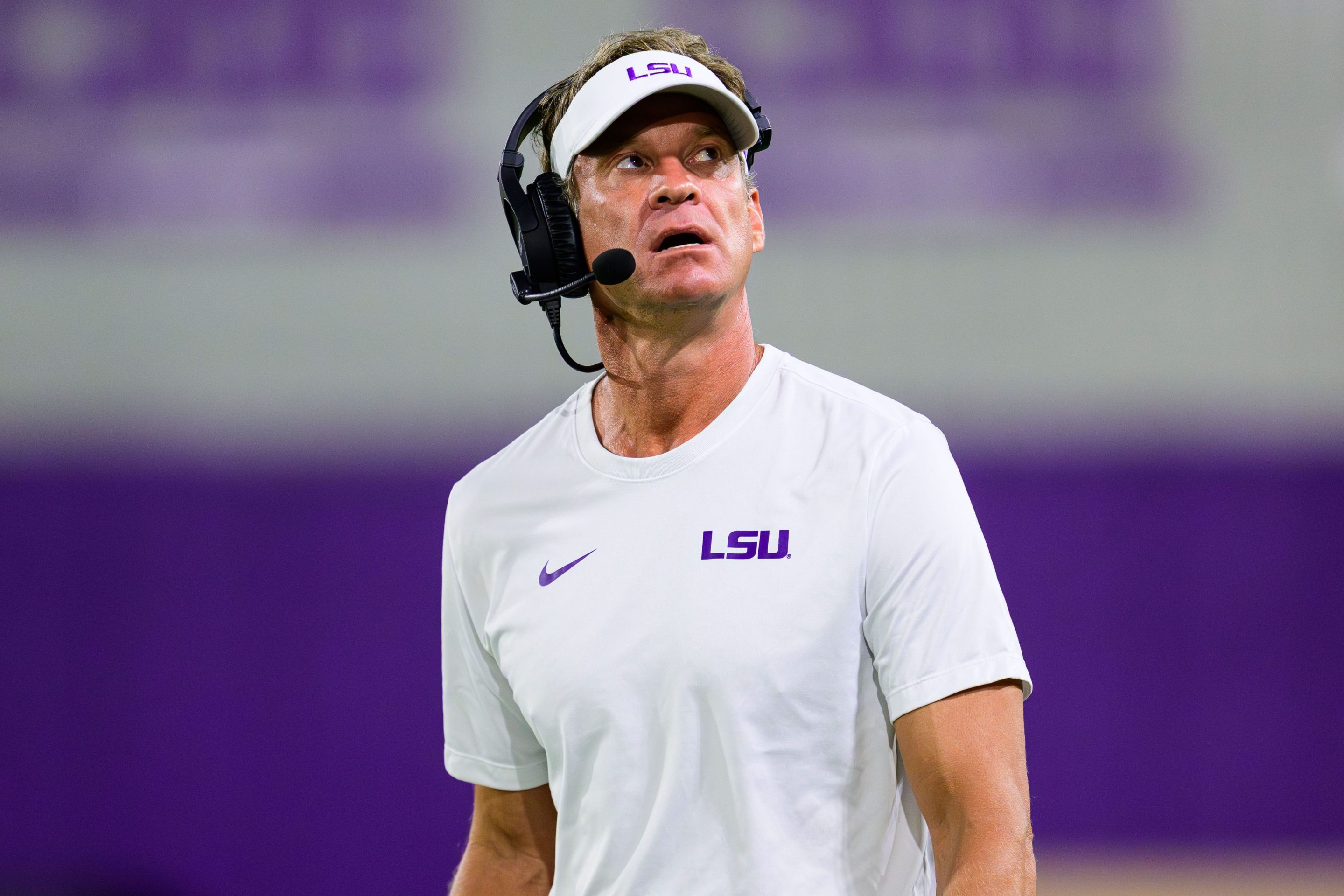
After burning down an entire state's worth of bridges with his incredibly messy exit from Ole Miss, Lane Kiffin is now the head coach at LSU. The controversy surrounding his departure from Oxford did the impossible, making Kiffin's name even more infamous than it already was, and has put a massive spotlight on his first season in Baton Rouge. Ahead of that first season, Kiffin is out making the image-rehabilitation rounds, kicking things off with a Vanity Fair profile, in which the "still shaken" coach aims to tell his side of the fiasco in which he abandoned his team in the middle of a playoff run for a bigger school and a bigger contract.
Kiffin centers his self-justification around the college football calendar, which is fair. As currently organized, the calendar really is absolutely fucked, requiring coaches and students alike to make major decisions about their futures while the season is still ongoing. There was no reasonable scenario in which Kiffin could've delayed taking the LSU job till Ole Miss's playoff run came to an end. But while it is kinda true that the calendar forced his hand, it's also kinda besides the point. You don't get an entire state to curse your name simply because you took a new job. What really riled up Mississippians is how his decision to move on, and especially the timing of it, demonstrated just how little regard he holds this program in. The move was straight out of the well-established Kiffin career playbook: Take over an underperforming program, march them to the cusp of the summit, then flee for greener pastures, all but explicitly stating that he sees the program's potential as maxed out. It makes for a wicked burn on the school in question. It hurt Tennessee when he did it to them back in 2010, and it hurts Ole Miss now. And it also reveals Kiffin's bone-deep belief that he could and should always do better, that coaching is purely transactional, and that the dreams he sells upon first getting the job about being in it for the long haul are just that: dreams.
Of course, none of that is in the Vanity Fair profile. Instead Kiffin flips it around and argues that, actually, it was Ole Miss that lacked loyalty to him, or at least would have in some hypothetical future where Kiffin wasn't winning championships every other year or something:
He never trusted claims that if he stayed at Ole Miss, a statue would be erected in his honor, even if his team started winning fewer games. Kiffin knows that, in Oxford and everywhere else, the love of fans and donors can sour in a hurry. “Once you make those expectations, they forget the stadium was half empty when we got there,” he says. “Once you involve money, everything changes.”
Again, Kiffin isn't necessarily wrong, but he is deflecting from his own actions. What made people so angry at him—aside from using Ole Miss and a hot new yoga body to rehab his head-coaching stock—is that he abandoned a winning team, one that could've competed for a national championship, and in doing so basically said he thinks seasons like that are a total fluke for a school like Ole Miss. To pretend this should not have affected his reputation there is disingenuous. In contrast, Curt Cignetti could lose every game from now on, and he'll still forever be the guy who brought a national championship to Indiana. Sometimes a chance at immortality is a better bet than a guarantee of a bigger NIL budget.
Kiffin continues, arguing that he did everything the school could've asked of him:
Ultimately, Kiffin argues, the sideshow shouldn’t matter, and Ole Miss fans shouldn’t be upset, because he held up his end of the bargain. “Did you make the university tons of money? Are out-of-state applications way up?” he says. “Did the city make tons of money—businesses, real estate? I mean, this is not a normal big city. This is Oxford, Mississippi.” Kiffin knows loyalty is rarely a two-way street in his profession. He points to recent examples including Penn State, where head coach James Franklin was fired less than one year after taking the Nittany Lions to the final four. “Are you letting down these fans, you know, Oxford, that’s been so good to you?” Kiffin says he asked himself last November, as he weighed a decision. The tone of his voice grows more passionate. “No coach I talked to at any point ever said, ‘stay there’… You got one life. People do it all the time.
Fine. It's all transactional and nothing more, so again, why even ingratiate yourself with the community in the first place? Why loudly go to these yoga classes? Why talk about Oxford reuniting your family? In the end, it all looks like a ploy to make him more appealing to bigger schools so he could dip out as soon as possible. He used the language of loyalty and commitment to make his transactions more appealing, and now he's suddenly mad everyone is pretending this all isn't transactional.
But even above the self-serving, one-sided loyalty talk, the richest excuse Kiffin gives about his decision to leave is that it was motivated by politics:
Kiffin also seems willing to indirectly invoke Ole Miss's struggle to distance itself from symbols like the Confederate flag, Colonel Rebel, and the nickname "Ole Miss" itself. When he was coaching there, Kiffin says, top recruits would tell him, “‘Hey, coach, we really like you. But my grandparents aren’t letting me move to Oxford, Mississippi.’ That doesn’t come up when you say Baton Rouge, Louisiana.
Ah, yes: that liberal bastion known as Louisiana. Look, obviously Ole Miss is not exactly tiptoeing around its links to the Confederacy, and it's obvious that it's easier to convince a black kid with options to come to Baton Rouge than Oxford. But you're kinda just splitting conservative hairs when it comes to these two schools. Baton Rouge is not exactly the favorite to win the Woke Olympics, coach. Kiffin must've known that line would set off more drama, because he reached back out to the magazine the next day to clarify that his comments were intended as purely fact-based and not "shots" at the school. Nevertheless, Kiffin, well into his third football act, shows that very little has changed when it comes to his mindset. However, he better hope something has changed when it comes to his ability to meet expectations, especially when those expectations get even higher.