Even in sports that do not literally hand out points for style, the matter of aesthetic value is of discursive import. The most dominant athlete or team in the world can be taken down a peg or two on the moral underpinnings of play style. There are hoops (ethical) and hoops (unethical). You can win, but what is it worth if you do not win beautifully? You can lose, but at least you suffered beautifully when it counted. The ugly victor is a goblin; the beautiful loser was too pure for this world.
What figure skating does as a sport is declare aesthetics an essential component for victory. The fundamentally subjective evaluation of how beautifully or, to borrow the favored technical term, artistically one skates is converted into a scored part of the performance. When the Olympic commentary puts in a snide aside about how a skater is "not an artist" or "doesn't have the artistry," it is, taken generously, a technical critique of the performance. Of the score each skater receives, a significant part of that is dictated by artistry.
Unfortunately for ethical, artistry-favoring figure skating fans, relatively recent developments in the men's event have proven that the small details like step sequences and spin quality and skating skill, still, can be rendered less important. Like many technical innovations in sports, said "quad revolution"—turning quadruple jumps into elements that can be consistently performed, pioneered by skaters like Yuzuru Hanyu, Nathan Chen, and Jin Boyang, the last of whom is participating in the 2026 Olympics—was a bit more fun in the beginning. It helped that in the revolution's early era, Hanyu was the most ethical of skaters: Not only did he push the technical limits of the sport, but he could perform. Chen faced criticism for only being a jumper, but at least he had both a rival in Hanyu and the decency to, on occasion, totally blow it, most notably at the 2018 Winter Olympics.
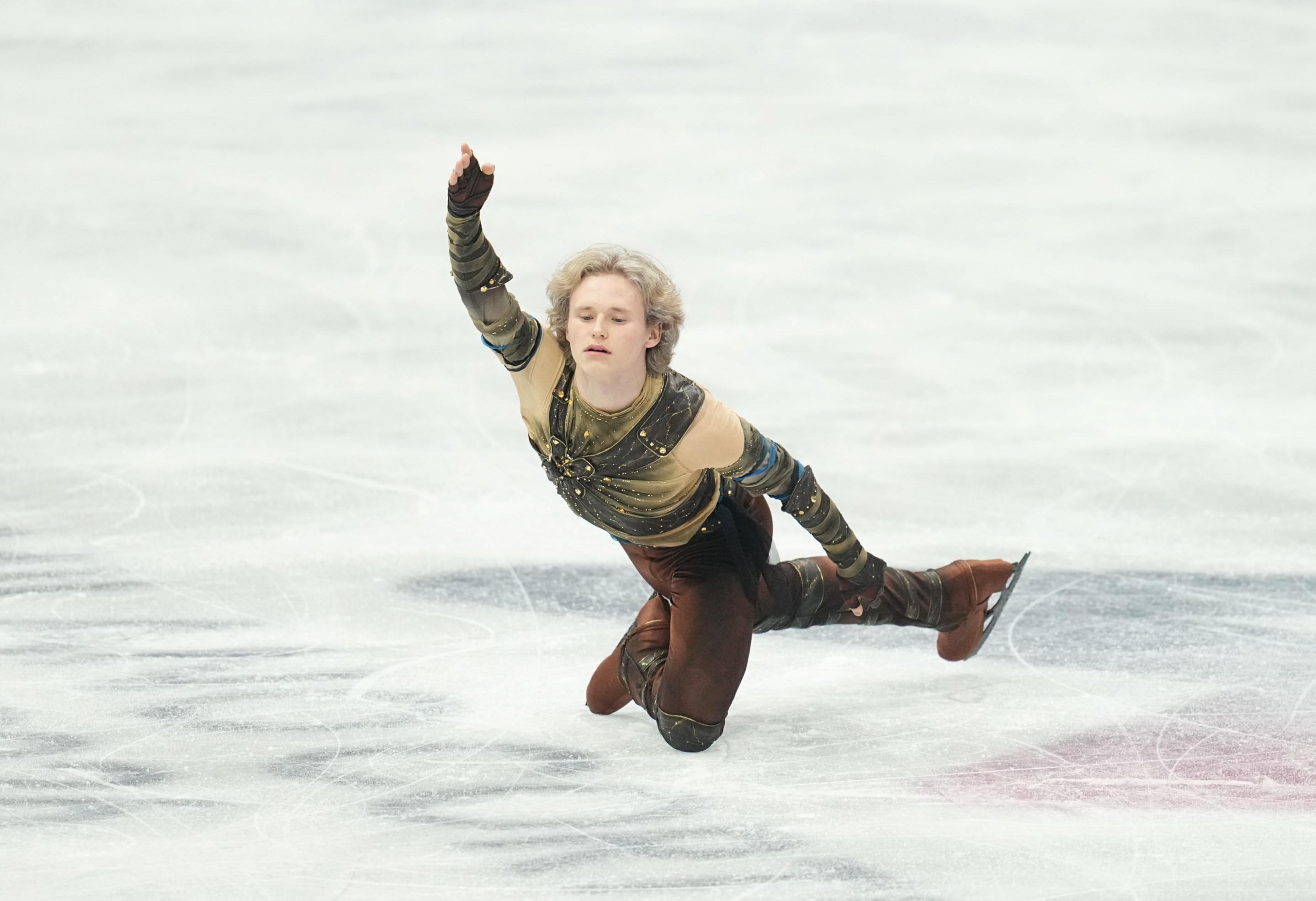
The Ilia Malinin Situation is this: The 21-year-old American has pushed the bounds of technical figure skating to their presumed maximum, and he is still going out there, threatening everyone who will listen with a future quintuple. He remains the only skater to land a quad Axel, formerly the figure skater's white whale. He has landed seven quads, the maximum a skater can perform without performing a quad-quad combo, which would be the actual maximum a skater can perform without running into rules regulating repeated jumps. He has not lost an event since 2023, which is to say that he has not performed worse than a gold medal since 2023. None of his closest competition are consistently landing four quads in a free skate, though some have the upside. None are landing five at all. Even with the quad Axel being undervalued by figure skating's current scoring system (a triple Axel is 2.10 points more than a triple Lutz, while a quad Axel is only 1.00 point more than a quad Lutz), so long as Malinin lands all his jumps, which he frequently does, another skater winning is a mathematical impossibility.
But in the team event, when Malinin had a shaky performance by his own standards, it seemed like there might be some hope for the ethical skaters out there that Malinin could have his own 2018 Nathan Chen–style Olympics. The short program of the men's individual event would be especially fertile proving ground: While the gap in the free skate is near insurmountable, the short program only allows three jumping passes and one combination, which lowers the technical ceiling.
Unfortunately, whatever lapse Malinin experienced during the team event appeared to have passed. He didn't go for the quad Axel, though he didn't need to in order to end his short program—which is about "being a warrior"—with the highest score of 108.16. In true Malinin fashion, it did still come with a healthy amount of sticker shock. His final, second-half boosted jumping pass earned him an eyewatering 21.87 points, which never gets easier to absorb even as it happens again and again. One never wants to start assigning gold medals before it's time, but after the short program, Malinin has moved from prohibitive favorite to Prohibitive Favorite.
Amusingly, Malinin breaking the technical ceiling means that for a sport that already does factor artistic ability into its scoring system, having greater artistic ability can still function as a moral, if not literal, victory. His foil here is in Yuma Kagiyama, who actually beat Malinin in the short program of the team event this year, skating cleanly where Malinin did not.
If you wanted to distill the Malinin–Kagiyama rivalry into an oversimplistic dynamic, it would be athleticism vs. artistry. Kagiyama is a performer with ineffable charisma and the best skating skills of all the men, which is not to disparage his jumping ability or consistency—he landed four quads in his free skate on the way to an Olympic silver in 2022. There is a palpable difference between watching a Kagiyama and Malinin performance, and during the short program, where the technical gap is smaller, it's understandable why some want Kagiyama to be rewarded for it, perhaps even with a higher score.
Malinin's Tuesday score, which was just under Kagiyama's team event score, seemed to set Kagiyama up nicely for such a result. If Kagiyama were to skate his program cleanly again, the judges would not give him any lower than the score he had in the team event. Unfortunately, Kagiyama stumbled on his last jump, the triple Axel, and so had to settle for second. (The following video is of Kagiyama's performance during the team event, which he skated cleanly.)
Part of the reason why figure skating fans are constantly being driven insane is the ability to make that sort of assumption: that if Kagiyama skated his program cleanly again he would necessarily have a higher score than the first time around. The subjective part of figure skating—PCS, or Program Component Score—is fundamentally fake. In theory, PCS is made of discrete parts, but in practice, judges pick one number and vary it by .25 across the three categories of composition, presentation, and skating skills. Scores inflate with reputation (you are rewarded with name recognition and longevity), federation size (a skater usually gets rewarded with higher scores if they are, say, American or Japanese), and how late you perform among your fellow skaters (scores always inflate toward the end). Complaints that a particular skater is under- or over-scored are fundamentally a complaint with the broken nature of figure skating judging. After winning the Grand Prix Final in December, off the back of seven clean quad jumps, Malinin himself expressed surprise that his PCS score was as high as it was, describing his performance "like a jump competition."
The flip side to that sentiment is that there is a beauty to Ilia Malinin performing in a jump competition, if not necessarily one aligned with figure skating's traditional aesthetics. While Malinin has a very different sort of charisma from Kagiyama, he, too, can have the crowd eating out of his palm. Malinin is not some slovenly meathead with poor technique brute-forcing his way through clumsy quads. He is a technically brilliant jumping talent, the likes of which nobody else has ever seen, and he makes that known to the viewer.
The argument that Malinin's skating poses is that there is an artistic beauty to a human body performing a miracle, the same beauty that runs through all athletic achievement. If figure skating is a sport, then it is—on top of being an artistic performance—something to be won. And if figure skating is to be won, then the elements that compose athletic beauty must necessarily be a part of what the sport rewards or admires: the ruthless simplicity of knowing how to win and being able to execute it to a degree no one else can; the gulf a spectator feels watching someone else exist in a way that is incomprehensible to them, physically and psychologically.
More than anything, Kagiyama is a victim of time. Here is a beautiful skater whose career is sandwiched between two technical greats, and during the one-year window between Chen's retirement and Malinin finding his consistency, Kagiyama was injured. Of course, one is always free to argue that there is a greater moral injustice plaguing Kagiyama on top of the indignity of his birth year. That, too, has always been a fundamental characteristic of sports.