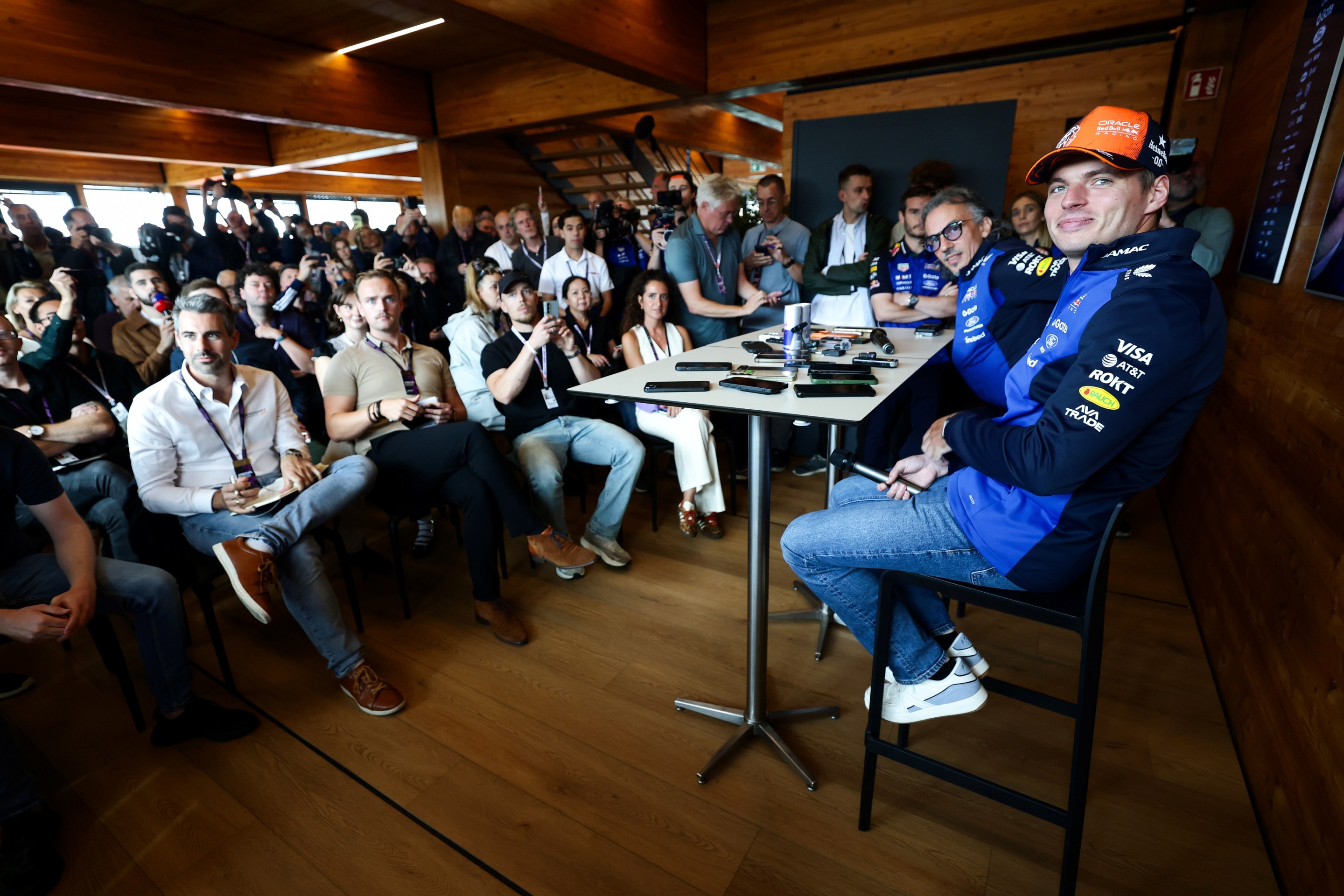

On Tuesday morning, Red Bull Racing officially announced that Helmut Marko would be stepping down from his position as Red Bull motorsport advisor, which the 82-year-old Austrian had held for two decades. His exit comes shortly after the sacking of former team principal Christian Horner, with whom Marko had a more or less public power struggle over the past couple of years; in the end, Marko only spent a few months as the sole remaining stalwart of the Red Bull dynasty. Car designing guru Adrian Newey left for Aston Martin, cool-headed sporting director Jonathan Wheatley took his talents to Sauber, CEO Christian Horner was ground up by the dynastic machinery's gears, and then there was Marko, who—well, what exactly did Helmut Marko do?
For very casual fans, the role of "motorsport advisor" can be a bit impenetrable, and belies the high-ranking nature of Marko's appointment. He was employed not by Red Bull Racing, but reported directly to Red Bull, the energy drink company, and was a close friend of late Red Bull owner Dietrich Mateschitz. From a spectator's perspective, Marko's role could easily appear to be to take every opportunity to make some public statements, all the better for how loudly he made them. The most notable of these statements came in the form of racist stereotyping of his own drivers.
In 2023, for example, Marko said of Sergio Pérez, "We know that he has problems in qualifying, he has fluctuations in form, he is South American and he is just not as completely focused in his head as Max [Verstappen] is or as Sebastian [Vettel]." (Pérez is from Guadalajara, Mexico, and thus North American.) Marko later attempted to clarify his comments to Austrian media, stating, "It wasn’t meant that way. I meant that a Mexican has a different mentality than a German or a Dutchman. But who knows, maybe it’s controlled."
In 2021, Marko said of then–Red Bull junior Yuki Tsunoda, "Tsunoda is not a typical Japanese driver. The typical Japanese driver—we have one in Formula 3 with Ayumu Iwasa—is polite, disciplined and would never make statements like Tsunoda."
The comments about Tsunoda were relevant to one of Marko's key roles with the team. Here is something Marko did: He helped manage Red Bull's sweeping junior program, the scope and success of which surpassed any other team on the grid. In 2025 alone, seven out of the 20 F1 drivers had current or former ties to the program, including Max Verstappen, Yuki Tsunoda, Liam Lawson, Isack Hadjar, Carlos Sainz Jr., Pierre Gasly, and Alexander Albon. Some of this is down to Red Bull, and the scope of resources available to them, including a full sister team; four seats account for a fifth of the grid, and Red Bull juniors simply have more time and opportunity to make a name for themselves than junior drivers elsewhere.
That takes nothing away from acknowledging Marko's impact on the Formula 1 grid as a whole, though there are two ways of reading the number of former Red Bull juniors that have gone on to have a better time somewhere else. On one hand, it is complimentary to Marko's eye for talent that drivers unable to make the cut for the Red Bull factory team have been able to find long-term drives elsewhere. On the other, perhaps it is telling that the turnover through the Red Bull junior program is so high, and that its survivors have wound up better off elsewhere. Control over the Red Bull roster has gotten muddled of late, but before the clumsy promotion/demotion of Lawson, there was the disastrous management of Gasly's 2019 midseason demotion and Albon's corresponding promotion, which, for a period of time, threatened to derail both drivers' careers.
When the talent selection worked, it worked, and could engender some fierce loyalty: Verstappen was adamant, during the early days of the gauche Marko-Horner struggle, that he would not continue with the team if Marko were to be ousted from it. There are numbers that speak in Marko and the Red Bull machine's favor: six Constructors' Championships and eight Drivers' Championships, the latter split neatly between Sebastian Vettel and Verstappen, who started their careers with the team.
This year, Red Bull was two points away from a ninth Drivers' Championship, but the team did not win. There will be no additional counting statistic for Marko's legacy, and in that way, this is a fitting moment to see him off on the merits of his public work instead.
As to that public work: One of Marko's first statements this season came after Hadjar crashed in the formation lap of his debut race. The then-20-year-old rookie kept his helmet on as he cried, and was comforted in the paddock by Lewis Hamilton's father, Anthony Hamilton. Marko said afterward, "Isack Hadjar did a little bit of crying after his crash. That was a bit embarrassing." One of his last statements this season came after 19-year-old Mercedes rookie Kimi Antonelli made an error in the closing laps of the Qatar Grand Prix, which resulted in Lando Norris gaining two points in the championship race. Despite available evidence to the contrary, Marko declared, "It was twice where [Antonelli] more or less waved Lando by. It was so obvious." His comments helped fuel a slew of online abuse toward Antonelli, and Red Bull released an official apology for Marko's statement the next day.
A broad overview of Marko's legacy will hinge on how one apportions the credit for the team and drivers' successes during his tenure. But it would not be unjust for the lasting memory of Marko and his handling of young drivers to be of what can be attributed purely to him—how he chose to portray himself at length to anyone who would listen, and spoke, often unkindly, when there was nothing that needed to be said. In that way, too, Marko's influence on the grid was unmistakable.