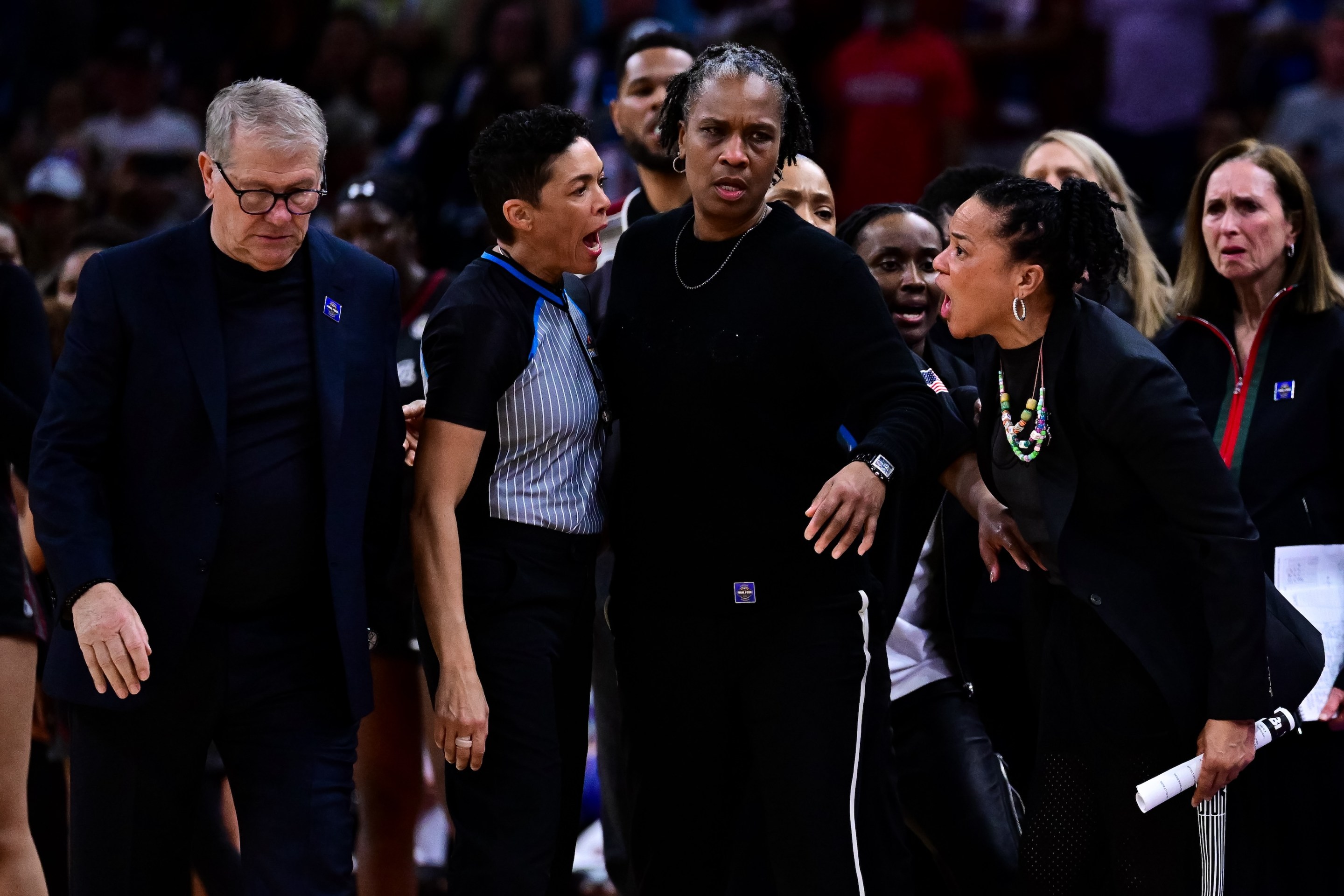


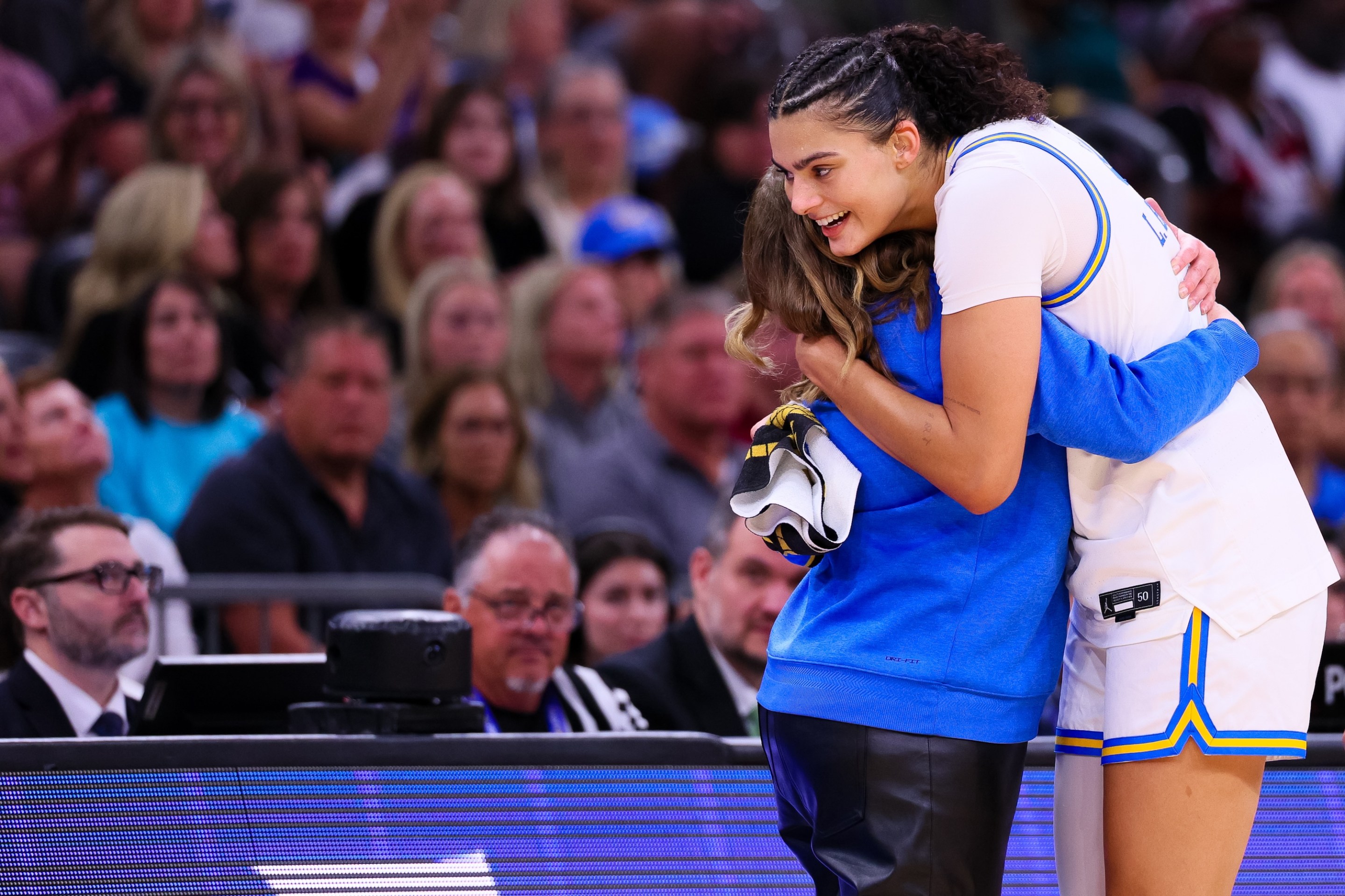
There was a moment early in the third quarter of Sunday’s national championship game when you could see exactly how UCLA was going to win and why. The South Carolina Gamecocks, desperate for offense, had taken to gambling now: sending bold passes through traffic, pawing for steals, taking shots early in the clock. They needed something—anything—and in the absence of a real halfcourt method, the only option left for them was madness. South Carolina point guard Raven Johnson tried to push the pace, lobbing a pass overhead to a streaking teammate in transition. But into the air leapt Kiki Rice to intercept it. The camera lurched and slowly panned back the other way; the other Gamecocks went flying out of the picture. Rice considered her next steps and kicked the ball over to the corner for Charlisse Leger-Walker, who knocked down a three. In UCLA’s hands, the game calmed down.
Slow and steady, the race was won. The Bruins defeated South Carolina, 79-51, Sunday afternoon to bring home the program’s first NCAA championship and its first national championship since the AIAW tournament in 1978.
Styles make fights, and this matchup promised an interesting one: South Carolina was designed to disrupt and accelerate. UCLA had been one of the slowest teams in the country this year, its halfcourt offense built to maximize Lauren Betts, the 6-foot-7 center who made the team function. In a queasy Final Four game against Texas on Friday, the Bruins didn’t look terribly comfortable with high pace and heavy pressure. But there’s a reason UCLA was playing in the national championship game and Texas wasn’t. It’s hard to fluster these Bruins for 40 minutes. That’s enough time for them to figure out how to wrangle a whole game.
Slow and steady, but never not intense. A gameplan built on defensive pressure might have worked if UCLA weren’t also just better at all the little things, if they didn’t also just hustle harder and jump higher. South Carolina was outplayed in all the areas Dawn Staley teams typically take pride in: The Bruins outrebounded the Gamecocks 49-37, 21 of those on the offensive glass, and outscored them 40-28 in the paint. The box score tells the truest story, one of a shared effort from a senior class whose six players could all find themselves selected in the first round of the WNBA draft next week. All five senior starters scored double figures. Each one also logged at least two assists, many of those on clean entry passes to Betts, who scored 14 points on 6-of-10 shooting and was named Most Outstanding Player. Wing Gabriela Jaquez’s 21 points led her team, but she was most impressive as a rebounder. “She’s relentless,” Staley said after the game. “Just championship-type behavior.”
The big-game comfort the Bruins felt yesterday—“We just knew we were going to win,” Betts said—was one they’d suspected would develop from their experience at the Final Four last year. “We’ll be better next time we’re here,” UCLA head coach Cori Close said last April, in the aftermath of a blowout loss to eventual champion UConn. That was no question: There would be a next time. And no question, UCLA was better. Rice grew as an off-ball guard, as Leger-Walker was trusted to run the floor more. Jaquez, always a consummate rebounder and cutter, was newly aggressive as a scorer. Betts, often scrutinized for being just another drop big, looked comfortable guarding in space this year.
UCLA is hardly a haven from the high-turnover environment of college basketball: Close lost an entire recruiting class this offseason, when all four of the freshmen on last year’s team entered the transfer portal. In an impatient industry, there's something almost quaint to Close winning her first championship at 54 years old, after 15 seasons in this job. “The game finally paid her back,” Dawn Staley said. Close is a coach’s coach, always handy with a quote or a story about seeking wisdom from a colleague; one imagines her bookshelves stacked with self-help and memoirs, all of it sticky-noted and underlined. At last year’s Final Four, she mentioned sitting in on Geno Auriemma’s practices when she first took the job at UCLA. She credits weekly meetings with John Wooden, back when she was an assistant, for helping her grow as a coach.
Coaches sometimes find themselves placed on a binary scale: motivator or tactician. For a long time, Close was damned with the faint praise of being the former—good for a soundbite, bad for a big game. To her credit, she was never content to be only one kind of coach forever. “I hope I’m a leader that chose to grow. If one of our core values is going to be a growth mindset, it has to start with me,” she said postgame.
From the beginning, this shaped up to be an all-or-nothing year for UCLA. Graduating seniors scored all the Bruins’ points in this year’s Final Four, so Close begins almost from scratch now, tasked with a rebuild just as in-conference Los Angeles rival USC returns to full strength. If this is the culmination of years of work, Close still isn’t likely to treat it as an endpoint. “Banners hang in gyms and rings collect dust,” she often says. But what she, Jaquez, Rice, and Betts built, slowly and deliberately, will age better. Every pyramid needs its base.