

A college basketball coach in the middle of a meltdown is extended grace that generally wouldn't be granted to any other adult having a tantrum in public. On the merits, there's nothing much to say on behalf of a grown man who is stamping and fuming and turning a Cran-apple color while heatedly saying things like "It's about respect." That's just an embarrassing thing to do, and if and when you see an adult doing all that, you can safely assume some unflattering things about, at the very least, their capacity to experience shame. You can generally read a whole worldview into the person doing it and feel confident about those assumptions being correct.
But it's different for coaches, or anyway there are ways in which it theoretically could be that work to get them off the hook somewhat. The specific acts of hopping-mad clownishness are still just what they appear to be, of course, but the heightened emotional register and general overage of college basketball create a context that could, again theoretically, be exonerating. Look at Tom Izzo huffing and puffing like a bagpiper on the sidelines and you might be able to convince yourself that he just cares so much about these kids that he has forgotten himself a little. Squint harder than that and you can see Mick Cronin going out of his way to humiliate his own players as a reflection of how much he respects the game. Squint and twist as hard as you can, really bear down, and it's honestly still tough to do much with Dan Hurley constantly acting like Christopher Meloni in Oz, but someone will surely find a way to figure that one out.
Coaches are the main characters of college basketball because they stay in one place the longest, and also because of an unfortunate cultural default toward whichever older white guy is screaming the most. This has its benefits and costs, but over a long enough period it has the effect of turning those coaches into caricatures, and finally into cartoons. It was not really surprising that Geno Auriemma responded poorly to Connecticut's upset loss to South Carolina in the women's Final Four on Friday night, both because the defeat ended Connecticut's perfect season and 54-game winning streak, and because Geno Auriemma is the way he is. Coaches are only human, but Geno Auriemma is also only going to do Geno Auriemma-type stuff. He will do it both because he cares so much and competes so hard and because he is, if you want to be nice about it, Geno Auriemma.
The outcome was much more of a stunner than Auriemma being peevish and sour about it all. Connecticut boatraced South Carolina in last year's national championship game, and while this year's 38-0 record speaks fairly eloquently for itself, the Huskies only had one win that really qualified as close. They were the most dominant team in the sport all year, and that dominance expressed itself in number of victories that were outsized even by the standards of Peak Auriemma—a 102-35 victory over DePaul, a pair of wins over Xavier that came by a combined 123 points—but mostly through a drumbeat of no-fuss, no-muss dispatchings of less hapless programs that continued unbroken through the first three rounds of the NCAA Tournament. The Huskies seemed so much better than the field that the conversation surrounding them this March was less about whether they would or could be beaten than the mental health hazard they posed to opposing coaches.
And then South Carolina pretty roundly dominated them in every facet on Friday, in a 62-48 win that felt much more like a blowout after the Gamecocks opened the second half on a 16-4 run. The Gamecocks simply never let Connecticut get into its offense, and All-Americans Azzi Fudd and Sarah Strong combined for only 20 points on 31 shots. "Our whole objective was to get them to shoot as inefficiently as possible, make them put the ball on the floor," Gamecocks coach Dawn Staley said after the game. "Don't give them as many catch-and-shoot opportunities. I thought our kids really locked into that." The Huskies shot just 31.1 percent as a team, and their 48 points was nearly 38 below their season average. Auriemma was convincingly incensed after the game about South Carolina taking 22 free throws to UConn's six—in the sprawling postgame coach tantrum that swamped the outcome, this was the only bit that comported closely with any observable reality—but the Gamecocks came by that advantage naturally, by being aggressive and assertive where Connecticut seemed first stymied and finally just overmatched. South Carolina's 47-32 rebounding advantage was highlighted by a backbreaking 14 offensive boards. It is doing Auriemma a favor to even humor the possibility, but it was in every sense the sort of beating that a coach might pitch a big postgame fit to distract from.
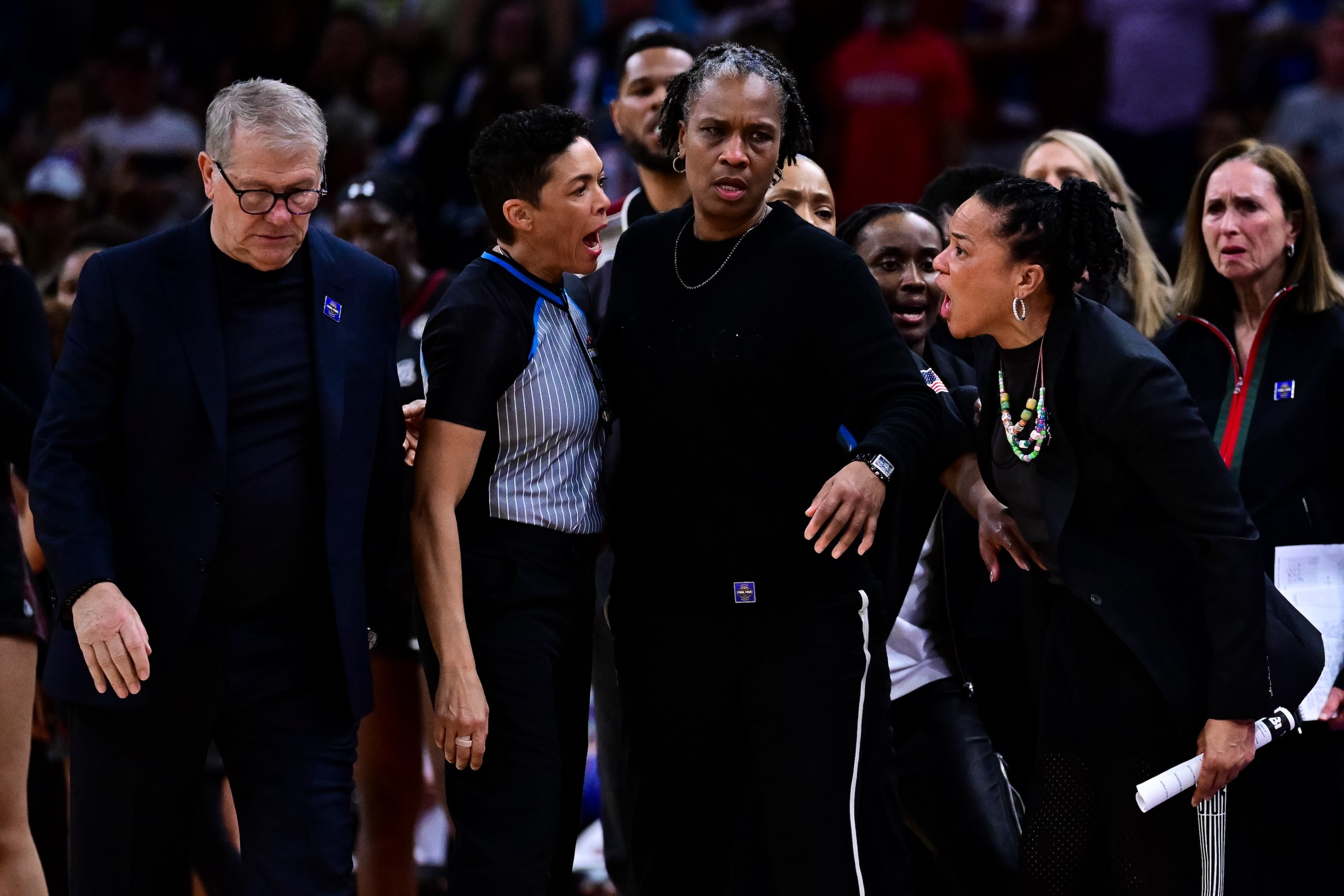
Anyway, Auriemma's meltdown made it abundantly clear that he was not really in control of the spectacle that he kept on making of himself. It began with a jarringly pissy on-air interview after the third quarter, peaked when he confronted Staley before and after the final buzzer while refusing a postgame handshake—he was already marching back into the locker room when Staley said, several times, "I will beat Geno's ass"—and continued through an increasingly ruddy and affronted press conference. The bit that Auriemma returned to most frequently was his offense that Staley did not shake his hand before the game, or rather that she did not shake it at the moment and in the way that he had hoped to have it shaken. "The protocol is, before the game, you meet at halfcourt," Auriemma said after the game. "Anybody seen that before? The two coaches meet at halfcourt and they shake hands. Correct? You ever see it? They announce it on the, on the loudspeaker. And I waited there for like three minutes." He made two distinct and equally overstated "don't care for it" faces at this point before adding the bristly kicker, "so it is what it is."
When a coach says "it is what it is," it is something like the opposite of that—a person who is as angry as they've ever been announcing that they are refusing to accept and will continue to refuse to accept what is. It's worth noting that this was pretty easily the most composed Auriemma was throughout this meltdown. By then, the tantrum was already receding toward Saturday's inevitable and decently fulsome statement of apology: "It's unlike what I do and what our standard is here at Connecticut," it read in part. Auriemma had been corrected on several points—Strong had ripped her own jersey, not a Gamecocks defender; he did shake Staley's hand pregame, just not when and where he wanted—by a baffled press corps. He fleshed out his complaint before the fourth quarter that Staley "rants and raves on the sideline and calls the referees some names you don't want to hear" by bemoaning a "double standard," that means "some people are allowed to talk to officials like that and other people are not."
Is this interesting to you? It has never been easier to find a grown man pitching a child-size fit in public than it is at that moment, and while Auriemma certainly delivered the queasy and shameful feeling that comes with witnessing that sort of thing, the whole production was exhausting long before college basketball's winningest coach finally got done crying himself out. It's not just that it was so much smaller than the moment and the game deserved, but that there was so little redemption in it in comparison to the game that preceded it. An upset in the Final Four is valuable and memorable because it is surprising; this sort of spectacle, whatever its startling particulars, is the opposite of that in every way.
After the game, both Staley and (eventually) Auriemma expressed some regret that his coachy excess would dampen or overshadow the game itself. That's a valid enough concern, but while his meltdown will leave a smudge on Auriemma's legacy, it's hard to imagine that it will be an especially long-lasting one, and not just because of the likelihood that he will replace and re-replace it numerous times before it's all over. It's just not interesting enough to last while there's still basketball to be played. This is the desperate truth at the center of every coach tantrum—how doomed all those vain and fuming attempts to pull everything back toward the screaming guy on the sidelines always is when there is basketball to be played. And South Carolina will play in the National Championship Game against UCLA later today.