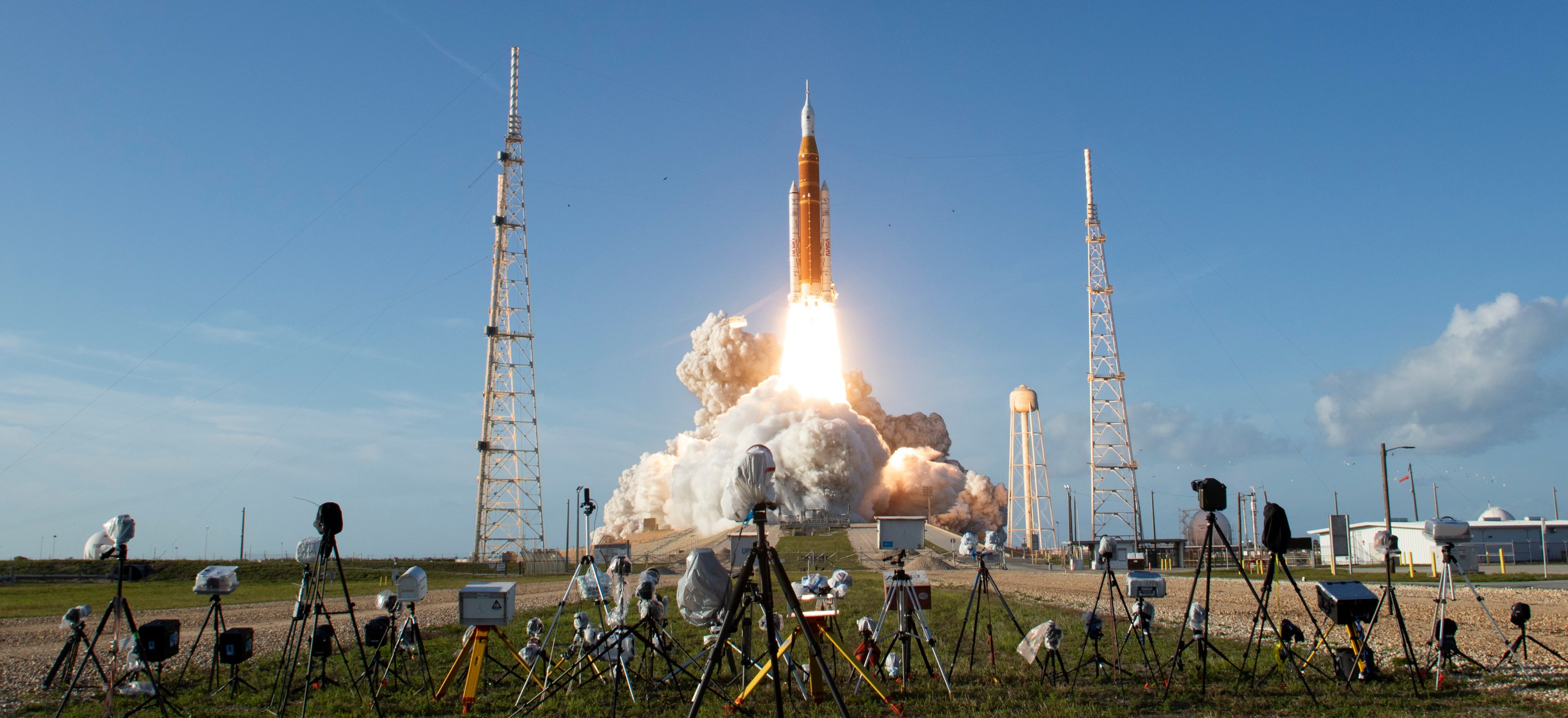

It was about 65 minutes after liftoff, the Integrity spacecraft 800 miles above the Indian Ocean and moving at about 16,000 miles per hour, when the historic words were spoken: "Integrity, Houston, toilet is powered."
It was a spaceflight milestone. Artemis II, which launched from Florida Wednesday evening, will put four humans around the Moon for the first time since the Apollo missions ceased in 1972. But the Orion crew vehicle, named Integrity, has something those Apollo astronauts lacked: an onboard toilet. As Orion spends its first day boosting itself to a high-Earth orbit in preparation for its lunar jaunt, it's already farther from the planet than any crewed spacecraft in 54 years. That means its toilet is the most distant toilet in the history of humankind.
Nine minutes later, the toilet broke.
For various operational reasons, the toilet was among the first systems powered up only after Orion reached orbit, and it hadn't been a painless operation. On step 2.5 of the startup checklist, mission specialist Christina Koch queried mission control in Houston about a particular urine filter that had, perhaps, been installed incorrectly. It appeared to be "without beads," Koch radioed to CAPCOM, a distinction unclear at the time but which would prove to be Chekhov's Urine Filter, fated to play an important role.
On step 6.7 of the startup checklist, almost immediately after turning on the water, the power to the toilet cut out, and Koch reported a blinking amber fault light. After some brief chatter, CAPCOM told Koch to continue with other, more pressing duties, as Orion was preparing for an apogee boost to raise its orbit in preparation for the gravity-assist slingshot to the Moon.
"We will need to think about that for a while," mission control said of the broken toilet. Then, later: "Question for Christina about toilet." It was slightly surreal to listen in on the chatter, so soon after launch, so practical and mundane a concern with such a spectacular backdrop. In space, everyone can hear if you can't pee.
It’s very funny, because toilets are funny, but I also find it touching because it’s so relatably human. Space missions are filled with impossibly genius men and women achieving scientific feats far beyond our intelligence, discussing them with indecipherable jargon and initialisms, and then they’re talking about toilets. Hey! Toilets! I use those things too. Everyone needs toilets. A mission's primary concern is the safety of the astronauts undertaking it, and they're just people, like us, with the same bodily functions. They’re pushing the boundaries of spaceflight up there, but they’re also worrying about where they will pee and poo.
It’s important science, too. If we ever want to think about extended spaceflight or habitation, we’re going to need toilets. It’s unavoidable. Put humans in a confined space for any length of time, and they’re going to need to piss. What do they do with their piss? Even more valuably when every gram of weight must count, can they drink it? Lots of smart people have spent collective decades trying to figure this out.
Previous Moon missions saw the astronauts shit in bags, or experiment with diets. It wasn't an ideal system. On Apollo 8, Bill Anders went nearly a full week without defecating, while Frank Borman had diarrhea. On Apollo 10, a rogue turd escaped its containment bag and floated through the cabin while the crew circled the Moon. To this day, the turd's owner has not been identified. At least the astronauts found it funny:
It took NASA six years and $23 million to design the Universal Waste Management System, and it was first installed on the International Space Station in 2020. The UWMS—invariably referred to by everyone at NASA as simply "the toilet"—uses suction to keep waste from escaping, and captures and filters the urine it collects to return to the craft's water supply. Just as importantly, it is capable of handling what NASA calls "dual ops—when they’re doing both defecation and urination at the same time,” said Melissa McKinley, the toilet's project manager.
Most importantly, it needs to work. "The toilet is a ‘mission-critical’ system, so if it breaks down, the whole mission is in jeopardy," one expert told Scientific American.
Because you're surely curious by now, here's the fussy toilet in question, from a National Geographic pre-launch tour:
@natgeo How does an astronaut go to the toilet in low gravity? Ahead of the Artemis II launch, NASA astronaut Christina Koch gave us a look inside the Orion crew capsule's toilet—complete with handholds, bright orange insulation, and surprisingly loud plumbing. Take a tour of the Orion spacecraft at the 🔗 in bio.
♬ original sound - National Geographic
As the technology has progressed, toilets have become a must for extended space missions. Between Artemis, the two space stations and their docked crew vehicles, there are currently 10 toilets in space—a new record. Well, nine and a half, depending on the status of Orion's.
This wasn't a true emergency, really. At a press conference, NASA administrators said they expected that it would take a couple hours to troubleshoot the toilet, and astronauts don't really settle down and start eating for a while, given all the mission work they have to do on Day 1. But they do snack. A single sandwich is placed into a pocket on each astronaut's flight suit just ahead of launch, so they can nibble on something even before they unstrap. When real meals start in earnest, though, toilet availability becomes a little more pressing. Here's the menu for the mission; five different spice levels of hot sauce are available. Nobody wants that toilet up and running more than the crewmates of whoever likes their sauce the hottest.
A little more than two hours after launch, mission control told Koch that the toilet was now available for "fecal collection"—the fault had been determined to be specific enough that it only affected liquid waste. NASA's working theory was that some oxone beads, used to decompose organic compounds, had come loose from the urine filter (I told you it would be important!) and jammed the toilet's fan.
In the meantime, pissers would still have to use CCUs, or Collapsible Contingency Urinals. These are what they sound like: small, flexible bags to pee in. And they got used. A few hours later, Orion radioed Houston that they had a full CCU and asked for the best time to dump it into space.
Finally, a little more than five hours after launch, Houston developed a potential fix. They walked Koch through the steps to boot the toilet back up and try it out, and—FLUSH! "Houston, Integrity, good checkout," Koch reported.
"Happy to report that toilet is go for use," CAPCOM radioed back. "We do recommend letting the system get to operating speed before donating fluid."
"We are cheers all around, and we will do that," Koch sent back.
The scale of space is a little overwhelming. By that point, Artemis was already 50 times farther from Earth than the International Space Station. As it and future missions go even farther, it's going to be vital that onboard systems work as intended, and can be fixed straightforwardly enough by the crew. In fact, finding these pain points is the fundamental mission of Artemis II, paving the way Artemis III to actually land on the Moon.
"This is a flight test," NASA associate administrator Lori Glaze said of the toilet issue at the post-launch press conference, "and a lot of what we're doing here is exactly this: test out all of the things that require crew interaction. We anticipate to have a lot of these. That's what we're here for: to work through 'em."
Before the crew settled in for their first sleep, ahead of a perigee burn Thursday morning, Koch called down with a question: The astronauts would like to pee before bed. Are you sure this thing is safe to use? Houston offered reassurance. "Christina, you are good to use toilet all night."