CHALON-SUR-SAÔNE, France — Roughly 15 minutes after driving past the start line, Harry Talbot decides it's time to pull over next to a field of droopy sunflowers. He scouted the route of Stage 11 of the Tour de France kilometer by kilometer earlier this year on Google Street View to identify potential spots where he and his fellow photographers could set up their shots, and we'd arrived at the first of the day.
To my eye, the sunflower field is perfect. To Talbot, Zac Williams, and Max Fries, it is pretty clearly lacking. Talbot explains that he doesn't like the background of scrubby oaks on the far side of the field. "The sunflowers are nicely spaced, but the road isn't high enough to layer the shot," Williams observes. "It's not shit, but it's not a banger." They won't do. We drive on.
I spent Stage 11 embedded with the trio of photographers. Williams and Talbot host the Race Chasers podcast together, and they're shooting for a handful of clients: some bike sponsors, some teams, some apparel brands. Fries works for Red Bull–Bora–Hansgrohe; while the other two photographers are targeting several dozen riders, he's only shooting eight. That's a limitation, rather than an advantage. "You only have eight possibilities," Fries said. "Yesterday on the climb, they were hidden in the group."
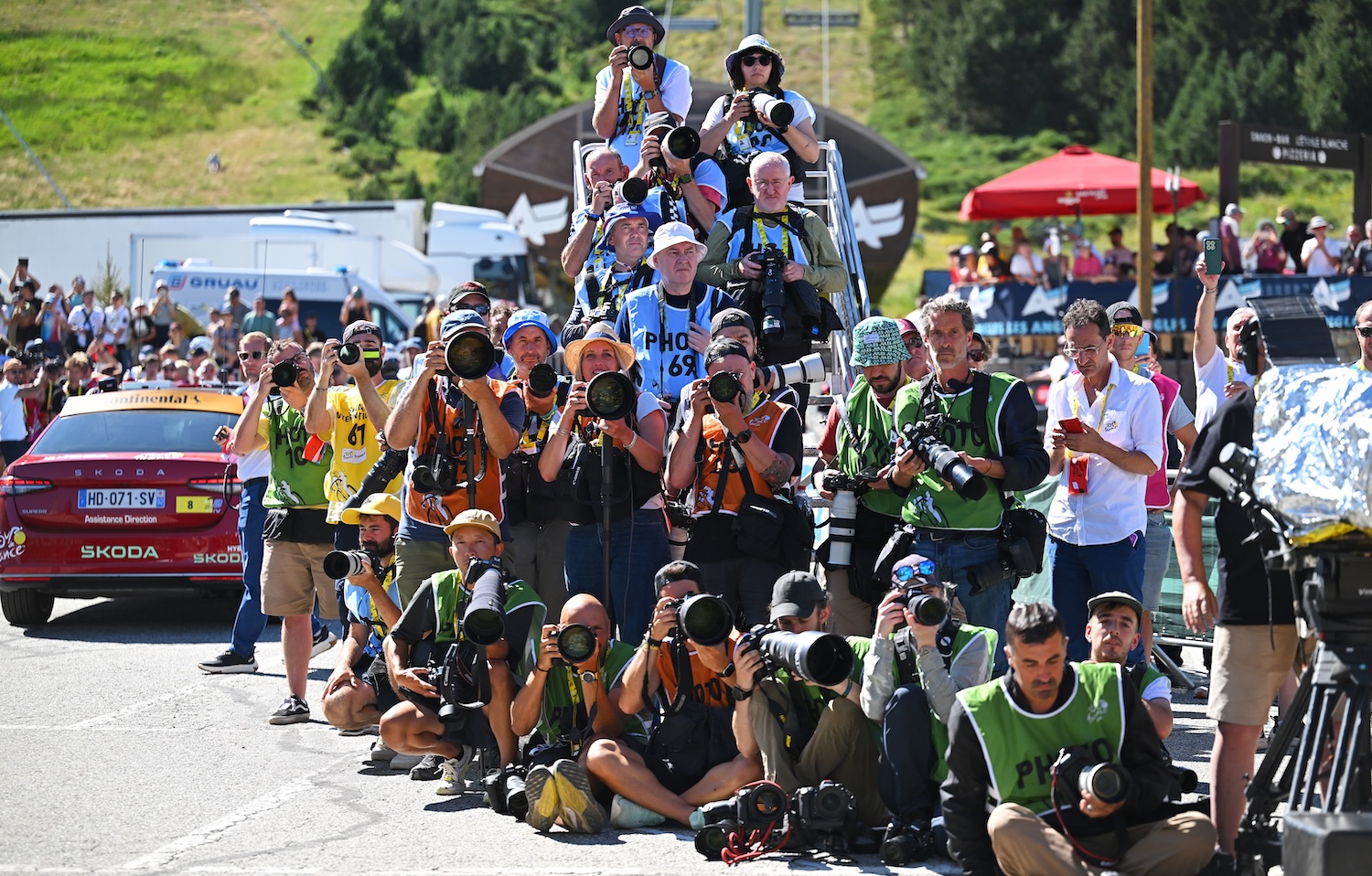
I wanted to experience the Tour as they do, to learn about how we each tell the story of the same race in different languages. Photographers are an essential piece of the Tour de France's press corps, one with responsibilities, incentives, and perspectives distinct from those of a print reporter or TV person. The operative difference is that writers rarely get to see any actual racing, since doing so is almost always an active hindrance to doing our jobs, whereas a photographer's value depends entirely on their ability to see the race and share that vision. The Tour de France is simply too much for any one method of observation to account for everything. You can cover the race as a magician or a surgeon, in the Benjaminian sense, but not both. So how does being a photographer work at the Tour de France?
"We hate the photo motorbike because it's always filled with fucking morons who've never shot a bike race," Williams says, as said motorbike passes us. L'Equipe and Tour organizer ASO have their own photo motorbikes, while the privilege of getting to rotate into one of the precious few open seats on the moto for everyone else is often reserved for "some local guy." This seated yokel is lazily shooting with an iPhone, failing to take advantage of his freedom from the defining burden of the photographer: having to find and access spots. We've relocated from the sunflower field to a regular field, and we're here to take a "quintessential" sky shot. Perhaps, I asked, of those interesting clouds over there? "I think those clouds are ugly," Talbot said. Like our now-abandoned sunflower patch, this field is the product of Talbot's granular scouting. He traveled through all 21 stages via his homemade form of VR last month, looking for places that had the precise combination of elements to frame a shot, place within the day's course, and access to escape routes.
That last bit is critical. The second you shoot your photos, the clock starts ticking. You have to get all the way around the front of the race to get back on the course, which involves hauling ass down narrow backroads and convincing capricious police that you're worth moving the barriers for. It was especially difficult on Stage 11, which wound up being the fastest stage in Tour history. "The photo guys have a way harder job than the TV moto guys because they have to keep getting ahead of the race," said NBC's Steve Porino, who's spent plenty of time on motorbikes.
"Yesterday was fucked," Williams said. "Because there were like four or five different roadblocks where we just got told, You can't come in." Talbot agreed: The worst part of the job was "constantly being told you’re not allowed to do things that you are."
Why subject yourself to this? The amount of money photographers can make varies wildly. "We came here for three years and made no money," Williams said. "To start in the industry, you have to make a name for yourself." The Tour's photo corps is larger than any other race's, with the best photographers in the business (they agree it's the husband-wife duo of Ashley and Jered Gruber) joined by ambitious retirees living out their dream of shooting here and upstarts who know they won't make anything but connections.
"When I came to Europe, I didn't really know anyone," Talbot said. "I lived in a car, bounced around, and met as many people as I could. I would go work back home in New Zealand in the winter, then spend all my savings trying to make it here. The process took a couple years. My second year, I almost broke even." Eventually, he made enough connections to assemble a steady income's worth of clients, though there's no stability in the cycling photography business. "Everything's on a year-to-year contract, but in the winter you have to do the dance again," he said. "It all comes down to budgets and where marketing dollars get allocated, where staff go and stay. You can have strong relationships, but at the same time, it feels a little fragile."
Cycling photography is a hits business, and at the 2025 Giro d'Italia, Talbot took what Williams termed one of the best cycling photographs of the last decade. What was the secret to shooting the switchbacks in such an evocative way? "I just kept walking, then I turned around, and it looked good," Talbot deadpanned.
Back on Stage 11, luck was also on our side: Williams nimbly handled us back into position in time to get into a short argument with a quartet of surly gendarmes. He charmed them into moving the barriers, which wouldn't have been possible if I'd tried. "If we didn't speak French to them, they would've just told us to fuck off," he said. After getting sky shots in the field earlier, Talbot had two potential spots in mind in Saint-Léger-des-Vignes: a bridge and an underpass. The bridge wasn't quite right, so on we went. The underpass was better. The three photographers inspected various angles, set up, and prepared to "spray and pray."
This was the single biggest lesson of the day: the ridiculous level of uncertainty on the job. If you run the gantlet of cops, and if the riders you need to shoot are in the right position, you still only get one chance at a usable photograph before the riders are gone. "You can be in the middle of nowhere and some rando just stands up and fucks your shot," Williams said.
In the first field, Fries didn't get what he needed, since the Red Bull guys were on the other side of the road. "People think it's easy," Williams said. "They think we just get to go travel and have fun. I’ve been to Rome four times to shoot the Giro, and I haven't even seen the Coliseum."
"Marketing people don't understand that you can't control everything," Fries said. "Red Bull is so demanding, because they're used to organizing their own sporting events where everything is built around getting the shot. But I have to explain to them that here the limits are so high, and the stuff we can do is super low." Things turn out well for him in the village, as the Red Bull guys rip through town in tight formation in the bunch.
Witnessing the speed of 170 of the world's best cyclists slamming it past you is thrilling and a little scary, though more than any other sensory element, I'll remember the sound. The peloton sounds like a million cicadas trying to whisper the same note, like a chorus of fishing reels, like a metallurgist's attempt to convey the sensation of wind. The sound is clean and intense, conveying with it the danger of life at these speeds and the tremendous skill it takes to maintain them. That's the sort of sensation anyone covering the Tour, photographically or journalistically, tries to translate for their audience. Talbot, Williams, Fries and I are experiencing the same thing, and the different mediums we use will necessarily catch different textures. Or, to use one picture instead of three similes, here's the shot Fries took in Saint-Léger-des-Vignes.
"Cyclists, more than any other sport I've seen, hate the media," Williams said. "All you do is write about them, and you have to really get to know them as people before they trust you." Most riders don't want to do press at all, and a handful of teams, most notably NetCompany-Ineos, treat us with undisguised hostility. But riders love the photographers. "Cyclists are deeply vain people," Williams said, "and we take photos of them that make them look cool. They even want crash photos because they look baller."
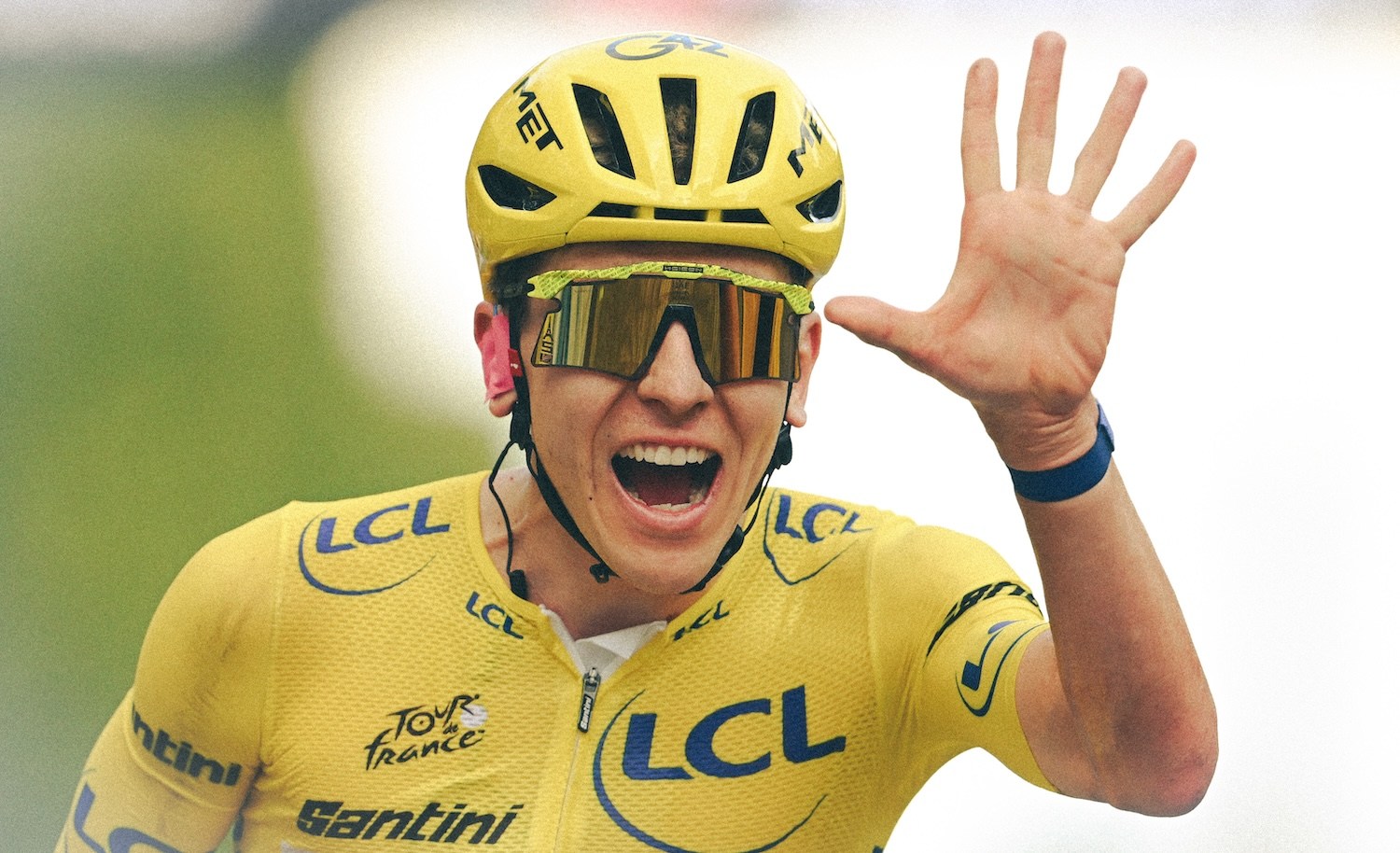
Who looks the coolest? They rattle off some favorites: Mathieu van der Poel, Wout van Aert, Remco Evenepoel, Filippo Ganna. "As much as I hate the domination of Pogi, he looks so good on a bike," Williams said of Tadej Pogacar. "Imagine if Pogi looked like Chris Froome did."
Fries and Talbot's favorite race to shoot is the Strade Bianche. "Teams care about it, it’s beautiful good racing, everyone tries hard, so there are good expressions to shoot," Talbot said. "Today they don't look like they're trying. There's more emotion, more tension in their faces when they're riding hard."
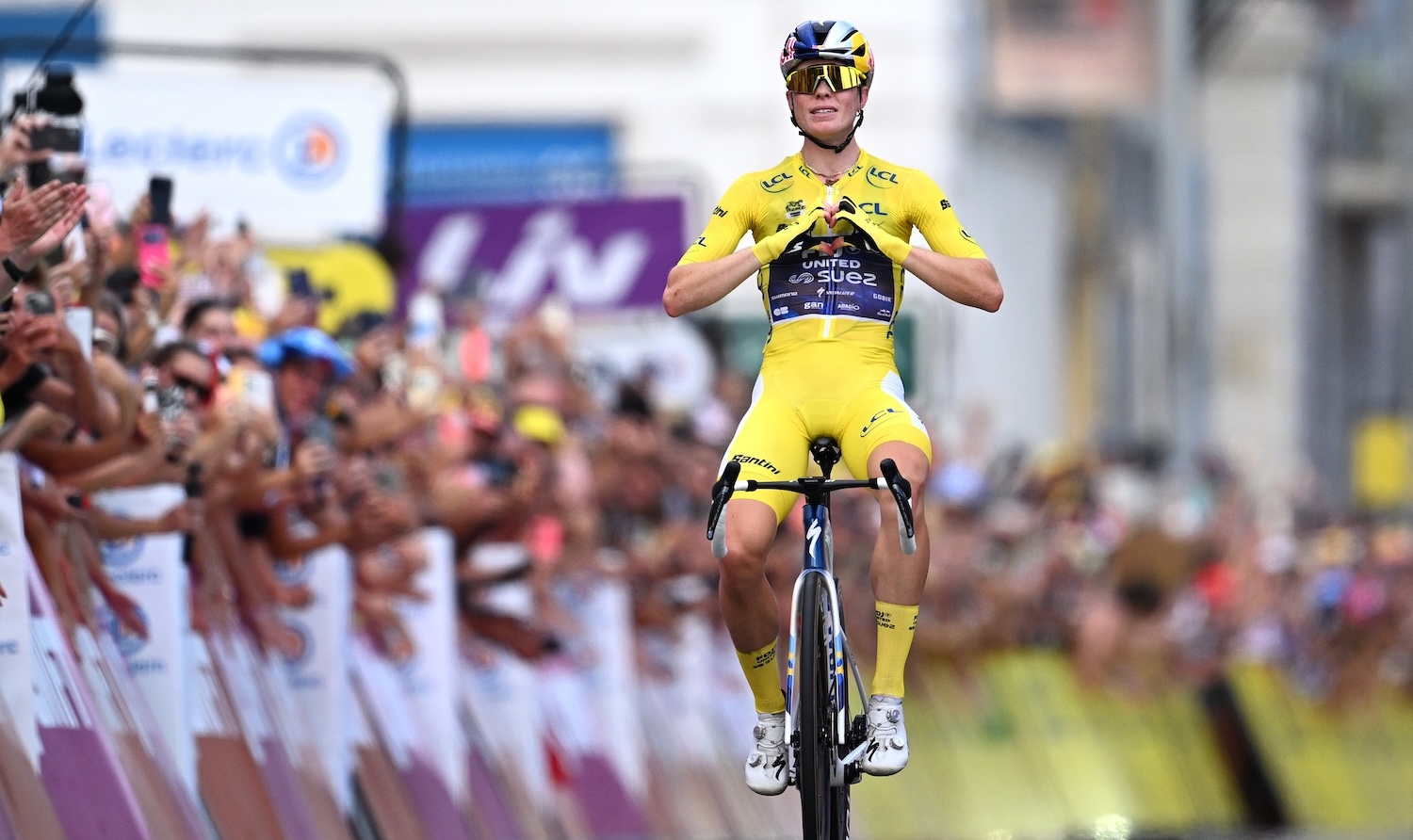
That answer hints at the power of a photo as a distinct storytelling device. Even if our subject is identical, say, Søren Wærenskjold winning the sprint that afternoon in Nevers, a photograph can show what I can only tell. In exchange, I can draw readers a picture of what's outside the frame. But while the writers and the photographers have different responsibilities, unequal access to the press buffet—it's ravaged by the time the photographers get to the finish—and divergent relationships with our subjects, we need each other. There's a symbiosis here, a necessary one given that the race we're writing about defies complete explanation in any one language. That limitation is itself beautiful, as are the various methods of scrabbling toward it. We're the blind men describing an elephant, and if we can't take in the whole thing, we can hopefully give a sense of how massive and awesome it is.
The day's racing ends in a sprint—a mostly boring, narratively inert outcome for me, but not for Williams and Talbot. When it comes to sprints, "the worst ones are the close ones, because nobody has time to celebrate," Williams said. Things break his and Talbot's way: Wærenskjold crosses the line, pumping his fist in exaltation. They get the shot.