There are broadly speaking two types of gamblers: valuable and not valuable. All are referred to as customers. The latter group are dilettantes. These people deposit maybe once or twice, usually to take advantage of a first-time deposit promotion, but rarely or never again after that. Maybe they don't care much for sports, or are turned off by the way betting on sports makes watching sports miserable. Or maybe they tried the slots, and the slow drain of money down to zero left them feeling empty. Whatever the case, they don't have the itch. These customers are not valuable.
I learned to sort gamblers into these categories during the years I worked for an online sportsbook. I worked in customer service, at first directly with customers and later in a more behind-the-scenes role. These jobs required a little bit of detective work, and I often found myself wading through piles of extremely detailed personal information about our customers. Names, addresses, payment history, net losses, geolocation, remarks left during previous customer service interactions; all of this was there for me to review any time there was a problem with a customer that needed to be solved. Through this process I got intimate looks into the lives of strangers.
What I came to understand while doing these jobs is exactly what kind of customer is most valuable to an online gambling company. All gamblers fall somewhere on a spectrum from habitual to compulsive to addicted. Addicts may be technically valuable customers in that they deposit regularly, but they are not desirable customers. You don't want your customers killing themselves or losing all their money. How then could they continue to deposit?
All companies have varying levels of safeguards in place to weed out this type of customer, but most of these safeguards come into action when it is already too late. Customers don't set limits on their accounts until after they have done something bad, if they ever set limits at all. Customer service agents are trained to recognize signs of addiction when players reach out, but most customers never actually reach out to customer service, and therefore their addictions can't be caught this way. Using too many different credit cards in a row might trigger a temporary lock on your account, but this type of control can't be too tight, lest it begin to interfere with the not technically addicted but still habitual depositors. This all raises the question: How do we separate the addicted from the habitual, ideal customer?
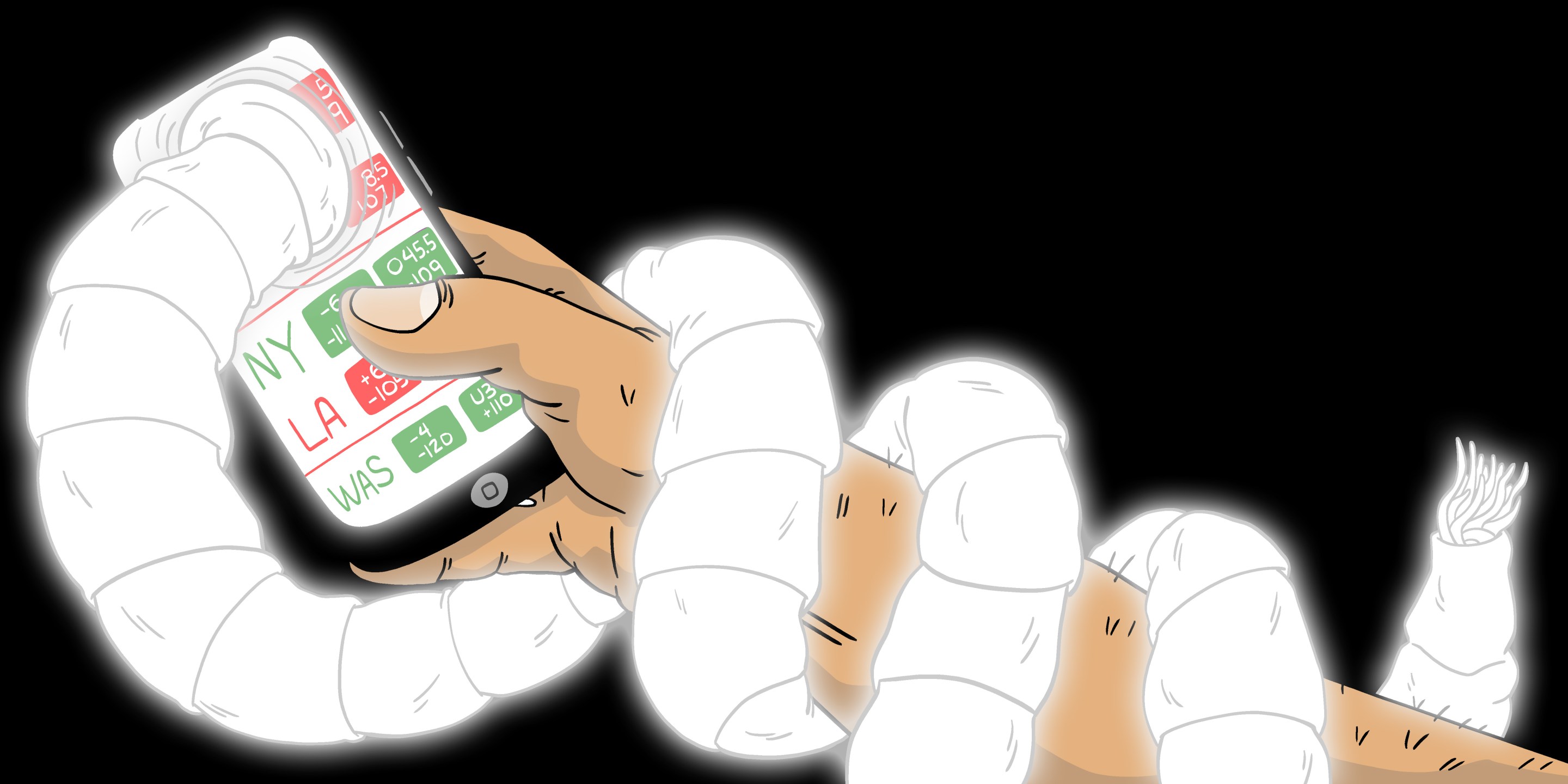
Maybe this ideal customer deposits 10 percent of his monthly earnings, and still keeps up with his house and car payments. But he and his family will suffer from that loss of income. And when an emergency comes, it will hit harder and reverberate longer. Like tapeworms, these companies prefer a consistent supply over time, and a dead host is no good at all. But the person is still parasitized, and is weaker for it. Are these people not addicts?
The more time you spend thinking about these questions and watching and interacting with gamblers, the clearer it becomes that the "ideal" customer, who deposits every day, week, or month, is suffering from a compulsion of some kind.
And we haven't even gotten to the darkest part of it all: the bonusing. All the mobile gambling operators award bonuses in the form of free bets or bonus money, which requires a certain amount of play-through before it can be converted to real money and withdrawn. There are a number of psychological tricks being employed here, all for the purpose of keeping the player feeling like they are getting to play for free. The ideal amount of bonus per player is a certain small percentage of their net losses. The calculations used to determine the right percentage and the methods used to award the bonuses vary from company to company, but each aims to keep their customers' wagering steady with the least amount of capital expended.
I never worked on the backend, so I can't say exactly what lizard-brained reward mechanisms any of these companies' algorithms prey on. But you can be sure that they are extremely effective, and only get more effective with time. There are people at every one of these companies whose sole job is to refine these systems, and they get paid the big bucks.
And now, thanks to the miracle of mobile computing, we can carry these parasites with us in our pockets. Not only can we, we must! If you want to talk to your family and friends, use GPS navigation, or "authenticate" yourself for your job or to visit your doctor, you will need a cellphone. As long as a cellphone is a requirement for life, there is no complete escape. You will always have a device on your person which can instantly transport you to a casino, and it will beckon relentlessly.
In the course of my job, I had to review many customer accounts, and certain patterns emerged. I examined the type of gambling customers did, the amount and frequency of their depositing, and the kind of neighborhood they lived in to get an idea of how underwater they were. I could look closer and see if they wagered first thing in the morning, or in the middle of the night, and see if they had a history of setting and removing "responsible gambling" limits from their accounts. I could see how often payments were declined, and how often the individual came to customer service to try wheedling a bonus out of a sympathetic agent. I could see the history of disturbing remarks they had made, and how many chargebacks had been threatened and carried out. I could see the remarks they made when closing out their accounts, and what they said when they begged to have them reopened. With a little googling, I could put together an even clearer picture of a life outside of the app. Obituaries, social media accounts, and local news all contain a lot of information about individual tragedy, pain, crime, and bankruptcy.
Many of the gamblers I dealt with stick with me, but two especially. The first was an old friend of mine from high school whom I had not talked to in years. I saw he had dropped about $10,000 in a few years before making a comment to customer service that got him mercifully banned from the platform. I could see from his geolocation pings that his location would move quickly from a gas station to a parking lot while wagering. He gambled while driving, it seemed.
The second was a young man I had never met, a decade younger than myself. He had a history of saying genuinely disturbing racist and threatening comments to customer service agents, and had eventually been banned for it. He had a distinctive name; a quick Google search led me to a news report of his recent arrest, and a social media account. The account had a history of sports betting talk interspersed with racist and sexist comments. But many years before this, when he would have been in middle school, there was an indication that he had lost both his parents. A set of public obituaries basically confirmed it. I could feel in my gut that this man, whom we had happily drained of what little money he had before kicking him to the curb, had really never stood a chance in this life.
I've heard all the arguments both for and against legalizing online gambling. What I think is missing from that conversation is the fact that it's not really just gambling online that has been legalized. What has been legalized is extraction, and the new methods of extraction that are possible using the internet and mobile devices. These companies have identified a group of people with a monetizable compulsion, and we have legalized the tools needed to industrially harvest money from them.
Our state governments are happy to comply as long as they get their cut, and this "windfall" comes without having to tax the billionaires and their conglomerates who already own most of the country. It all functions like a privatized tax, where people pay based on how bad they have the "itch," with most of the revenue going to corporations. With mobile gambling, these companies have not only been allowed to insert themselves into our sports leagues and news organizations, but also into our homes. Formerly, gambling executives had to build great temples to which the willing made pilgrimage, and from which they were able to leave after taking their beatings. Now these CEOs are in our living rooms, bedrooms, kitchens, bathrooms, and cars. They sit on your hip wherever you go, with a hand waiting over your wallets and purses. And we have let them do it.
In a given year, around 15 out of 100,000 deaths in the United States come from suicide. Among gambling addicts, this rate is multiplied 15 times, according to studies. DraftKings reports 4.8 million users, and FanDuel reports 4.5 million. Among those millions of customers are a significant number of customers whose lives are being steadily worsened by gambling, and among those customers are people at high risk of suicide who might never have been put in such a precarious position had they never had a portable casino put in their pocket. Perhaps our gambling tech overlords have factored this in as the cost of doing business, or perhaps they don't think about it all. I don't know if any former customers of the company I worked for killed themselves, but I do remember days when gamblers frustrated over a disputed payout or a bad beat would threaten suicide, necessitating a quick locking of their account followed by a call to their local police department for a wellness check. All the cases I followed up on ended with police reporting an embarrassed and annoyed but physically unharmed person. Knowing it was inevitable that one of these cases would eventually have a much darker ending became too much, and so I quit.
Though the damage I did while at the company cannot be undone, I can sleep a little easier now knowing I am no longer a part of that rotten business. I encourage everyone else working at these companies to do the same as I did, and quit. The job can be walked away from; the casino, on the other hand, follows you everywhere.
If you have experience working in the gambling industry and would like to tell us about it, email tips@defector.com.