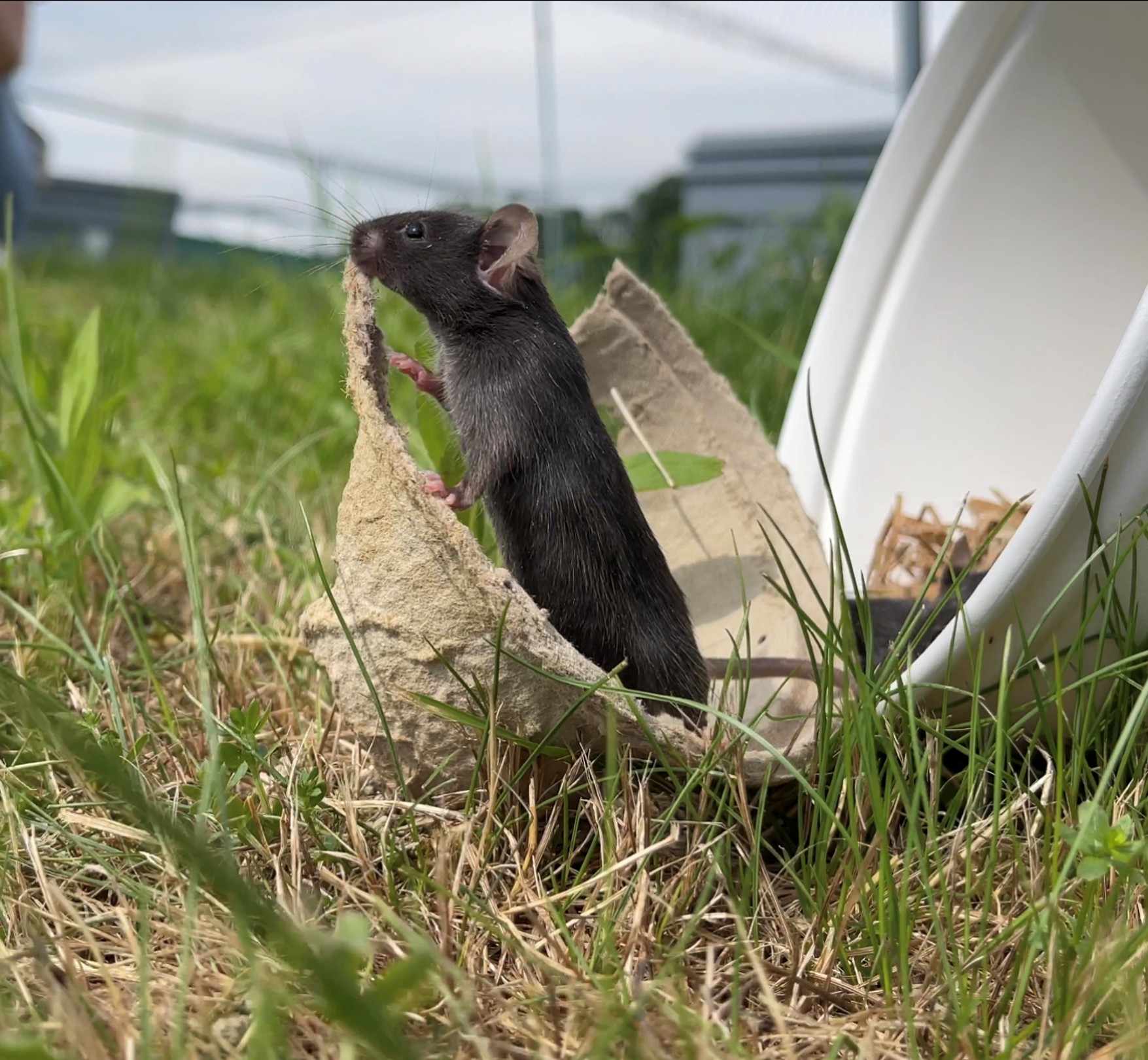
Each time Matthew Zipple, a behavioral ecologist at Cornell University, releases a mouse that was born and raised in a laboratory into the green expanse of a field, he is amazed. He transports the mouse in a paper cup, lays the cup on its side in the grass, and takes off the lid. "When the lids come off it’s like they are on another world, from their perspective," he wrote in an email. "There are a million new smells, there’s grass, there’s dirt, there is sunshine."
The mouse's new world is an enclosed field approximately 10,000 times the size of their shoebox-sized cage. The field is full of other former laboratory mice, each of whom lived the same shoebox life before the field. Within a few days, the mouse has explored the entire enclosure. "They are doing things that they couldn’t do in the lab and that their ancestors haven’t done for dozens of generations—things like bounding over grass and digging in the dirt," Zipple said. In the field, the mice build nests, dig burrows, and find their own food. They choose which mice to socialize with, and when. For the first time in their lives, they experience weather.
This rewilding experiment is the subject of a brief paper recently published in Current Biology by Zipple and colleagues. After rewilding a batch of laboratory mice, the researchers discovered the mice's learned fear and anxiety responses were utterly transformed by their time in the field. The research offers fresh insight into what conclusions scientists can accurately draw from lab mice research, as well as how people might live less anxious lives.
There may be no life more standardized than that of a laboratory mouse. Lab mice live in cages in rooms with strict controls for temperature, humidity, light, and noise. They often have limited social experiences. Even the mice themselves are standardized; researchers can order a batch with the exact same genetics, with whatever distribution of age or sex they require. These environmental controls exist to ensure the research is reproducible. "It allows for clear experiments, where many potentially confounding variables can be held constant," Zipple said.
This strict set of standards has real-world implications for both lab mice and people. For the mice, they enter and leave the world knowing only a small, static sliver of it. For people, less than 10 percent of drugs that succeed in preclinical trials in laboratory animals like mice or monkeys are eventually approved for human use, Zipple said. "What explains that huge gap between laboratory results and translation to the real world?" he asked. "I think that much of it is explained by the environment of the lab itself."
According to recent evidence from lab groups including Zipple's, some traits studied in laboratories can be generalized to the challenges and complexity of the outside world, but others cannot. Last year, Zipple and colleagues found that the rate of biological aging differed between lab-reared mice living in fields and mice living in labs.
As such, Zipple's research adds to a growing body of evidence that these clear-cut lab experiments do not always hold true in more complicated environments, like the wild, or in more complicated subjects, like in humans. He suspects the confining nature of the lab could have the greatest impact on drugs intended to treat behavioral issues such as anxiety and depression. He and his colleagues wanted to investigate what would happen if mice that had only ever lived in a lab environment were to enter the real world. How might they be transformed, and how would these new experiences affect the way they behaved in studies?
The experiment began with the elevated plus maze, a common tool used to test rodent anxiety. The X-shaped maze has two arms that are open to the air and two that are enclosed like a hallway, offering the mice the option of open space or security. The arms are elevated nearly 20 inches off the floor—a real plunge for a mouse. When lab mice are exposed to the elevated plus maze, they develop a fear response and avoid the open arms of the maze in future tests. After the researchers exposed dozens of lab mice to the elevated plus maze, all the mice developed a fear of the open arms. When they returned the mice to the maze a second and third time, the rodents' anxiety heightened, as they spent even more time in the enclosed arms.
Then, the researchers moved half of the mice to the field and kept the others in standard lab conditions. After a week spent romping around the field, the rewilded mice returned to the maze. There, the researchers were shocked to discover that the mice returned to the levels of fear they displayed in their first exposure to the maze, not the heightened fear of their second or third go. In other words, the field had "reset" their fear response. In designing this part of the experiment, Zipple remembers thinking, "That would be crazy if it worked, but let’s try it." Lo and behold, it worked.
The researchers are not sure how what aspects of the field transform the mice. Is it as simple as a return to nature, an environment that the mouse's ancestors knew well? Does the field merely represent a more complex and unpredictable environment that offers the creatures more experiences? "We can’t disentangle those two things here," Zipple said. For humans, at least, research suggests that spending time in nature can decrease both acute and chronic anxiety.
But the researchers believe the change in the behavior of the mice comes down to agency, meaning the creatures' ability to change their environmental experiences as a result of their behavior. A mouse has extremely limited agency in a cage. It can move around, but that's basically it. "It cannot change its social environment. It cannot dig. It can’t reliably avoid or seek light or different temperatures or hunt for food. It doesn’t run inside its nest when it starts to rain," Zipple said. "All of those are things that our rewilded animals do in their daily lives."
In this way, the new paper offers a model of how behavioral research might be conducted on mice in the future. Instead of studying mice that live and die in the lab, researchers might study mice that live complex lives in a real-world environment. "This isn’t to say that drug development shouldn’t begin with laboratory testing—it definitely should," Zipple said. But he believes more research should include another stage of preclinical testing on animals living outside laboratory conditions to help determine which drugs might be safe and effective for people. Drugs that succeed both in the lab and in the field, if you will, are the ones with "the best promise of spanning the translational gap from mice and monkeys to humans," Zipple said.
Exposure to novel experiences, the researchers suggest, is crucial for any study of fear or anxiety. Of course a strange maze would terrify a mouse that has only ever known a shoebox. But what of a mouse that has explored a vast field, ran from the spatter of raindrops, felt the warmth of the sun and the chill of night, and dug into the living soil of the Earth? To a mouse that has seen the world, an elevated maze is not such a big deal after all.