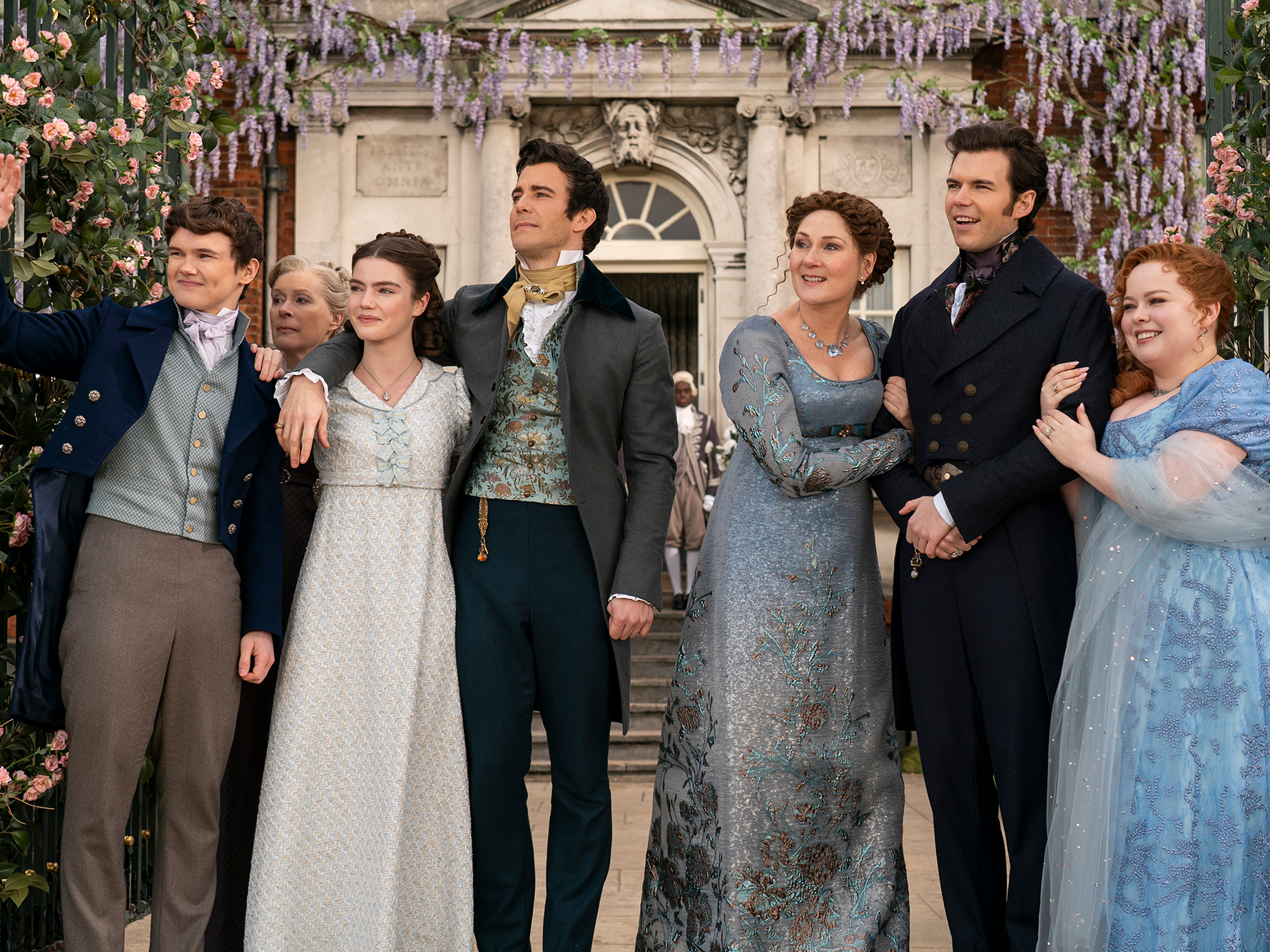
In the world of Netflix’s Bridgerton, the wildly popular Regency romance adapted from an equally popular book series, some things are constant: The women wear organza and brocade gowns; everyone takes long walks in manicured parks, and longer reclines in ornate sitting rooms; there is always a ball to attend; and these balls will feature string-quartet covers of modern pop songs. Everyone is trying to find their love match, and everyone is desperate to impress the queen. The women are women—pure, proper, dainty, skilled at the pianoforte or embroidery—and the men—strong, brusk, and sexually experienced—are men. Racism has largely been vanquished, but patriarchy triumphs. Actual patriarchs, however, do not fare so well. There’s something else that remains constant throughout every season of Bridgerton: All the dads are dead.
Yes, all the fathers are deceased. I wouldn’t blame you if you’ve never noticed—it’s not an obvious conceit of the show as much as a quiet pattern, like the showrunners are trying to MKUltra millennial women into believing that you can only fall in love if your father exists solely in postmortem flashback. But it’s true. Each season follows a different Bridgerton sibling as they find love in high-society London, and their father Edmund is dead, so that’s half of the lovers’ dads in one go. But their romantic counterparts are also always fatherless: The Duke of Hastings, Kate Sharma, and Sophie Baek, the love interests of the first, second, and fourth seasons, respectively, have lost their fathers to unidentified illness, while Penelope Featherington, fortunate enough to have a living albeit somewhat distant father through most of the first season, loses him to murderous bookies by the time her love story arises in Season 3. Even the young Queen Charlotte, whose story is told in the show’s eponymous spinoff series, is apparently fatherless; it’s her brother who arranges her marriage to the recently ascended King George. George, obviously, just lost his father, too.
But while the protagonists may be fatherless by the time of their courtship, the show is sort of daddy-obsessed. Mothers are always telling their sons what their father would have thought of their behavior (usually negative, at the beginning, and positive toward the end when the young man has found love); young lovers are either aspiring to the love their parents had, or actively seeking to avoid it. Each of the seasons’ lovers has some kind of daddy issue which drives the narrative. Simon’s abusive father was desperate to maintain his bloodline, and the season’s main conflict centers around Simon’s refusal to have children as revenge. Antony’s father was a good, dutiful patriarch, and as a result, Antony struggles to negotiate a perceived conflict between his affections and his obligations as the head of the Bridgerton household. Kate is eager to marry off her younger sister, abandoning the possibility of her own participation in the marriage mart, because her father’s death has left her responsible for the family. Penelope’s absent father threatens her propriety—her season is characterized by regular reminders that she has “no male relation” to sponsor her through the marriage mart, a high-intensity environment in which she’s been consistently rejected due to her domineering mother, her family’s bad reputation, and her general inexperience with talking to men. And Sophie, of the show’s most recent season, is the illegitimate child of a nobleman who promised always to protect and provide for her. After his death, her stepmother asserts that her father left her nothing in his will, forcing Sophie out of high society and into work as a maid.
There are some obvious reasons why the show might prefer dead fathers to living ones. One of the primary operations of Bridgerton is to bring the romance genre to a progressive-ish audience of young women with an extremely ambivalent relationship to heteropatriarchy. And what does this audience want out of their love stories? Apparently, stories where young men and women are exceedingly limited by their gender, are aware of these limitations and initially resist them, but ultimately find a way to make the demands of a patriarchal society work for them. This fantasy is more easily maintained when the avatars of patriarchy are conveniently buried away.
Just as the audience themselves are inheriting and renegotiating their parents’ relationships to sex, marriage, and reproduction, the absence of fathers in Bridgerton force the young lovers to confront their responsibilities as newly minted adults in Regency-era high society. Simon is responsible for carrying on his bloodline, as is Antony, while Benedict and Colin grapple with their auxiliary roles as second and third sons in a family where their brother is the patriarch; Penelope, Sophie, Daphne, and Kate all need a husband for financial security and social acceptance, unable to rely on their fathers for protection. The characters are as aware as their audience of the ways their society oppresses women—Daphne complains that her brother has “no idea what it is to be a woman,” Sophie explains to Benedict that the girls of society are marriage-obsessed because they’re functionally raised to be breeding stock—but instead of rejecting the infantilizing strictures of their society, the women find happiness within the confines of their strict patriarchal world via the reformative power of True Love.
Consider Bridgerton’s first season, which follows the story of Daphne and the Duke. Daphne, the oldest daughter of the Bridgerton family, wants nothing more than marriage, children, and a husband as exceptional as her father was to her mother. She instead falls for the Duke of Hastings, her older brother’s college friend and notorious “rake.” In the first scene between them, they argue about the merits of family life: her for, him against. It is revealed through a series of flashbacks that the Duke refuses to have children due to the abuse of his father, whose primary concern was the continuation of the patriarchal bloodline. But despite the Duke and Daphne’s mutual enmity, and the Duke’s refusal to take a wife, the two form a sort of alliance to navigate the marriage mart, and, through a series of circumstances escalating their mutual sexual tension, find themselves drawn together and into a forced marriage. Not all is well: The Duke never wanted to marry or have children, and he and Daphne treat each other deplorably as they negotiate their newfound circumstances, most notably in a scene where Daphne commits what the show was later forced to characterize as sexual assault following public outrage, but is presented as sort of a justifiable revenge scheme. But, of course, Daphne prevails by uncovering his hidden pain, showing him that love can be beautiful and that he doesn’t have to be like his father, and the season concludes with the joyous birth of their first child.
Here, the show sublimates the characters’ dissatisfactions with society as more-or-less personal neuroses related to their fathers: Simon doesn’t want children due to trauma, not because of the oppression of the title system; Sophie can’t accept Benedict’s love because her father abandoned her, not because he’s her employer. These neuroses are ultimately resolved through the magic of a love match: Simon learns to open his heart to children, and the season ends with the birth of the next Duke of Hastings, the heir that Simon’s abusive father so desired and Simon so resisted before falling for Daphne. When the previous romantic leads return in future seasons, they’re usually serenely playing with their baby or organizing a ball or romping in bed with each other in an attempt to “produce an heir”—a far cry from their earlier selves, who are resisting or begrudgingly participating in the marriage mart as an economic necessity. The young men have left behind the burdens of their fathers’ shadows, and the young women once again benefit from patriarchal protection. Through love and marriage, they have renegotiated patriarchy in their favor.
And who is egging them on along the way, encouraging them to find their love match, telling them that “reformed rakes make the best husbands,” espousing the gospel of transformative love? Their mothers and aunties, their sisters, and the Queen. Lady Violet, the Bridgerton matriarch, is notorious for her advocacy of loving marriage as the ultimate aim in life. Meanwhile, courtship is played out as a sort of game for the Queen, who decides each season which young lady is the most beautiful, unique, and desirable, and then dedicates herself to proper matchmaking. She lusts for gossip, herself abandoned by her schizophrenic husband, the King, who is too unwell to lead the court—another absent patriarch, who appears throughout the seasons as an occasional, erratic reminder that it is Up To The Women to keep society moving forward.
For the show to work, it can’t be men who are telling these young women to play pianoforte, stuff themselves into corsets, or avoid untoward contact with their lovers. It has to be other women who are pushing them for an heir, telling them to forgive the men for their rakish behavior, encouraging them that marriage and children will be their greatest joy. When living fathers do appear—Cressida Cowper’s domineering father a prime example—their obsession with marriage and offspring comes off as evil and controlling. But when it’s women telling other women that marriage is the route to self-actualization, that Mary Wollstonecraft’s critical assessment of marriage “does not sufficiently value love,” we’re meant to find it inspiring.
Bridgerton’s trick over four seasons has been to bury fathers and elevate husbands. It’s worked on me, as I put it on and feel my Gender Studies degree gently smothered under tulle and organza. And it seems like showrunners are eager to push the conceit of “patriarchy minus patriarchs” even further next season, as it has been announced that Season 5 will depart from the books and feature a lesbian love story. However, even here, the story is structured by the space left by a departed male—John Stirling, Earl of Kilmartin, who dies of an aneurysm leaving behind his wife Francesca and cousin Michaela to fall in love on the Scottish moors. Whether the two women will manage to queer the Bridgerton formula, in which every female lead ends up happily subdued into wife- and motherhood, remains to be seen. But there’s certainly an opportunity here for the show to choose something different—for a woman to find happiness not by winning the game but by divorcing herself from it altogether, albeit only after her attempt at heterosexual marriage ends.
So far, the women of Bridgerton have only been able to grasp happiness when the various men in their lives have given it to them, whether through death, love, or both. The show offers a convenient fantasy, but a good man alone can’t resolve the trouble of patriarchal oppression—no matter if it's a love match.