This week, Rolling Stone published an article in which writer Marisa Fox interviewed hostages who were held in Gaza after Oct. 7, talking to them about how music helped them. The artists mentioned in the piece include Frank Sinatra, Bill Withers, and Avenged Sevenfold. What caught my attention was one specific paragraph that was illustrative of the low journalistic standard for writing about Palestinians, Arabs, and Muslims.
The part in question is about 40-year-old Moran Stella Yanai, who was held hostage in Gaza for 54 days before she was released. As you read the following excerpt, your vision might be clouded by some unexplained yellow filter, and the bootleg adhan used in every Hollywood film set in the Arab World will begin to involuntarily play in your head:
Singing above ground was risky, particularly for women, as it's haram (forbidden by Islamic law) for a female to sing in public. Yanai was so driven by desperation for food or water, she threw caution to the wind and began to chant “Tamally Ma’ak” [“Always With You”], a popular Arabic song, to one of her captors. “He was shocked,” she recalls, “but he came back and said, ‘Sing it again.’”
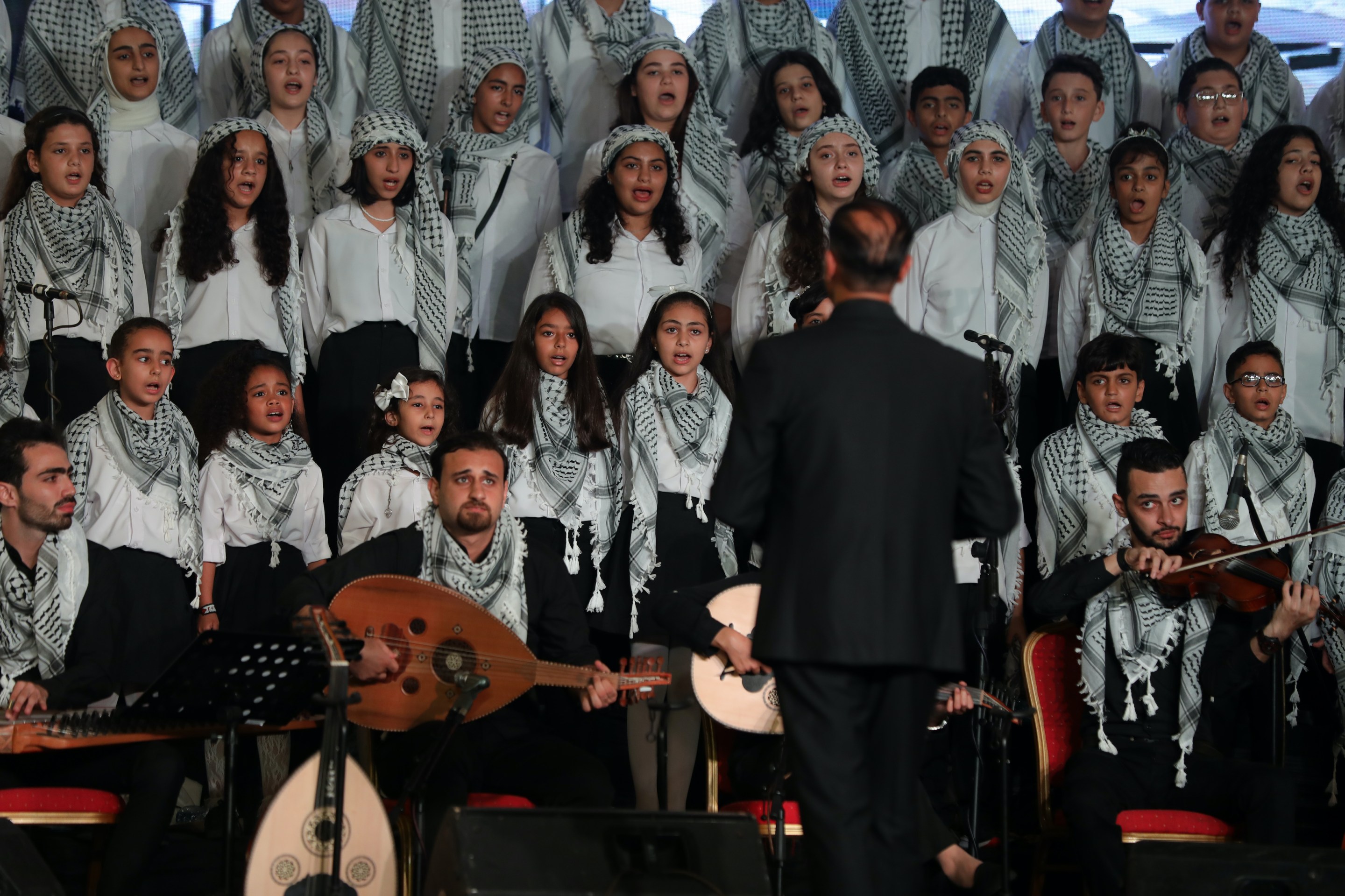
Setting aside a discussion on the cultural power of Amr Diab, that first sentence struck me as strange. For a while now, there have been Muslim women who sing in public. They even make careers from it. Diana Haddad, Haifa Wehbe, Nemahsis, and SZA are just a few of the artists who can be found around the world. In fact, in 2023, Rolling Stone ranked Umm Kulthum as the 61st-greatest singer of all time. There are some schools of thought in Islam that might disapprove of women singing, but to use them in such a sweeping statement would be like claiming all Christians forbid dancing, just because some Mennonites prohibit it.
Eventually someone at Rolling Stone realized this, because the paragraph was edited without a note. Here's what it says now (emphasis mine):
Singing above ground was risky, particularly for women. In Gaza, where Hamas rules by strict Islamic modesty laws, it is considered haram (prohibited) for women to sing to non-related men. Yanai was so driven by desperation for food or water, she threw caution to the wind and began to chant “Tamally Ma’ak” [“Always With You”], a popular Arabic song, to one of her captors. “He was shocked,” she recalls, “but he came back and said, ‘Sing it again.’”
This updated sentence is also lacking any evidence. About 10 years ago, the New York Times wrote about a Palestinian woman singing for crowds in Gaza City at multiple performances. For a recent example, with credit to the journalist Bradford William Davis: Middle East Eye posted a video in 2024 of two Palestinian women singing in a refugee camp. There's also a 2023 video of a woman named Roya Hassouna playing the oud and singing for children at a camp in Rafah. More generally, there is a rich history of Palestinian women and folk music, easily accessible to anyone with the internet.
I emailed the magazine's co-editors-in-chief, Sean Woods and Shirley Halperin, for more clarity; a spokesperson for Rolling Stone's parent company, Penske Media, declined to comment. Israel's restriction on international media entering Gaza has limited the methods of reporting available, so that might be one reason why a claim like this could be published. Another might be that you can write pretty much any baseless thing you want about Palestinians, Arabs, or Muslims, and very few people in positions of editorial power will object to it.