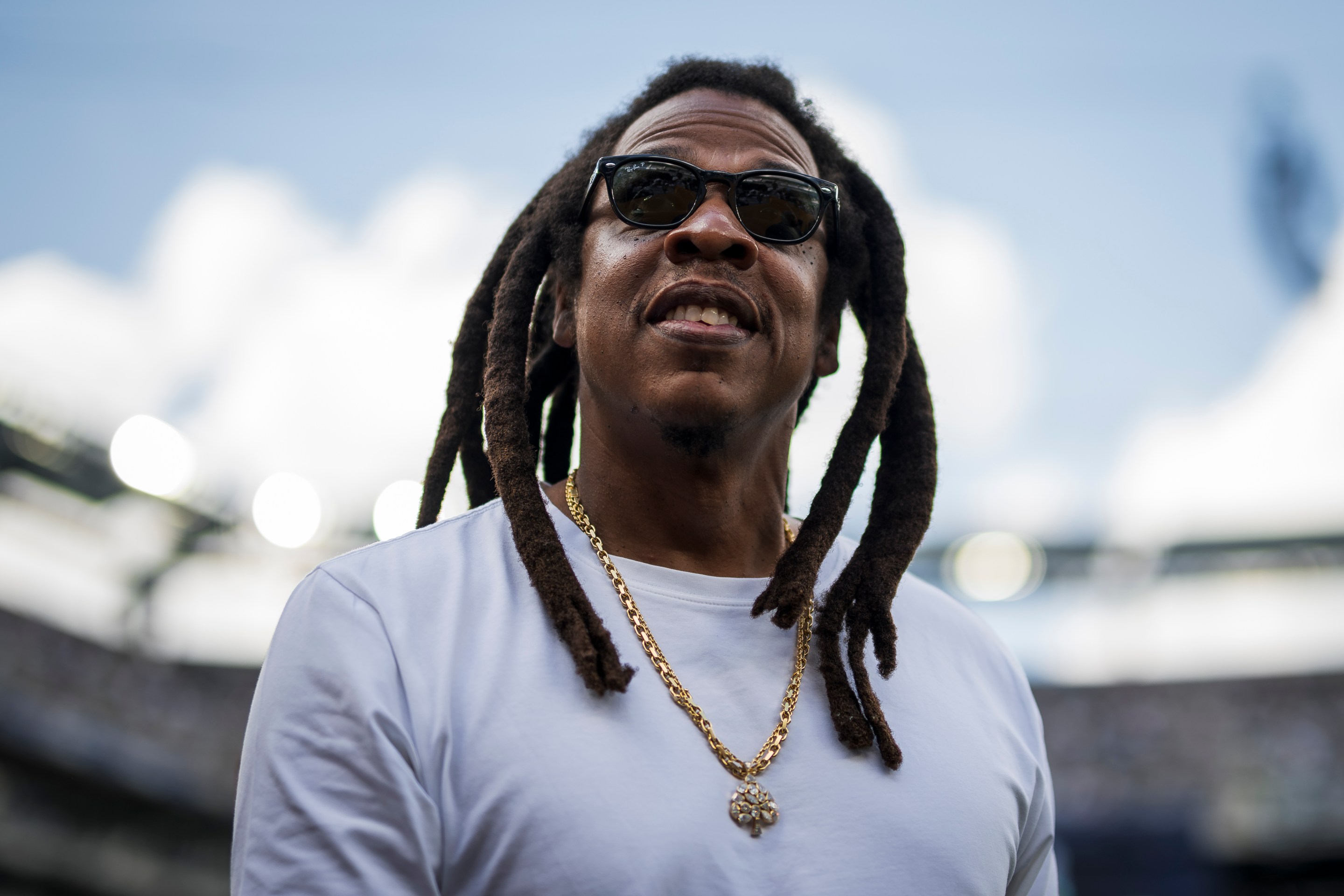
JAŸ-Z is coming back, umlaut included. Not that he’s been some kind of recluse the past few years, absent from the public imagination—he’s been doing evil billionaire things, laundering the NFL’s post-Kaepernick reputation through the grandiose production of the Super Bowl halftime, escaping Diddy’s dragnet, and somehow showing up as part of a fraud charge levied against the Uncle Nearest whiskey brand. Music-wise, he’s been quiet: no album, no single, no concert, no significant output since co-starring on Jay Electronica’s 2020 album A Written Testimony. The last time anyone was talking about him in a musical context was 2022, with the verse he did on DJ Khaled’s “God Did,” which was fine but mostly notable for being long.
But he’s back now, with a splashy new interview in GQ, headlining The Roots Picnic in Philadelphia and a couple of Yankee Stadium shows in the summer to satisfy our cultural love of anniversaries that are multiples of five. 2026 marks the 30-year anniversary of his classic debut album Reasonable Doubt, and 25-year anniversary of The Blueprint, the album that solidified his place as one of greatest rappers ever, if not the greatest.
The Yankee Stadium shows will no doubt be grand affairs: The online ticket queues clocked in at over 800,000 people for each, and of course sold out immediately; they’ve added another date they’re calling “extra innings.” They will likely include some expected special guests (Mary J. Blige, Eminem, possibly a Jaz-O reunion) and a few that might be a little more surprising: Nas, Snoop Dogg, Fat Joe, Slick Rick, and Q-Tip, who all feature in some way across these two albums. I don’t know, it’s JAŸ-Z; he might bring out Barack Obama and Oprah. People will spend hundreds and thousands of dollars to go scream every word of his songs back at the man and feel the euphoria of celebration. And Hov will make a few million dollars. Everyone involved will get what they want.
Which is all so, so boring. I have been a JAŸ-Z fan for more than half of the years I have lived on this earth, and if I could attend the Yankee Stadium concerts, I absolutely would, but also there is no part of me that wants to spend the money it would require. The “legacy artist puts on big to-do in celebration of their monumental album” thing has been done a million different times now. While I recognize the importance of hip-hop artists being afforded the opportunity to reach this point in a genre maligned as a fad and racistly dismissed as having no artistic value, the idea of it still draws me into a yawn. Especially when there’s another idea sitting right there, an infinitely more fascinating one.
Yes, Reasonable Doubt and The Blueprint have big anniversaries this year, but 2026 will also mark 20 years since his absolute worst solo album, Kingdom Come. That’s the Yankee Stadium show I would be eager to see. “[T]he wins are so big that I can see where that can dominate a person’s memory, that you forget the losses,” he told GQ, and Kingdom Come was a massive loss. Even he knows it. Billed as a comeback album after his so-called retirement in 2003 with The Black Album, Kingdom Come was an artistic low point that has managed to get even worse over time. Hov grabbed a few pretty good Just Blaze beats that sound like lesser versions of better Just Blaze beats, some bottom-tier Kanye West and Dr. Dre tracks, and perhaps the worst Neptunes beat in existence, and slapped together an album that sounds so desperate to re-establish his relevance, you might have thought we really were in some kind of JAŸ-Z drought that could be quenched by any dribble from him.
We weren’t. He hadn’t gone anywhere. He showed up on songs with Kanye, Beyoncé, Bun B, Young Jeezy, Rick Ross, Lupe Fiasco, dead prez, Pharrell, Memphis Bleek … there was plenty JAŸ-Z in those three years between solo albums. He starts Kingdom Come by sounding the alarm, that hip-hop was losing its way (“The game’s fucked up, niggas beats is banging/Nigga your hooks did it/Your lyrics didn’t/Your gangsta look did it,” as if he didn’t admit a few years before that “I dumb down for my audience to double my dollars”), which in 2006 simply wasn’t true. Nas may have been declaring Hip Hop Is Dead, which someone is always saying, but even if 2006 wasn’t 1996, it was damn good: J Dilla’s Donuts, Remy Ma’s There’s Something About Remy, E-40’s My Ghetto Report Card, T.I.’s King, Ghostface Killah’s Fishscale, The Coup’s Pick a Bigger Weapon, Ice Cube’s Laugh Now, Cry Later, Outkast’s Idlewild (underrated), The Roots' Game Theory (album of the year), Lupe Fiasco’s Food & Liquor, Lil Wayne’s Dedication 2 mixtape (not my cup of tea, but I respect that it was a thing), The Game’s Doctor’s Advocate, all released before Kingdom Come, and then we got Snoop’s Tha Blue Carpet Treatment, Clipse’s Hell Hath No Fury (right there with Game Theory), and Young Jeezy’s The Inspiration. Maybe you hated Jibbs doing “Chain Hang Low,” but hip-hop fans were hardly hurting for worthwhile output at the time.
In 2006, the game didn’t need JAŸ-Z, which couldn’t feel good for a man who had positioned himself as hip-hop’s marquee talent, the one who could deliver when everything felt adrift. That insecurity is everywhere on Kingdom Come. No one needed his indictments of hip-hop on “The Prelude,” “Oh My God,” or the title track. His lessons in being a grown-up which were actually lessons in being rich (“30 Something”), or a Cam’Ron diss (“Dig a Hole”). Absolutely no one needed to hear him try out a sexy voice next to Usher (“Anything”) or strain to make a statement about Hurricane Katrina with Ne-Yo (“Minority Report”). And no one, anywhere, at any time, not even in the worst version of hell, has ever needed to hear what it would sound like for JAŸ-Z to collaborate with Coldplay. The whole thing was an exercise in placing ego ahead of artistic expression, coming up empty even on the ego gratification part.
I would love to see him perform it live. Not only because it would be the greatest challenge of his career to perform songs only a diehard stan and apologist would readily know the words to, but because it would be an opportunity to expand the ways artists engage with their legacies. Everyone is more than willing to turn over the process that resulted in magic, while only discussing their less-than-stellar work as a stepping stone to something better. It’s unthinkable to consider the failure on its own terms. This is JAŸ-Z’s chance to move culture again.
And this is bigger than him. A week before JAŸ hits the stage at Yankee Stadium in July, the country will no doubt be awash in big, dumb celebrations of the nation’s founding, it being the 250th year since the Declaration of Independence, with the current crop of American psychos in charge making it even bigger and dumber, glossing over our many ongoing failures, aggrandizing a country actively engaged in imperial regime change atrocities abroad as well as the terrorizing and killing of its own citizens. It’s not JAŸ-Z’s responsibility to provide counterprogramming, though I can’t help but daydream what it might look like to have someone of his stature model what it looks like to do deep, public reflection on what it means to fail—what it means to fall short of the standards and expectations you’ve set for yourself, then examine those failures and their relationship to who you’ve become, to consider the effort it takes to create and the difficulty of sustaining that effort, and figure out how to fold the failure into self-conception, even as it dogs you with regret.
For the past 30 years, no rapper has enjoyed the amount of critical, commercial, and street-level acclaim that JAŸ-Z has achieved, but it also hasn’t been 30 years of unbroken successes—he did not one, but two albums with R. Kelly. Forgetting, or obscuring, or neglecting, or deliberately repressing, we are very good at it. I’m interested in projects of remembrance that don’t lose themselves to the triumph found in nostalgia. I want us all to get better at remembering the worst we’ve done, to look at it honestly, to reckon with the parts of ourselves driven by fear, bitterness, greed, and anxiety. I want JAŸ-Z to explain why in the fuck he made that goddamn song with Chris Martin. Seriously, what the fuck was he thinking?
Since he's never going to come to terms with the moral bankruptcy of being a billionaire, the least he can do is give us that.