In 2012, a self-published author of erotic Twilight fanfiction, whose books had gained a large fan base online, was offered a seven-figure contract by a major American publisher. E. L. James's Fifty Shades of Grey trilogy would become the three bestselling titles of the 2010s in the U.S. (even Fifty Shades Freed, the now mostly forgotten end to the trilogy, outsold The Hunger Games). They would also sell over 150 million copies worldwide across 52 languages.
The impact was immediate: Op-eds were written. Bad prose was excerpted. Stock photos of fluffy handcuffs appeared everywhere. And, amidst all the endless discussions about ethical BDSM and "mommy porn" and what, exactly, women might want, fanfiction had suddenly become highly lucrative. Instead of asking what Fifty Shades meant for women, people should have been asking what it meant for publishing.
Some fanfiction authors and readers have always been deeply opposed to monetizing fanworks, seeing it as a fundamental betrayal of fanfiction itself. But the eruption of a subterranean erotic world into mainstream publishing has had more seismic effects than just irritating fanfiction purists. Fanfiction-originated romances, erotic and not, have an eye-catching presence in most bookshops now; this has fueled ongoing culture war content about the feminization of contemporary fiction, the degradation of literary standards, and whether men can even sell books anymore. Plus, the spectacular example of Fifty Shades has given fanfiction adaptations a reliably pejorative connotation. Adapting fanfictions can attract a very invested fanbase, but it has also always been freighted with accusation: of bad, melodramatic, cheap writing, and even of plagiarism, or a more nebulous kind of cheating.
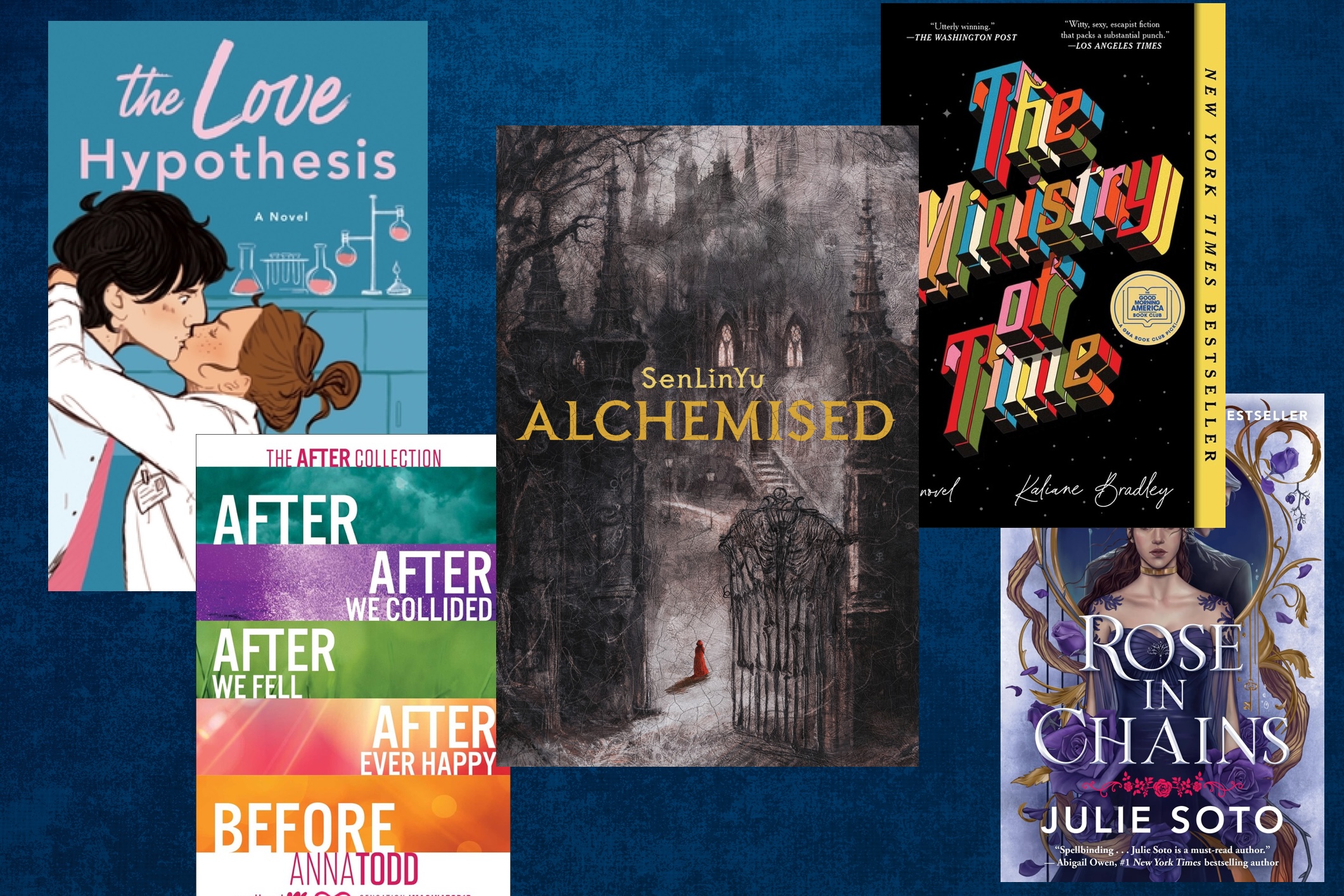
Not that this proved much of an impediment. The success of Fifty Shades soon buoyed a host of successors and similar novels, none of which are household names a decade on (though one, Gabriel's Inferno, was adapted into a 2020 film), but which sold well and whose collective influence can still be seen on bestseller lists. A year after Fifty Shades wrapped up, along came Anna Todd's After series, which originated as One Direction Wattpad fanfiction; they sold tens of millions of copies and were adapted into five feature films. In 2026, fanfiction's power over published genre fiction is arguably stronger than ever. Fanfiction's influence is no longer most discernible in specific, singular megahits. It has deeply shaped some of the highest-selling genres, particularly romance, young-adult, fantasy, and their hyperpalatable Frankenchild, romantasy.
Ali Hazelwood's college romance novel The Love Hypothesis, whose origins in Reylo fanfiction are so thinly veiled that the love interest is called Adam (as in Driver, as in Kylo Ren), is being adapted into a film where Adam is played by Tom Bateman, the real-life husband of actress Daisy Ridley, who played Rey in the Star Wars films. Meanwhile, no fewer than three adaptations of Harry Potter fanfiction, specifically Draco/Hermione ("Dramione") fanfiction, hit bestseller lists in 2025. The most famous of these is SenLinYu’s Alchemised, a 1,040-page behemoth horror romance in which a young healer endures a series of moderate to severe war crimes. The fanfiction engine is so powerful that even those who write entirely original fiction may find themselves drawn into its conventions. One notable recent example is Rachel Reid, author of Heated Rivalry; her books are not based on fanfiction, but when writing the story that became Game Changers, she adapted it into Captain America fanfiction and posted it on the AO3 fanfiction website in hopes of finding an audience for her work.
If I sound skeptical, I am, but I don't wish for said skepticism to be confused for a dismissal of fanfiction. Fanworks and fan cultures are, frankly, wondrous: engaged, constructive, tuition-free writing communities for writers at all levels! Massive archives that include works of serious ingenuity, talent, and feeling! Fortresses' worth of gay erotica! Fanfiction helped teach me, as an adolescent, how to write; it helped me learn how to articulate desire. Trouble has always lain, however, within the hunger to turn fanfiction into published fiction, and in how fanfiction's fantasies are repackaged for mass appeal. Jenny Hamilton has written for Reactor about some of the issues with this year's Dramione adaptations, which tap into an appetite for fantasies about a white supremacist enslaving an "ambiguously brown" woman, but make those fantasies more palatable by invoking dark romance, enemies-to-lovers, and the joys of moral ambiguity. Plus, they provide a convenient way to enjoy Harry Potter content for those who are a little on edge about J. K. Rowling's turn to anti-trans crusading. All three of the authors in question are unhappy about said turn; two of them, Julie Soto and Brigitte Knightley, told the Washington Post that they felt that Rowling's views had tainted the original material, but that fanfiction can be "an act of resistance against the created material." What, exactly, the novels are resisting is less clear.
Regardless of where you land on the ethics and efficacy of romances that originate in fanfiction, you likely don't think of fanfiction as something that influences more rarefied novels, outside of the sphere of genre. The writing of fanfiction is culturally associated with books that are popular, emotive, low-culture, and not very good on a prose level. Yet the most popular examples of the fanfiction-to-publishing pipeline are not representative of fanfiction's full influence; fanfiction is influencing high culture and high-ish culture fiction, too. It's everywhere, and if you think you've never encountered it, you are probably wrong.
"Writers of all stripes write fanfiction; I've taught in a prestige PhD creative writing programme for 20 years, and my students have always talked about their fanfiction," said Professor Anne Jamison of the University of Utah, one of the most eminent academic experts on fanfiction. "I know creative writing professors who moonlight writing very literary Hannibal fanfiction because it's fun, and someone will read it. I've even had quite avant-garde students use fanfiction, and that's interesting, because fanfiction is very affect-driven, and avant-garde practice really isn't."
It's very difficult to know exactly how many literary fiction authors dabble in fanfiction, or more than dabble; authors' fanfiction histories are kept to whispered rumors at bookish parties, lest the taint of the low spoil the careful production of a high-culture product. "From a profit standpoint, I don't even know why publishing houses market books as prestige anymore rather than middlebrow," Professor Sarah Brouillette, a specialist in contemporary literary culture at Carleton University, told me, "but I think they're trying to maintain the prestige of publishing itself." That prestige is maintained by insisting on an author's singular and original brilliance, untainted by a base desire to replicate someone else's success.
But using "fanfiction" as an insult or an accusation against those who write less overtly commercial works flattens our understanding of both. How might we discuss fanfiction's influence on published fiction in a way that acknowledges that we get something out of fanfiction, and its related forms? Can we reach a healthier vision of the relationship between fiction and desire? One way of doing that is by looking at the prestige novels that achieve a sort of lively fusion cuisine of fanwork and traditional publishing: well-written, enjoyable books that seize on the strengths of fan culture, their techniques, their intricate histories of feeling, and execute them successfully while also reaching beyond them, into the structural wholeness and self-sufficiency that is less of a priority in serialized fanfiction. It's worth looking at how they use and adapt features of fanwork, and how they manage to dodge the stigma that those features sometimes attract.
Kaliane Bradley's The Ministry of Time (2024) is an ideal recent example of this kind of hybrid project: a novel with clear roots in fanwork and fan culture, and which has thought about and transfigured those origins into an interrogative novel about desire, fantasy, and power. The Ministry of Time is a sci-fi romance, but one that has maintained a sheen of prestige for various reasons—its focus on British colonial legacies, its historical elements, its divergence from typical romance structure, and Bradley's own credentials. (Bradley is an editor at Penguin Classics and a former editor at Granta.) It was longlisted for The Women's Prize for Fiction. It is also one of very few novels in that space with legible fan-culture origins: The love interest in The Ministry of Time is Lieutenant Graham Gore, a minor character in the first series of AMC's The Terror.
Bradley is still somewhat short of an open fanfiction author; her statements on the subject read as careful. She has spoken of developing a pleasurable fixation on Gore after some spontaneous research while watching The Terror, and receiving research help from an online community of polar exploration devotees, who furnished her during the pandemic with their archives about Gore. Her interest led to writing passages of speculative fiction for her fellow enthusiasts, imagining what it would be like to have Gore as a roommate; a friend told her, after a series of installments, "I think this is a novel." This is a fanfiction pipeline—dabbling in speculative stories about characters for a group of equally enthusiastic friends, producing a manuscript fast and pleasurably—but Bradley avoids the term and avoids associating herself with fanfiction websites or any knowledge of fanfiction culture, instead keeping the story to a spontaneous literary game. Fanfiction is always treated as much less suspect if it's stumbled upon from first principles.
But regardless of these evasions, The Ministry of Time does not totally disavow its relationship to The Terror. It is the story of a mixed-race British-Cambodian woman (like Bradley herself) who is obsessed with a man from a foreign, unfathomable world—a world of ice, and of whiteness, and of men—and who is intensely conflicted about her desire to access that world. The novel's premise is that the British government has discovered time travel, and decides to experimentally pluck five people out of their time periods to determine whether they can adjust to the 21st century. Focusing on historical figures who died isolated from others, and who can therefore be picked up without wider repercussions, the Ministry rescues a freezing Gore, who is about to die on Franklin's famous doomed expedition. The unnamed narrator is assigned as his "bridge" to help him acclimatize to the modern world. The narrator is intensely committed to her charge, but her job has driven her into closer proximity with empire than she seems able to process. The story unfolds as part-romance, part-espionage thriller, but this thread feels like a microcosm of watching The Terror: loving the men, fearing for the men, but also knowing that these men represent the long, violent reach of colonialism into the furthest corners of the world.
The relationship between fanwork and tradpub can also be seen in the novel's treatment of queerness. Terror fanfiction is almost all gay; the show is, after all, about a group of 150 men bonding and dying in the Arctic, and most of the romantic relationships and emotionally charged friendships in the show are between men. But, throughout the history of fanfiction adaptation, contracts offered to authors of gay fanfiction have often been contingent on remaking the story as straight.
Jamison's 2013 book Fic quotes author Kara Braden, who prepped for and took such a deal for a Sherlock fanfiction, proselytizing about how her story "goes beyond" the shallow excitements of "OMG GAY SEX." It's a revealing passage: In it, the story being straightened—or available to be straightened—is exactly what marks it as mature or universal enough for publication, while the irrevocably gay stays underground, doomed to the realm of the childish and the unprofitable. The relationship between queer and straight narrative, here, resembles the relationship between fanfiction and original fiction: "Fanfiction is something you move past in order to grow up," Brouillette notes, "and 'growing up' means getting your own, saleable IP." Fanfiction adaptation has, too often, been a process of finding a story's queer pleasures and converting them into straight money.
Yet while The Ministry of Time is an M/F romance originating in an M/M space, and while its overarching straightness has likely contributed to its success, deviances from that straightness are essential to its plot. Graham has spent his life among men at sea, and has an ambiguous sexual history with men. The narrator is both intrigued by and frightened of Graham's manhood and attachments to men. Her relationship to him is somewhat Oedipal as a result; she is debilitatingly attracted to him, but, within her role as his carer, refers to him at times as her "overgrown son." Meanwhile, the narrator's intense, vexed, and at times clearly homoerotic relationships to other women prefigure a crucial twist in the novel's plot. If straightness is a passage that carries you toward an ideal, The Ministry of Time is more interested in when your ship gets stuck in ice.
In The Ministry of Time, the power and eroticism of the core romance directly helps the novel's political commentary hit harder. Some of the most successful and well-loved prestige fiction could not exist without the honed pleasures of non-prestige forms. Romance and speculative world-building can supercharge political insight, while pleasures, simple comforts, are themselves full of sociopolitical horrors, if the writer is willing enough and skilled enough to excavate them. But there is another element to all of this: that of labor, and how the writer's work has changed over time. "Writers are more expected, now, to show up already trained rather than training on the job; there's less space for editing, especially for those who self-publish," said Brouillette. "There's creative writing instruction, but it's so expensive, and many experience it as very exclusionary. Fanfiction spaces are becoming more important as places for training writers."
Writing novels is often very difficult and very lonely. There are things that make it easier, like writer's retreats, robust and supportive communities, and archival access, but they are often difficult to attain, and they are rarely abundant even for more privileged writers. Fanfiction provides many of the tools that writers struggle to access if they don't already have a professional network: friends, proofreaders, fellow researchers, a built-in and enthusiastic audience. It allows writers to get straight to experimenting with plot and dialogue, without the immense challenge of establishing a platform and a world and attracting readers from scratch. And in the gruelling publishing landscape of endless failed pitches and bad pay, it promises a rare vision: writing for fun.
In science fiction and fantasy, where fanfiction is somewhat less stigmatized, a plethora of prominent writers have talked about their fanfiction histories, from five-time Hugo Award winner N. K. Jemisin (a veteran of Dragon Ball Z fanfiction) to three-time Locus Award winner Naomi Novik, who literally cofounded AO3, one of the biggest fanfiction websites on the internet. It's not a stretch to believe that some literary fiction writers are quietly using fan cultures as a lifeline during their writing journeys, whether through direct participation or by indirectly resourcing their inexhaustible emotional energy. Who wouldn't want to learn from the people who seem able, day after day, to delight in writing without promise of pay or recognition—the exact condition of drudgery that is keeping so many from writing at all?
Literary agents have already spotted that fanfiction communities are useful places to recruit new writers. Every time a fanfiction adaptation gets popular, agents go hunting on fanfiction websites for new clients; there were cycles of this after Fifty Shades, and it continues to be a common practice in genre fiction. Both Ali Hazelwood and SenLinYu appear to have been scouted by agents who had read their fanfictions, and Rachel Reid's agent, Deidre Knight, recently told New York magazine's Book Gossip newsletter that she reads fanfiction to talent scout. According to Knight, "editors are looking for people that are coming out of fanfic because they understand the tropes and they understand what readers want. It’s driving trends on the publishing end a lot more than people realize." Fanfiction communities already function like shadow MFAs for genre, where candidates prove their capacity to build a brand and an audience from scratch, rather than their capacity to compete in the more exclusive, moneyed, craft-focused MFA world.
Yet pressure is building on authors in all sectors to provide evidence of brand-building; fewer and fewer authors are selected as rarefied ambassadors of their craft, and the rest of us are being queried about follower counts, maintaining Instagrams and Substacks, and doing our own PR. Fanfiction is both its own recruiting ground and a model for what is happening to writers everywhere, as the funds to train writers dwindle and self-training becomes the norm. What is Substack, if not AO3 for underemployed journalists?
Fanfiction adaptations are still usually a way for publishing houses to juice established IP, which rarely incentivizes artistic experimentation or high editorial standards. But fanfiction is also a rare site of voracious creative work without remuneration, resourced by a grueling books industry that needs to sell its workers a dream. As for readers, fanfiction offers things that many of us enjoy, regardless of our aesthetic tastes: emotional intensity, imaginative power, complex implicit worldbuilding, delayed gratification, love, sex, pain, pleasure. Literary fiction has a nervy relationship to its own pleasures, in case they undermine its capacity to edify and to challenge, though the class-based signifiers literary fiction uses to sever itself from more openly libidinal fiction do not alter the facts. We read fiction, most often, for pleasure.
The most rarefied classics can make you horny; they can be full of adventure, romance, twists, the joys of seriality, of payoff. But the shame of libido is so great that libido is treated as something apart from literary skill, and skill is anyway expensive. We are drowning in novels that, no matter what pleasures they offer, still leave us a little dissatisfied. Meanwhile, every novelist who does write deliriously pleasurable and skilled books arrives like a miraculous accident, and may be so unintelligible to a bifurcated market that it takes years to find them. But when we do find them, we may owe stranger thanks than we know.