
Everyone is trying to get to the bar. The name of the bar? The bar is called Erewhon.
This past January, I spent a long weekend in Los Angeles. I was excited to catch up with my friends and their dogs, to swap Mediterranean oak forest for chaparral and the faintly hallucinatory deep-winter warmth endemic to that biome, and to microdose the L.A. experience of encountering celebrities in mundane contexts. But mostly I wanted to go to Erewhon.
Erewhon is a chain of grocery stores with locations throughout the greater L.A. area. The chain gets its name (an anagram of "nowhere") from a satirical 1872 Samuel Butler novel about a "utopian" society that locks up the ill, forcing people to tend to their health and wellness under threat of imprisonment. Erewhon is known primarily for selling smoothies and a suite of ridiculous wellness products, all for outrageous amounts of money, though the items on offer at the store only go so far in explaining the broader Erewhon phenomenon and the chain's nimbus of mystical prestige. Most grocery stores, particularly in L.A., sell overpriced smoothies and serums, but only Erewhon attracts the paparazzi, carries itself like a luxury brand, and symbolizes something deeper about health and consumerism. So what distinguishes Erewhon?
Kerry Howley's fantastic 2023 New York magazine story on Erewhon is essential here. It covers Erewhon as content phenomenon; Erewhon as COVID-19 pandemic phenomenon; Erewhon as intended corrective to L.A.'s atomizing car culture; Erewhon as exemplary of a design philosophy built around "curating an experience of connective energy"; Erewhon's place on the irony–sincerity spectrum; Erewhon as signifier of wealth; whether Erewhon executives have read the book—two haven't while the one who had said, "'That’s a wild book,'" and "moved quickly on from the subject"; and Erewhon's wending history (which should be familiar to anyone with passing familiarity with Joan Didion, the history of the internet, or Haight Street) from 1960s outpost for devotees of an esoteric tropho-philosophy called the Unique Principle into the multibillion dollar empire it is today. It has what I consider to be a perfect kicker.
Two-and-a-half years later, I went because I was interested in Erewhon as grocery store.
I believe no single institution reflects the characteristic mundanities of any given city's urban life quite like its grocery stores. Everyone has to eat. The food people eat, and the ways they access it, are mediated by geography, market forces, and the degree of connectedness, both within a city and between a city and the outside world. What distinguishes shopping for groceries in New York City, for example, is that it necessitates cramped, small-batch trips over the sorts of binges that require a car, and also its relative rarity: With kitchen space, storage, and time at such premiums, it makes more sense to eat out while on the move than to cook. (In my experience, people in big East Coast cities subsist on a diet composed almost entirely of sandwich-style foodstuffs.) Something like Berkeley Bowl, by comparison, with its astounding bounty of immaculate produce, could only become the sort of cultural institution it is in the East Bay, at the point where the agriculturally productive Central Valley meets the consumptive maw of the Bay Area.
People love their grocery stores. This makes a great deal of sense to me, both in the specific sense (I love Berkeley Bowl) but also in the theoretical sense, as grocery stores are the places where we are the purest subjects of capitalism. Unlike most consumer experiences, going to the grocery store is a necessity, and a frequent one. The experience requires you to make hundreds of choices and in the process develop a routine, and maybe something approximating an identity. The balance of universal and particular is fascinating. Most grocery stores are basically the same, but because they involve something as essential as food and something as alienating as interfacing with the market, even their minute differences are glaring.
"We tell ourselves there's a marked difference between these stores because if there isn't," Jaya Saxena wrote in 2019, "then our choices have been determined by the outside conditions of our lives rather than some innate fact." This is how you get something like the Trader Joe's tote bag craze, which, anecdotally, was all the rage in London last summer and is now everywhere.
Which brings us back to Erewhon. Indeed, the store reflects genuine parts of the L.A. experience, less its mundanities than its excesses. Yet what I learned when I went to the Silver Lake Erewhon is that Erewhon not a grocery store. It is more like a museum.
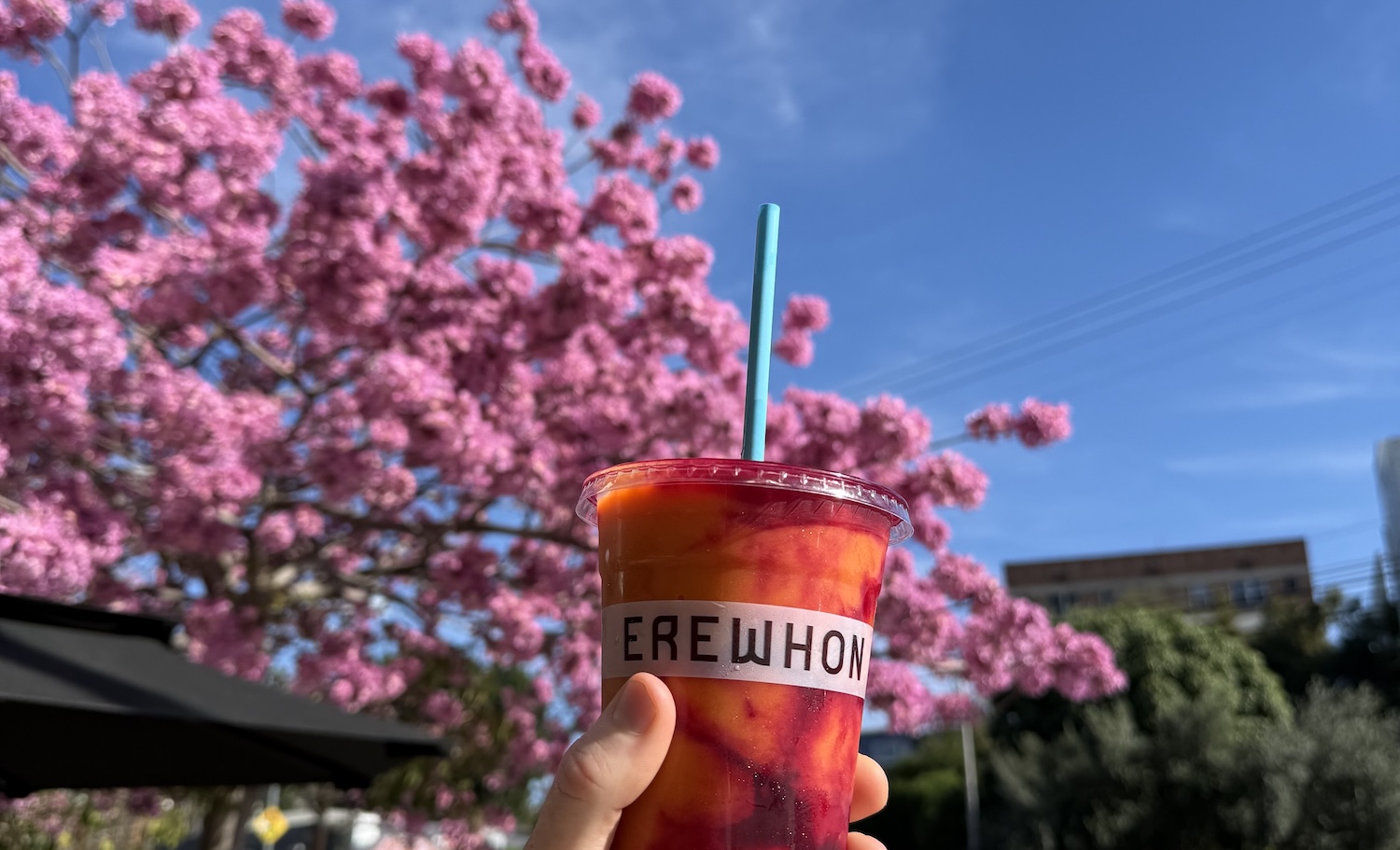
The first thing you see when you enter the Silver Lake store is a thick swarm of beautiful, studiously casual people brooding over the effulgent smoothie counter. The light in the store is soft and forgiving. The consumer is greeted by the sound of an armada of blenders steadily churning to produce the perfectly TikTok-blue–hued Coconut Cloud Smoothie; to integrate the He Shou Wu, deer antler, and "ant essence" that compose the Jing City tonic; and to pump out the Perfect Amino Choco-Revive by Gary Brecka, created in collaboration with the wackadoo pseudoscientist huckster whose snake oil of choice is hydrogen. Ushered to the smoothie counter by the design of the store and the ebullient greeter, I opt for the Turmeric Crush. It is my primary weapon against the passage of time, my gateway drug to immortality, or if I must settle, longevity. The cashier tells me that they will text me when the smoothie is ready. This functions as an invitation to peruse the offerings in the rest of the store.
The first product I see for sale is a trio of individually packaged strawberries that sell for $20 each. A small plaque next to the berries tells the curious peruser, "Our strawberries redefine sweetness and beauty. Each berry is cultivated to achieve perfect symmetry, brilliant color, and exceptional size." The berries confront you with their perfection. You gaze at the rubicund specimens and let yourself imagine indulging in the forbidden nectar. You imagine what it would be like to have both the material security and the freedom from embarrassment that would make you the sort of person who would buy a $20 strawberry. You think about the impossible logistics of producing the perfect strawberry in Japan and rushing it roughly 5,500 miles across the world's biggest and most powerful ocean—a process that places you, the would-be strawberry consumer, at the pointy end of the most decadent, most unfathomably specialized consumer experience currently possible under the extant limits of global human interconnectivity. You cannot smell the strawberries, unless you buy one.
The unreality of the strawberries is the perfect framing device for the grocery-store portion of the Erewhon experience. Behind the smoothie bar and the generously apportioned ready-made food bar is the hyper-curated vision of a perfect grocery store.
I follow what feels like the designed flow of the store, past the berries and the fleet of liquids to the produce section, which is a still life of vegetal flawlessness. Each sheaf of Salinas Valley celery in the produce section is canted at a crisp 45-degree angle. Each Cuyama-grown apple is polished to a reflective sheen. Every golden beet smiles at you with a ruddy-cheeked glow, not a speck of dirt to be seen.
Not one person is in the produce section, nor has anyone disturbed the harmony of its arrangement by selecting so much as one Hass avocado from Ventura County's Apricot Lane Farms.
This gets to what I mean when I say Erewhon is not a grocery store. To actually shop here, to fill one's basket with all the food required for a week of cooking and eating, would require an orgiastic expenditure of resources. The only people who can actually do so are the ultra-rich, making the experience of perusing the Erewhon shelves one of mildly interactive fantasy. Sure, you could buy the $24 coconut yogurt or the $178 Holi Ageless Lifting and Firming Serum, but the defining quality of grocery store consumerism is its replicability, and only those free from material want can practice that here.
Erewhon is a convincing yet ultimately parodic representation of a grocery store, a distortion of basic reality, placing it comfortably in Stage Two of Jean Baudrillard's orders of simulacra. To put it more plainly, Erewhon is a grocery store primarily in form, not in substance. It is a purveyor of heinously expensive smoothies, premade food, and wellness products that legitimates itself and justifies its exorbitance by also offering the consumer something like a museum experience—like a museum, it even offers memberships and sells extremely expensive promotional merchandise. Erewhon simulates the liberating, uncanny experience of being the sort of person who could grocery-shop like this. Even the shoppers who can grocery-shop like this are at Erewhon to perform this ritualistically, like an interpretive dance representing the concept of grocery shopping—hence the untouched produce displays.
This experience is characterized by an indulgence that straddles the line between healthful and onanistic. Everyone wants to be well, right? Erewhon posits a sort of spiritual and physical purification in sacrificing huge amounts of money for achingly specialized wellness products. How can you put a price on freedom from the ravages of aging, disease, and death?
It was time to retrieve my smoothie. I bought some truffle seed crisps for $11 and a tiny jar of sea moss gummies for $28, both of which were tasteless. From the checkout counter, I looked north out the window and saw the Hollywood sign grinning at me. My friends and I went outside, where I dove into what was the best smoothie I had ever had in my life by a comfortable margin. Under a canopy of eastern redbud, blooming generously two months ahead of its usual cycle in the sublime high-70s heat, I felt in that moment that I would never die.