On June 25, 1976, three and a half years after Roe v. Wade made abortion legal in the U.S., The Omen hit theaters. Most viewers remember the high-drama deaths—by impalement, decapitation, hanging—or the creepiness of Harvey Spencer Stephens’s young Damien, or Gregory Peck’s commanding gravitas. But I always remember poor Kathy.
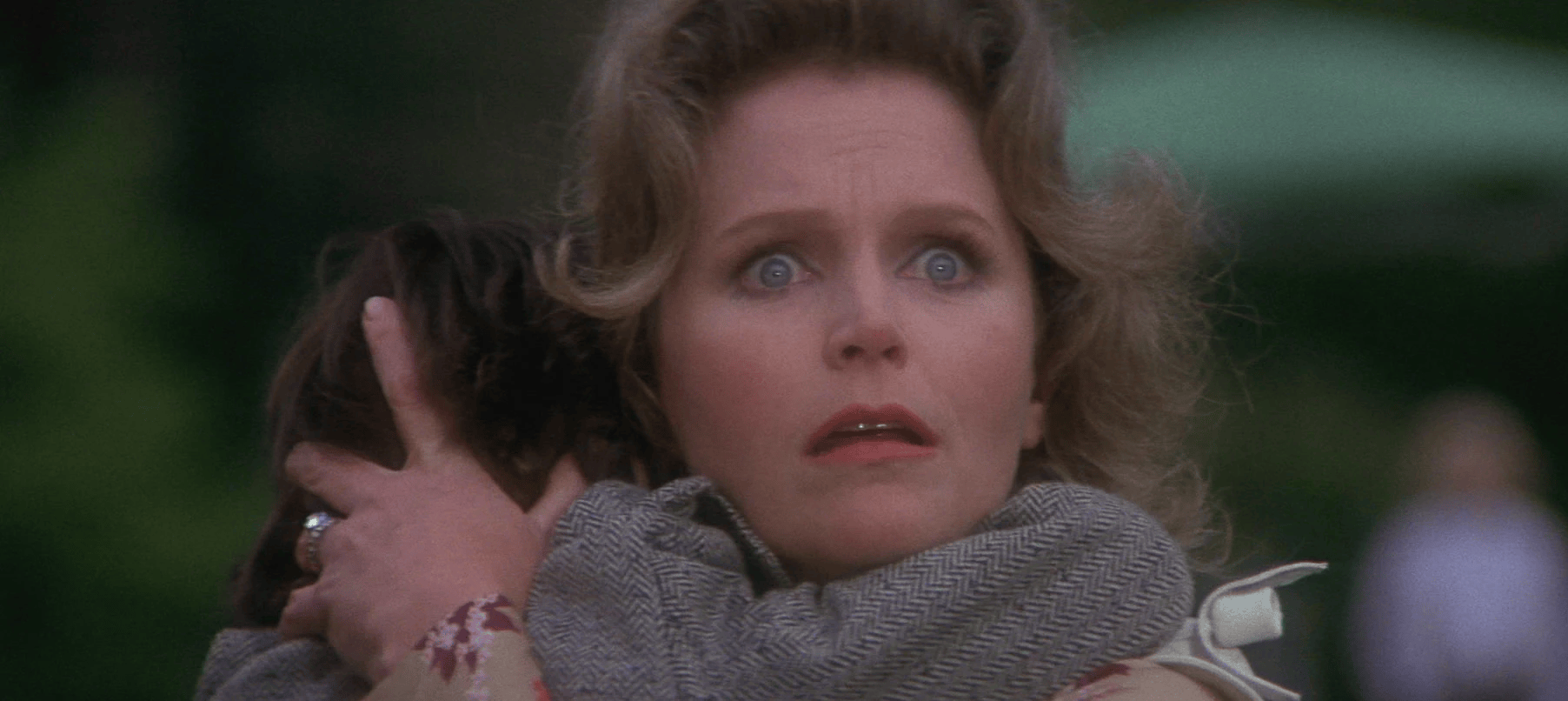
Katherine Thorn (Lee Remick, making the most of a fairly thin role) is the wife of Robert Thorn, an American diplomat stationed in Rome and later made ambassador to Great Britain. She’s a good woman and a loving, supportive wife. In the movie’s opening scene, as Kathy languishes offscreen in postpartum recovery, a priest tells Robert that their baby only survived for a few moments after birth. Robert is wrecked, but he’s especially concerned for his wife: “I’m afraid it will kill her,” he says. “My god, she wanted a baby so much, for such a long time.”
The priest suggests a deeply unethical solution: The hospital has another baby, born that very night, whose mother died in childbirth. Robert can present the baby as their own, and Kathy never has to know. Robert hems and haws a bit, but ultimately agrees. In intention, this is done out of love. In practice, of course, it’s an act of unimaginable betrayal.
Kathy doesn’t even question that the infant is their son—she has every reason to trust her husband, and she loves Damien so much. She goes on believing that Damien is her own flesh and blood even as disturbing events start happening around the boy, increasing in severity and frequency: Damien’s nanny dies by suicide in the middle of his birthday party. The boy throws a violent fit rather than entering a church for a wedding. At a safari park, animals swarm the car in response to Damien’s presence. It starts to wear on Kathy, naturally, but she believes her own mind is the problem, not Damien. She asks Robert to find her a psychiatrist, and he agrees.
Meanwhile, Robert is gathering information. It makes sense that he doesn’t tell her, early on, about his visit from crazed Father Brennan (Patrick Troughton), who knows that Damien is not the Thorns’ natural son. Robert doesn’t want Kathy to know about his original sin regarding the creation of their family, and besides, he doesn’t believe the old priest’s claims about Damien’s true nature. Why would he? He’s a sensible, secular man, a man of politics and diplomacy. Religion and superstition don’t have a place in his worldview. Not at first.
I was 11 in the fall of 1998, when abortion provider Dr. Barnett Slepian was killed by a bullet fired through his kitchen window as he prepared dinner at his home, about an hour’s drive from where I was born.
By that point, I knew what abortion was, in a vague and hazy childhood way. When Bill Clinton was reelected president in 1996, another girl in my class came to school parroting her own parents’ political rhetoric: “My mom says he’s a baby killer.” I asked my own mother about it when I got home. She was livid that I’d been exposed to that phrase so young, but she explained abortion to me in simple terms, something along the lines of Sometimes when a woman is pregnant, she doesn’t want to be. In those cases, she can have a medical procedure that ends the pregnancy. Some people don’t think that should be allowed, but I do.
Insofar as we all internalize our parents’ political positions early on, I adopted my mom’s stance on the issue, and before long it became a closely held belief. But while I started from a place of assumed safety—I lived in a world where Roe v. Wade existed—over time, the warning signs became more and more difficult to ignore. Roe was under attack, an attempted death by a thousand cuts on the state and federal level, both legal and otherwise. In 2003, it was the Partial-Birth Abortion Ban Act, later upheld by the Supreme Court in 2007. In 2009, abortion provider Dr. George Tiller was assassinated by an extremist while serving as an usher at his church. 2011 saw a new wave of TRAP laws across the country, meant to make it harder for clinics to operate.
Though reproductive rights activists sounded the alarm repeatedly as the Overton window continued to shift further and further to the right, nobody in power seemed to take seriously the possibility that Roe might be overturned. But anyone with eyes and pattern recognition could see what was coming. The dread built, the protections we had in place fell one by one. Not only was the monster advancing horribly, inevitably, it wasn’t even pretending to hide its intentions anymore.
It can be tricky to tease out the vapor-thin distinction between a movie treating a female character badly because she’s a woman, and a movie treating a female character badly because that’s what happens in horror movies. With Kathy, I think, it’s mostly the latter with a healthy dose of the former. It’s not that screenwriter David Seltzer hates Kathy—his script just fails to grant her much interiority. Everything about her life is mediated through men: her husband, priests, doctors, her psychiatrist. This is inherently horrifying, of course, but The Omen doesn’t really recognize it as such.
I did, when I first saw it as a teenager. I have a distinct memory of feeling my skin crawl at the point in the movie when Kathy has to ask her husband for an abortion. The thing that sets Robert on the road to believing that his son may in fact be the Antichrist is Brennan’s impossible knowledge that Kathy is pregnant again: He knows before Robert does. Damien will kill the unborn child, Brennan tells him, and will then move on to the Thorns. When Robert arrives home, Kathy’s on edge. She tells Robert that she doesn’t want to have any more children. Slightly confused, he assents. “Then you’ll agree to an abortion?” she asks, and then: “I’m pregnant, Robert, I just found out this morning.”
Later, Robert visits Kathy’s psychiatrist, two men sitting alone in a room and making decisions about the life and health of a woman who isn’t even present. The psychiatrist urges him to agree to end the pregnancy, though for mundanely patronizing reasons: “She knew how much you wanted one. Now she can’t cope. She searches for reasons that won’t make her feel inadequate.” She has fantasies, the doctor says, that Damien is alien, or evil, and that he isn’t hers. Another child would be disastrous to her health. Robert, however, flatly refuses, citing Brennan’s prophecy: “It was foretold that this pregnancy would be terminated. I’m going to fight to see that it’s not.”
But it’s all over by the time Robert gets home. As Kathy stands on a chair to tend to a hanging plant on an internal balcony, Damien zooms through on his tricycle, overturning both the chair and his mother, and Kathy plummets over the railing to the floor below. At the hospital, Robert’s first question to the doctor isn’t about Kathy’s prognosis, but about the fetus. The doctor tells him that she’s lost the pregnancy and then chides him for his reaction: He should be grateful that his wife is alive and will recover … so she can have more children in the future.
Kathy, from her hospital bed, begs Robert not to let Damien kill her. “I know you must think I’m crazy, but I’m so frightened,” says the woman whose Satanic brood-parasite impostor child has already put her in the hospital. Robert comforts her, but still won’t come clean, or even ease her worry that she’s mentally unwell by sharing his suspicions about Damien. Instead, he leaves her to recover alone, still in the dark, while he jets off to Rome to investigate the origins of the boy they’ve been raising. Not long after, Damien’s evil nanny Mrs. Baylock arrives at the hospital and pushes Kathy out a window, killing her.
The ability to get pregnant, in our society, means that for the duration of your fertile years, you’re seen with double vision, like a ghost of yourself superimposed over who you actually are. You are yourself, of course: a human with desires and opinions and wants and needs, who likes stupid action movies, who wants to learn Italian someday, who would rather eat lo mein than General Tso’s, who prefers this route to the grocery store over that one. But you are also a vessel for potential offspring, Schrodinger’s uterus awaiting a tenant. You are constantly reminded of your expected duty: to bear a child, regardless of your feelings on the matter. Friends, family, doctors, and even total strangers pass judgment disguised as advice through pursed lips on everything from tattoos to dietary choices to careers: But what about when you get pregnant? The aggregated message is that you, yourself, are not enough. The fact of your personhood isn’t sufficient. Babies take priority, while birthing parents are disposable. The actual must bow its head to the potential.
The Omen takes no explicit moral stance on abortion. It doesn’t have to, since anyone watching already knows the Church’s stance on pregnancy termination. But many viewers remain unaware of the explicitly Christian context that gave rise to the film in the first place.
Accounts vary a bit on how exactly this all shook out, but what most sources agree on is that Robert Munger, a born-again advertising executive, read the Book of Revelation and had the idea for a movie about the Antichrist as a child. He brought it to a friend, TV producer Harvey Bernhard, who loved it and immediately hired David Seltzer to write the screenplay. (Munger, whose self-professed goal for the movie was to spread awareness about the Antichrist, retains a credit on the film as a “religious adviser to the producers.”) Seltzer, in turn, incorporated ideas from evangelical writer Hal Lindsey’s 1970 smash-hit pseudo-eschatological mega-bestseller The Late Great Planet Earth.
As written, The Omen could easily have ended up discarded on the refuse heap of pop culture, a trashy piece of fringe Christian propaganda, but director Richard Donner ultimately took the film down a more secular path. His guiding principle was that everything that happened in the movie should have a plausibly sensible earthly explanation (in one of many examples, he replaced the hooved demons Seltzer’s script had called for in the cemetery scene with wild dogs). The resulting ambiguity makes for a better and more interesting movie, but also one that’s more palatable to a general audience, a Trojan horse for premillennialist Christian theology.
Against that background, it’s hard to read Kathy’s injury and death as anything other than punishment for the great crime of attempting to exercise autonomy over her own body, for wanting to end a pregnancy that’s threatening her health. We watch her ask Robert for an abortion, and then the next time we see her, only a few minutes later in the runtime, is when Damien knocks her from the balcony, in a bizarre and cruel echo of the trope of a woman throwing herself down stairs to induce a miscarriage.
Kathy’s death serves two narrative purposes. It advances Damien’s ascendency, another life ended like a task checked off a to-do list, and it motivates Robert to pursue more extreme solutions to the problem of his adopted son. To borrow a phrase from the world of comics, it’s a classic fridging: the killing or injury of a female character used as a plot device to move a male character’s story forward. Donner’s film isn’t interested in the tragedy of Kathy’s death on its own terms, or who she was as a person, or who else might mourn her. It’s the final erasure of a woman already shoved to the margins. There’s no reckoning for Kathy in The Omen, no moment where her husband, or any other man, is held to account for how he’s treated her. She’s a bystander, a tragic but ultimately unimportant casualty in the greater war against Satan.
In 2022, a few short months after the Dobbs decision, as stories were starting to filter out in the press about people dying and suffering after being denied abortions, production began on The First Omen. Arkasha Stevenson’s prequel, released in 2024, is shockingly good, full of style and audacity, made all the more impressive by virtue of being a feature directorial debut. It also serves as a corrective, of sorts, to Kathy’s story. Margaret Daino (Nell Tiger Free), a young novitiate, arrives in Rome to take her vows. She’s been a ward of the church her whole life, raised in a Catholic orphanage in Massachusetts, clear-eyed in her faith and her desire to serve a greater purpose. Margaret has no intention of having children of her own—taking the veil is another form of choosing not to—but she likes them, and likes working with them at the girls’ orphanage in Rome. She takes a particular interest in Carlita, who has been branded a troublemaker by the other nuns. Margaret sees herself in the girl: Like Carlita, she had difficulties as a child, visions or hallucinations that caused her to act out and to be punished.
Margaret’s presence in Rome has been orchestrated by Cardinal Lawrence (Bill Nighy, wonderfully oleaginous and smug), whose paternal benevolence has been a steadfast part of Margaret’s life since childhood. Everything is going according to plan: She’ll take her vows and commit herself fully to the Church as a bride of Christ. But one day, a man approaches her: Father Brennan (played here by Ralph Ineson) believes that Carlita has been bred for a purpose by a dark faction of priests and nuns who want to create something to fear in order to bring people back to the Church. Carlita, he says, is meant to be the mother of the Antichrist, and Margaret should watch for bad things to start happening around the girl.
Bad things do happen around the girl, of course, but they also necessarily happen around Margaret as she observes. Eventually, we learn that Margaret and Carlita are half-sisters, sired by a demonic jackal, and it’s not Carlita who’s to be the vessel for the Antichrist—it’s Margaret. In fact, she’s already pregnant, drugged during a night out and raped by the same beast that fathered her. The enormity of it is too much, and Margaret screams and spasms as she realizes. Brennan is horrified yet sympathetic. “I’m so sorry this is happening, my child,” he says. But it is happening, and must be dealt with. Margaret doesn’t hesitate: “I need it out of me. I need it out of me now.”
As they drive to an abortionist (the film makes the destination quite clear without using the word, with Brennan assuring Margaret that this doctor is “experienced”), another car slams into them. A dazed Margaret crawls out of the wreck as a church bell begins to toll midnight, June 6. What follows is a remarkable, near-feral performance from Free. Her face changes, and then her body: She starts convulsing, writhing, moaning, her body cracking and thrashing as her latent supernatural pregnancy quickens. She drops to her knees on the pavement as her stomach starts to swell.
Bilge Ebiri, in his review of The First Omen for Vulture, wrote: “Why should anyone be surprised that suddenly, in the wake of the Supreme Court’s overturning of Roe v. Wade, as state after state attempts to enact religious laws depriving women of bodily agency, America is getting horror movies about people forced into monstrous births by religious institutions worried about their growing irrelevance? Whether it’s from a direct desire to be topical or a subconscious need to make our anxieties tangible, horror throws our world back at us.”
In 1976, Kathy Thorn begged for an abortion, only to be granted a sick funhouse version of her request. In 2024, Margaret Daino demanded one, only to be denied in violent and cruel fashion. But Margaret had access to something Kathy didn’t: an interior landscape, one with its own deep reserves of rage.
When Margaret comes to, she’s tied to a gurney in the catacombs. Lawrence is there, murmuring empty comfort in her ear: She’s special and chosen, he won’t let anything bad happen to her, and this birth will help “redeem the Church.” “Please know that I love you,” he intones, in a perverse imitation of Robert’s professions of love for Kathy even as he makes decisions about her body without her input.
The camera pans over a tray of scalpels, forceps, retractors, a speculum, a malevolently medieval array of tools for a brutal task. We realize, as Margaret does, with mounting horror, that this is going to be a Caesarean. As the doctors cut open her torso, Margaret pleads for help from the surrounding crowd, which is studded with the impassive faces of people she once trusted. “Help me, I’m in pain,” she begs over and over, the plain, plaintive phrasing cutting through the baroque trappings of the scene and laying bare the inhumane horror at its center.
And then, like that, it’s over. She’s delivered twins, a boy and a girl. The crowd rejoices at the boy: Their project to breed the Antichrist is complete. They pass him around the room, touching his head reverently. Margaret, who’s being stitched up, has eyes only for the squalling baby girl, who’s been discarded, forgotten, on a nearby table. Finally, Lawrence remembers he’s supposed to at least pretend to care about Margaret. He leans over her, telling her that God would be proud of her. “Can’t you hear his voice?” he says.
“No,” she replies, just before stabbing him in the neck with a scalpel. “I only hear my own.”
My mother grew up in a time before Roe v. Wade. In the summer of 1973, when they were 17, a friend of hers got pregnant and sought out a termination. Once she’d been induced, the medical staff left the room, leaving a scared teenage girl to labor for hours in pain, all alone, as punishment.
I am no one’s mother, a fact that is unlikely to change. I’ve never, to my knowledge, been pregnant. I’ve never had an abortion, though people close to me, people I love, certainly have. I don’t have a tragic personal story to illustrate why the ability to decide what happens inside, and to, my own body is such a pressing concern for me. It just is. Your jurisdiction ends where my skin meets air. That is an unshakable core tenet of my beliefs.
During the first Trump administration, I volunteered with an organization that provided financial assistance and overnight accommodations for people who came to New York City to terminate their pregnancies. One evening, I hosted a couple from another state, and the next morning, as I was escorting them to the clinic on the subway, the patient’s husband asked me if I’d ever “had the procedure.” I haven’t, and I told him so. His next question: If I’d never had an abortion myself, why did I feel passionate enough about it to invite strangers to sleep on my couch? I found myself at a loss. How do you explain to someone who can’t get pregnant how powerful the omnipresent specter of pregnancy is? How the hyper-awareness of other people’s expectant entitlement toward your body dogs you through every day of your life?
Today, in a post-Dobbs world, abortion access varies state by state and is largely dependent on the whims of federal judges. According to the Center for Reproductive Rights, abortion is legally protected in 25 states and the District of Columbia and illegal with few or no exceptions in another 13 states. Yet another nine states are classified as “hostile” to abortion. Individuals are under fire, too: Pregnancy Justice, a nonprofit that advocates for the rights of pregnant people, reports that at least 30 states have laws on the books potentially criminalizing a parent’s actions in the wake of a pregnancy loss, creating an environment where miscarrying at home carries the additional fear of the cops showing up at your door. That these cases are often dropped or dismissed doesn’t lessen the stochastic terror they inflict, or the emotional and financial trauma they cause to people already navigating complicated feelings about their pregnancy loss.
The legal murk around abortion restrictions has also led to a significant reduction in the quality and availability of care for people experiencing miscarriages: Since the treatment for miscarriage involves the same regimen of mifepristone and misoprostol used in medication abortion, medical professionals are hesitating to treat miscarrying patients for fear they’ll run afoul of the law. At-home medication abortion rates have risen since Dobbs, as patients in states with abortion restrictions opt to receive mifepristone via telehealth appointment; as such, the availability of the medication via virtual visit is now the subject of an ongoing legal battle. Last month, the Supreme Court issued a reprieve in the form of an order that keeps the medication available, but there are at least three more pending cases in the courts that would restrict access. The FDA is also currently undertaking a “safety study” of mifepristone that abortion activists fear may be used to challenge its availability again in the future.
It will continue to get worse before it gets better, though to what degree, no one can say. Anti-abortion activists are now exploring the Comstock Act of 1873 as a potential avenue toward effectively banning abortion nationwide. People are already dying, and will continue to do so, due to medical neglect and cowardice, or due to unsafe measures taken in desperation, or due to retribution by the state or by individuals. Increasingly, the people in charge of the country are the same people who pledge allegiance to a cult of forced birth. Those of us who choose not to are often violently punished.
If Kathy and Margaret teach us anything, it’s that placing our faith in institutions, especially patriarchal ones—governments, churches, police, even domestic relationships—is unreliable at best and deadly at worst. In the end, it’s Carlita who helps Margaret escape the burning catacombs with her newborn baby girl after Cardinal Lawrence leaves them there to die. For those of us who want to continue to have agency over our own reproductive systems, the best hope we have now is each other.