
When athletes are said to thrive under pressure, that generally does not mean that they do not feel it. Rather, the common understanding is that athletes, or at least the great ones, are capable of taking pressure and turning it into fuel. That thermodynamic process is a part of the incomprehensible psychology necessary to reach the pinnacle of competitive athletic greatness. What better source is there for relentless motivation than wanting something so badly, or having something to prove?
Alysa Liu has no need for any of that nonsense. Where ordinary—or even extraordinary—athletes might be fueled by pressure, she simply doesn't feel any, ever. She thrives because she is immune. It was always understood that Liu could win gold at the Olympics, but with her technical content, she would need other skaters—say, Kaori Sakamoto, Ami Nakai, and Amber Glenn—to make errors. That assumption, however, always took one thing for granted: Of course Liu herself would never falter.
And of course she would never falter! Listening to Liu, it's so easy to forget the broader narrative of there not having been an Olympic women's singles figure-skating medalist from the United States since Sasha Cohen won silver in 2006. A storyline can overwhelm a skater, but Liu is untouched by externalities. She takes an artist's pleasure in sharing her work with a broader audience, but other than that, she appears—or, at this point, with qualifiers surely unnecessary, simply is—so self-possessed that everything she does is truly for herself. If there were any doubts about Liu's mentality, she dismissed them on Thursday, by executing under benthic pressure when no one else could and walking away, unscathed, with a gold medal.
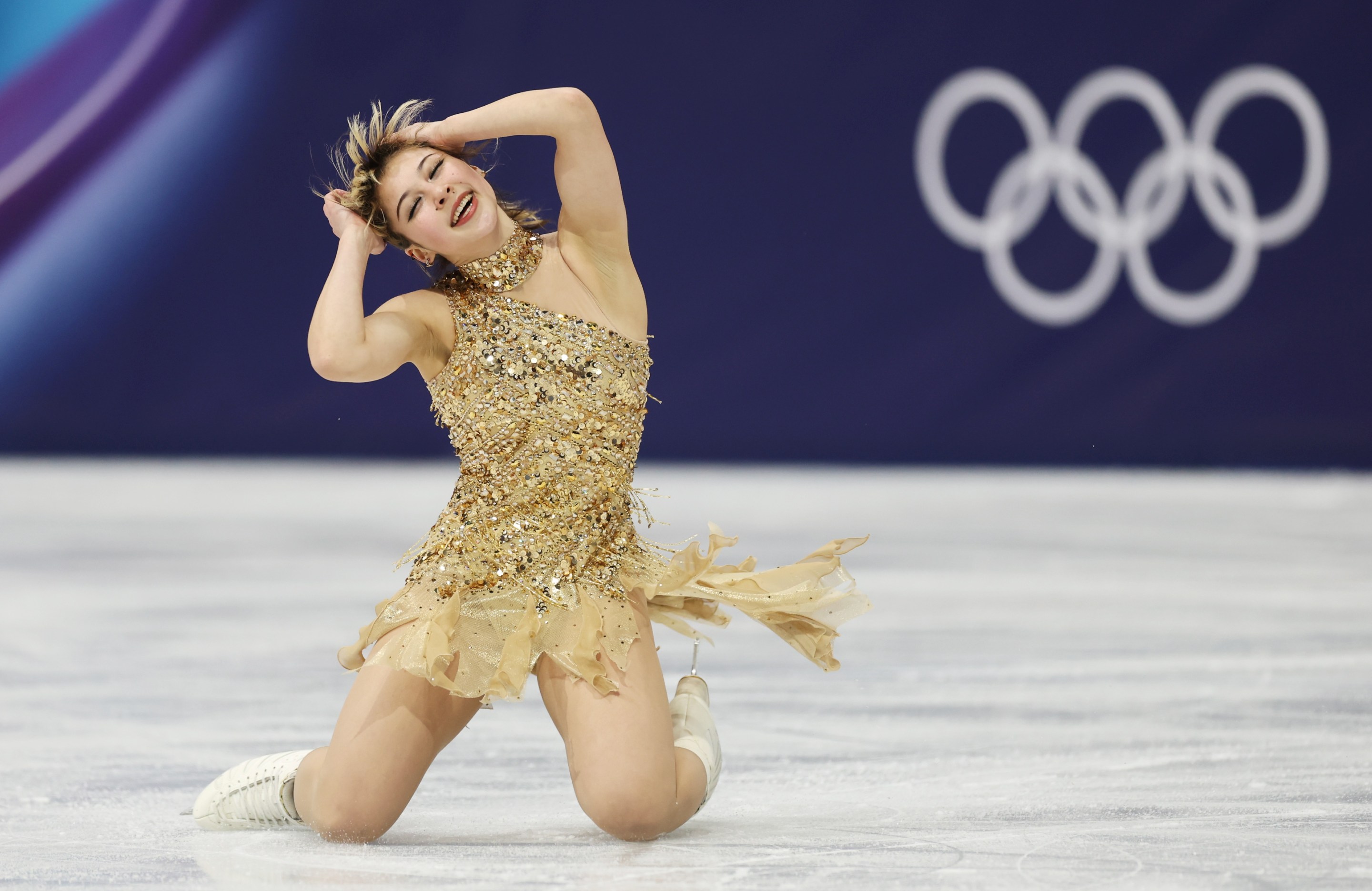
What is incomprehensible about Liu, then, is that core of her: what she must be made of to perform at this level, with all the training (occasionally literal) it entails. Something gleaming, probably, because you can see it radiating when she's on the ice. It certainly helped that for her free skate—set to the Donna Summer version of "MacArthur Park"—she was clad, presciently, in a golden, sparkling dress, with her hair dyed to match.
Where Liu's short program had been ethereal, her free skate was an unfettered celebration. If the final spin was the infinitely replayable moment of her short program, the fourth jump (at around 1:45 in the above video) is that for her free skate: a triple loop, fully rotated, into a glorious beat drop. All that build-up, and then we were finally off, discoing. The final jumping passes are always the most stressful to watch in any program, but there is never any tension in Liu's skating. Thanks in part to how she beams after each sequence and in part to her technique (oh, the miracle of a soft knee), she does, as much as it is a cliché, truly make it look easy.
It is impossible to watch the final stretch of Liu's skate without feeling some fraction of her joy. The two knee slides! The split jump to the orchestral sting! That spin, again! Liu herself was audibly elated with her performance; after the skate, she looked into the camera and declared, "That's what I'm fucking talking about!" The American censors were not quick enough to catch her.
Liu had secured the medal at that moment, but she still had to wait and see for the gold. The mistakes came, though they were understated compared to those last week. Eventual bronze medalist Nakai landed her triple Axel, but was brought down by a missed triple-triple combination and a couple of quarter underrotations. The great tragedy was that of Sakamoto, making her final performance of her career, who landed too low on a triple flip and was not able to add an additional triple toe loop to another one of her jumps, costing her over five points. She would finish just two points behind Liu.
It is cruel that Sakamoto should want the Olympic gold so much—objectively more than Liu—and have to retire without something that many would consider a just reward for years of service. The 25-year-old great is a generational skating talent who weathered the quad frenzy and then dominated the post-quad era of the sport, and she faltered only a little on her final opportunity. But that loss is a bearable, ordinary, sporting sadness, which is refreshing in the context of what happened in 2022, when all that pressure, and a doping scandal, cumulatively crushed the favored Russian skaters and left both the gold- and silver-medallist despondent in the kiss-and-cry area.
Four years later, and it is a different sport, with a healthier and more joyous podium to celebrate. One that can carry Nakai, who is only 17 and was just happy to be on the podium; Sakamoto, who will retire having laid ground for everyone who will follow her, Nakai included; and Liu, who, in the intervening time between Olympic cycles, retired, learned how to play the game differently from everyone else, unretired, and then miraculously emerged victorious.
There are a couple easy answers to the question of what Alysa Liu is made of. Watching her on the ice, gleaming, it's easy to think: diamonds, diamonds, diamonds. Or perhaps, as a concession to the hardware she's walking home with: gold, gold, gold.