
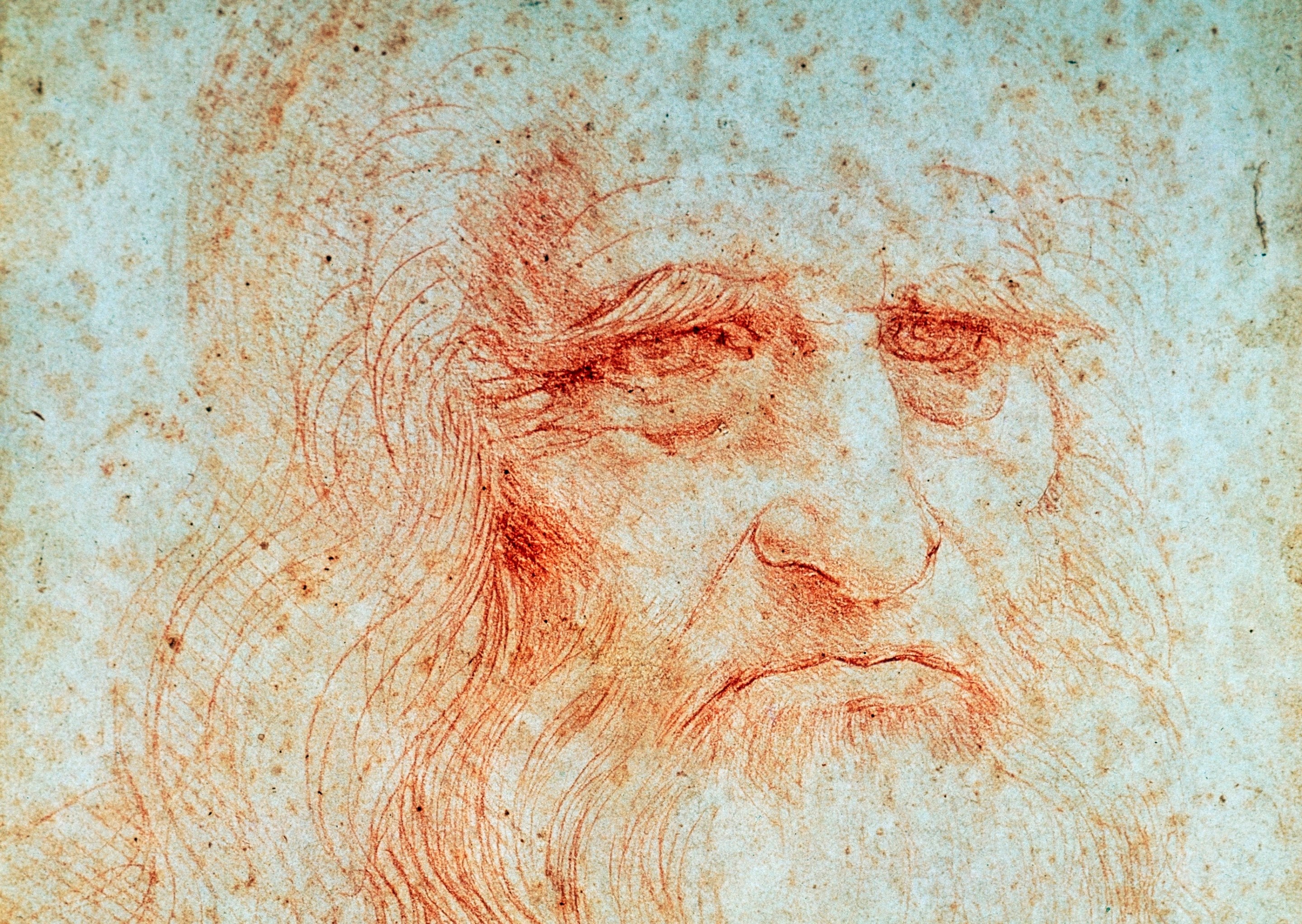
This week, researchers from the Leonardo da Vinci DNA Project announced they have made the kind of breakthrough you might expect from a project with that name: They have potentially identified Leonardo da Vinci's DNA. The announcement ran exclusively in Science on Jan. 6 under the (excellent) headline "The Real da Vinci Code," and the researchers have published a preprint, which has yet to be peer-reviewed, about the newly collected DNA. The news, which has since been written up in a slew of other science publications, is certainly thrilling for anyone who has been hoping to uncover Leonardo da Vinci's DNA, and still pretty exciting to people like me who did not know that this was something we were trying to do in the first place.
This new sample was swabbed (gently) from a drawing called Holy Child, a gauzy, sfumato rendering of pouting baby Jesus in red chalk. Many experts say the drawing is the work of Leonardo, as it has his characteristic left-handed hatching. Others are uncertain, suggesting one of his students could have created the work. According to the preprint, the swab collected a potpourri of DNA: fungal, viral, vegetal, and bacterial, in addition to human. Specifically, the drawing contained traces of the sweet orange tree, which was cultivated in the gardens of the Medici family, a key patron of the artist. This would seem to suggest that the Project is on the right track. But the human DNA could belong to any of the many people fortunate enough to handle or clean Holy Child over the years. The researchers ruled out the art dealer who acquired the drawing decades ago, but this, of course, does in no way prove the DNA is Leonardo's.
People have been questing after the body of Leonardo da Vinci long before anyone knew about DNA. The artist died in France, where he had been working in the court of King Francis I. Although he was first buried in the church of Saint Florentin in Amboise, France, his remains were exhumed and moved to a smaller chapel after the church was destroyed in the French Revolution, according to Atlas Obscura. But no one is certain which of the transported bones, if any, belong to the artist, who never married and never had children.
With no descendants and no earthly remains, one might wonder how it would even be possible to identify any DNA as Leonardo's in the first place. To solve this problem, the Project has traced 14 living male descendants of Leonardo's father, an official in Florence who had at least 23 children. The researchers hope to test their Y chromosomes, sections of which are passed down unaltered from father to son even across centuries.
In 2019, experts announced plans to DNA test a lock of blond hair first found in an 1863 excavation project at Amboise, which speculated the hair came from Leonardo's beard, and compare it to descendants of Leonardo's father and brother. In this week's announcement, the Project said it would carbon-date a strand of the blond hair, and if it is the correct age, potentially test its DNA against the Holy Child DNA sample.
One might wonder, as I did while reading this more than 3,500-word feature on the DNA that might possibly—perhaps, potentially!—belong to the great artist, why this matters so much. What is the end goal of investing so many resources in finding Leonardo's DNA? Was it simply to have it, to possess one more artifact of such a famous and accomplished man?
The first reason the story in Science offers us is the field of arteomics, a new field that studies the biological traces left on artworks. Before arteomics, paintings were authenticated in part by connoiseurs able to identify the style and technique and experts able to analyze physical traits of the painting by X-ray or spectroscopy. But with arteomics, scientists can extract organic traces, such as DNA or proteins, to authenticate these works or uncover other insights. In 2020, a team of researchers investigated the claim that the 18th-century English artist Thomas Gainsborough dipped drawings in skim milk to protect them from coal smoke. They found bovine proteins on his sketches (one aptly called Hilly Landscape with Cows on the Road), confirming the legend. The Project researchers also swabbed some letters from Leonardo's cousin, Frosino di ser Giovanni da Vinci, and found a proliferation of the parasite Plasmodium malaria, which was widespread in the swampy marshes of Renaissance Tuscany.
Arteomics, though an emerging field, is a real, worthwhile science. It takes existing tools—DNA sequencing and protein analysis—and applies them to a novel subject toward a novel end. But the other reason included in the Science story is not so worthwhile:
Identifying Leonardo’s DNA could not only help pin down the provenance of disputed pieces such as Holy Child, but might point to biological traits underpinning his genius, although some scholars resist chalking up his abilities to his genes. “I tend to explain Leonardo more as the result of a favorable cultural and economic context,” says Leonardo expert Domenico Laurenza, an art historian at the University of Cagliari.
Yet some of what made Leonardo unique seems rooted in biology. His extraordinary ability to capture subtle shifts of light and motion, for example, has long hinted at exceptional visual acuity. LDVP aspires to one day find genetic variants that could account for it, says Gonzalez-Juarbe, who works at the University of Maryland. “Our hope is to open a door to explaining what was so unique about the smartest guy in history.”
Searching for the "biological roots" of some form of intelligence? Smells like positive eugenics to me, which is still—say it with me—eugenics. Our genes do not explain who we are, however tempting it might be to find a gene for super-vision or super-intelligence or super-painting-talent. We are the product of the interactions between our genes and our environment, where factors like race, class, gender, and luck determine what we achieve. But this is one of the chief aims of the Project: "to use whole genome sequencing data from Leonardo’s remains to better understand his extraordinary talents and visual acuity through genetic associations," reads a statement on the J. Craig Venter Institute, where the Project originated. And many of the stories aggregating Science's report repeat this claim with little or no qualification.
Genes work in complicated, entangled, and mysterious ways. Having certain gene variants does not guarantee that a person will develop those traits. In fact, researchers who have actually collected the DNA of famed "geniuses" have found these genetic predictions often do not pan out. In a 2024 paper in Current Biology, a group of researchers tested Beethoven's genome for polygenic indices (an individuals' genetic propensity for specific traits) of musicality. Specifically, they tested the composer's genetic predisposition for beat synchronization. Beethoven failed this test, as his genome revealed an unremarkable score for musicality. "Our aim was to use this as an example of the challenges of making genetic predictions for an individual who lived over 200 years ago," one of the authors, neuroscientist Tara Henechowicz, said in a statement.
If the Project were to somehow locate a gene or group of genes that they claim are responsible for Leonardo's ability to capture swirling eddies in the water that were otherwise invisible to the average human eye—as the Project has suggested in a prior paper—what would we do with this information? (Putting aside the fact that genes for vision would not even be located on a Y chromosome, as one outside expert pointed out in Science.) Perhaps, in an era where startups allow parents to screen and select embryos for polygenic traits, embryos with "Leonardo genes" will be a popular request. Parents can already screen their embryos for sex, skin color, and eye color; why not add super-vision to the mix? Maybe you, too, could have a Renaissance child, if you have the money.
"We’re not saying genius is in the genes," David Thaler, a geneticist at the University of Basel and the Project told Science. "But if you see things that other people can't, you might think and create things that other people don't." In other words, genius is potentially in the genes? If Leonardo did indeed have genius genes, wouldn't the best proof be evidence of talent in any of his relatives? But this does not appear to be the case, as Thaler drily notes "the absence of evidence for talent in any of his relatives" in a paper on Leonardo's visual acuity.
There will never be another Leonardo da Vinci, because that is what it means to be human. It strikes me that a more valuable use of our time, resources, and scientific potential would be to learn all that we can from the actual work Leonardo left behind, which I suspect has more to teach us about ways of seeing the world and revealing its beauty than any dusty old beard hair or smear of DNA.