

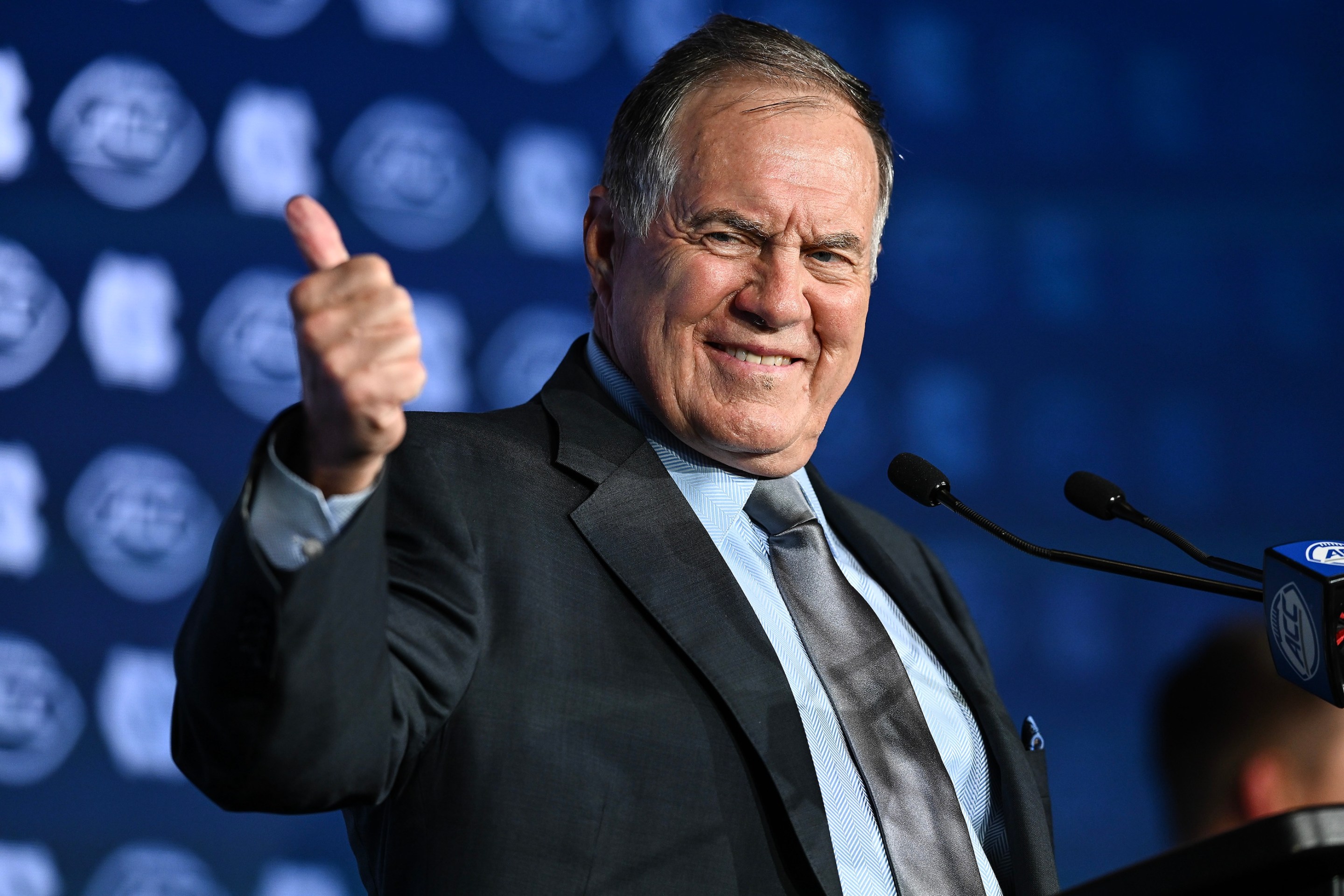
If Bill Belichick was willing to play to type today, he would rise in Uppermost Dudgeon—it's a suburb of Foxborough—and say he doesn't want to be voted into the Pro Football Hall of Fame at all, won't accept induction when it does come, and would attend the ceremony only for the privilege of telling everyone who worked to keep him out this time to eat a heaping bowl of death. Expert analysts call this "pulling a Schilling," but more on that in due time.
Of course he won't, though. He'll endure what The Athletic and everyone else in the incredulous-on-command media game described as "a snub" and pretend (poorly) to be gracious when he is elected, which will probably be next year. Too bad, too. Not because Belichick shouldn't be in the Hall of Fame, mind you; even the most benign of explanations doesn't cover the full 20-plus percent of voters who skipped him on any principle. But his temporary (for the moment) exclusion makes him the latest example of what we now know halls of fame to be at their essence: places in which sports grandees honor their friends and hosepipe their enemies. And Belichick, through cultivation and diligence and by being the contemptuous villain he chose to portray, has made far more enemies than friends over his nearly half-century in football.
The news that Belichick didn't get the required 40 votes (out of 50 electors) to gain inclusion came as quite the shock to many establishment football people, who should know that concepts like ethics and honor have nothing to do with football, or much of anything else these days. Baseball fans know this as the Bonds Effect, with one important caveat. Barry Bonds has only been suspected of being a steroid enthusiast and proven only to be aggressively impolite to nearly anyone he met in the job, while Belichick actually got caught cheating. This is hardly unique in the results-before-honor world of which we speak here, but despite the theory attributed to former Indianapolis Colts executive Bill Polian in Don Van Natta Jr. and Seth Wickersham's reporting at ESPN (which Polian has since disclaimed) that Belichick should not be a first-ballot HOFer because of the brigandries of Spygate and DeflateGate, it is Belichick's devotion and even zeal in being the most unpleasant bastard in a profession full of them that ultimately won the day. Even the only semi-compelling and football-related reason not to vote for his inclusion—that Belichick was more or less an extra-sour Norv Turner without Tom Brady—would not have swayed many voters if his public personality hadn't been so much "a bag of coal dust scattered in your eyes."
There are reasons one can see why he would not be on a ballot or two or five; as the respected and respect-worthy Charean Williams has pointed out, some voters only put players on their ballot on the theory that players are by definition more worthy than any other employees (and to be fair here, Williams said that she voted for Belichick). But the Hall does not account for that level of compartmentalization, meaning that every candidate is thrown into the same dumpster and the voters have to make salad out of the contents.
More saliently, though, because all the voters are gathered in one place, either physically or Zoomically, the chances of herd mentality breaking out is greater than, say, the Baseball Hall of Fame voting, which is still done at each voter's home, free out of outside pressures, usually in their underwear and while beating down the effects of last night's six gin-and-scotches.
There is no useful reason, therefore, to poll the Hall of Fame voters on which side they fell, except for the illusory benefits of electoral transparency and your own sense of vigilante justice. I mean, who wants to spend the next six months of their lives changing their email address and phone number every third day to keep the football vigilantes at bay? (For the record, your intrepid correspondent does not have a Football Hall of Fame vote, and for good reasons.)
But voting against even such a purposefully repellent figure as Belichick, in a profession that typically rewards that sort of behavior, suggests that this is just folks at the Elks Lodge getting petty revenge against the guy who steals the tips at the bar on meeting nights. The late and occasionally lamented Al Davis was roundly despised by much of the football establishment for any number of doesn't-play-well-with-others reasons, and he was inducted on his seventh try. Fame, after all, is actually a value-neutral term rather than an honorific here. It just means you know their names. Most people in this country's current administration are famous to one extent or another, and they're all awful human beings simply by dint of who employs them. More than that, being that way is how they got the job, and why anyone knows their names.
And by that standard, Belichick meets all the prerequisites for vengeance voting, even after you work around the six rings and 333 total wins. So what we are seeing here in considerable part is that he is even more elite at alienating everyone around him than he is at accumulation, and that's saying something. The road to punishment-by-personality that was first blazed by the Baseball Hall of Fame's repeated and ongoing rejection of Bonds, Roger Clemens, Alex Rodriguez and Curt Schilling (although he also volunteered to be a pariah, thereby proving his worthiness to be one) is now being made available to Belichick, with the only question being how long his electoral detractors and whoever might be whispering in their ears can maintain this stance. Or, in an alternate universe, whether the league and its 31-plus-the-Packers oligarchs feel like changing the rules to force-feed Belichick into Canton on the as-yet-unproven theory that they like him any better than the rest of us.
But the better comparison might be to Schilling, whose baseball career absolutely placed him among the Hall's best pitchers, but whose personality and overall conduct were so egregiously unpleasant that he's been denied the plaque because many voters just didn't really want to vote for him on general principle, and especially after he told them not to. You may decide among yourselves if that works for you; just don't share your findings here.
Maybe if there was a "don't act like a total GRA" clause in the hall's bylaws, we would never have been confronted by what seems here to be a stunning turn of false piety. With even a perfunctory nod to what sociologists call "baseline human warmth," Belichick could have paid referees off in packets of thousand-dollar bills and Patriot Team Store gift cards during the national anthem, and sailed into Canton because he was just "workin' for that competitive edge." It would have helped his case significantly if he was a little more forthcoming and colorful about it in press conferences, or if he didn't work so hard to be a charmless brute to all those around him in all social settings.
But no, character, which has never mattered all that much to pro football's honors list until just now, is suddenly a thing, just as it has intermittently been with the Baseball Hall. The issue, of course, is who gets to define character, and how, where, and, in this case, why. And since nobody wants to tackle that one, we are left with the intriguing thought that Bill Belichick might actually have gotten what was coming to him, albeit for the flimsiest of reasons. If he wins induction next year, we'll know that this was true, and that pettiness, no matter how well-aimed, won one day. Conversely, if he doesn't get the 40 votes again next year, we'll know how many important folks, temporary or otherwise, he really pissed off just by being the way he chose to be.