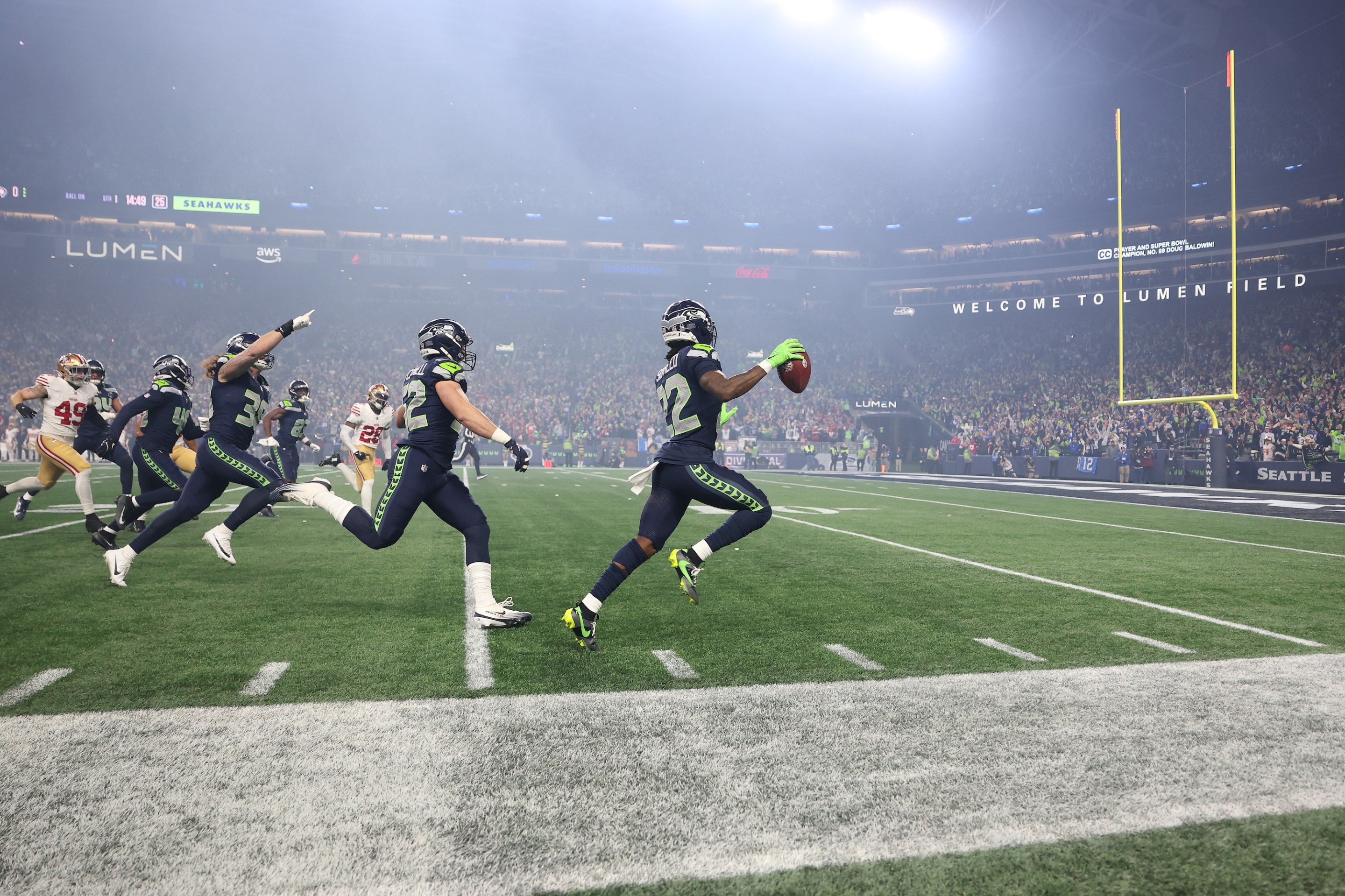
First impressions can be deceiving, but the opening seconds of Saturday’s 49ers-Seahawks NFC divisional round game really did presage the lopsided evening to follow. Maybe the game was over before it began: The Niners won the toss and deferred, perhaps to get a better look at an injured Sam Darnold. First mistake. Before Darnold could be looked at, Seattle return man Rashid Shaheed took the opening kickoff 95 yards for a touchdown. Half the country hadn’t yet switched over from the Bills-Broncos overtime on CBS, and the Seahawks were up 7-0. The coin toss was the only thing the Niners won all day.
So dominated was San Francisco’s offense that Shaheed’s touchdown, which took all of 13 seconds, would end up being the game-winning score in the 41-6 result. The Niners looked slow, weak, and sloppy against a defense that has killed opponents' passing games with heavy nickel and dime usage, stuffed the run with a loaded front seven, and generally befuddled quarterbacks all season with an array of disguised coverages. In the Seahawks' locker room postgame and at the podium, the phrase “complementary football” came up a lot. This team would be a fitting victor of a postseason whose lesson has been something like “quarterbacks don’t matter.” Darnold’s last playoff performance didn’t inspire much confidence, and a late-breaking report from ESPN's Adam Schefter about Darnold tweaking his oblique in practice earlier in the week inspired just as little, but in the end, Darnold felt almost incidental to the whole thing. The defense gave him short fields to work with, and the running attack finished the job in the second half. The job responsibilities of the Seahawks QB, whoever it may be, are simple: Don’t turn the ball over, target Jaxon Smith-Njigba, and everything will be OK. You don’t really have to do anything else.
No team scored more non-offensive touchdowns than Seattle in the regular season. On one occasion, special teams scored all their points: Jason Myers made all six of his field goals in the queasy 18-16 walk-off win against the Colts, in Philip Rivers’s first game back from retirement. Two catches by Shaheed on that game-winning drive got the Seahawks into field goal range.
The Seahawks traded for Shaheed at the deadline, sending fourth- and fifth-round pick to New Orleans for the field-stretching receiver, who will be a free agent this offseason. A Pro Bowler as a return specialist this year, he also proved his worth as a decoy who could force opponents into lighter boxes and open up Seattle’s run game, which seriously improved in the second half of the season. Of course, he did actually cool stuff with his burst too, like return a kick for a 100-yard touchdown against the Falcons in Week 14. “I don’t know what to say. That was just a crazy experience,” Shaheed said with a sheepish chuckle in the postgame press conference after Saturday’s win.
If there’s a team that understands just how much damage Rashid Shaheed can inflict, it’s another NFC West rival that sees the Seahawks often, and might see them again next Sunday in Seattle. A Rams-Seahawks conference championship game would be buzzy for pitting the league’s best offense against its best defense, but it would also pit one of the league’s best special teams units against one of its worst: The Seahawks ranked second in special teams DVOA this season, behind only the Jets, and the Rams ranked 26th.
After he returned a punt for a 58-yard touchdown to kickstart a 16-point fourth-quarter comeback against the Rams in Week 16, Shaheed mentioned to reporters that his team had spent much of the week discussing “kind of a weak point with their special teams.” Two days later, Sean McVay fired Rams special teams coordinator Chase Blackburn, saying the unit had to “be better in some critical moments.” Shaheed can take some credit for the rare in-season special teams coach firing—and the rare coaching change on a team that’s already clinched a playoff spot. Making that happen is something special.