

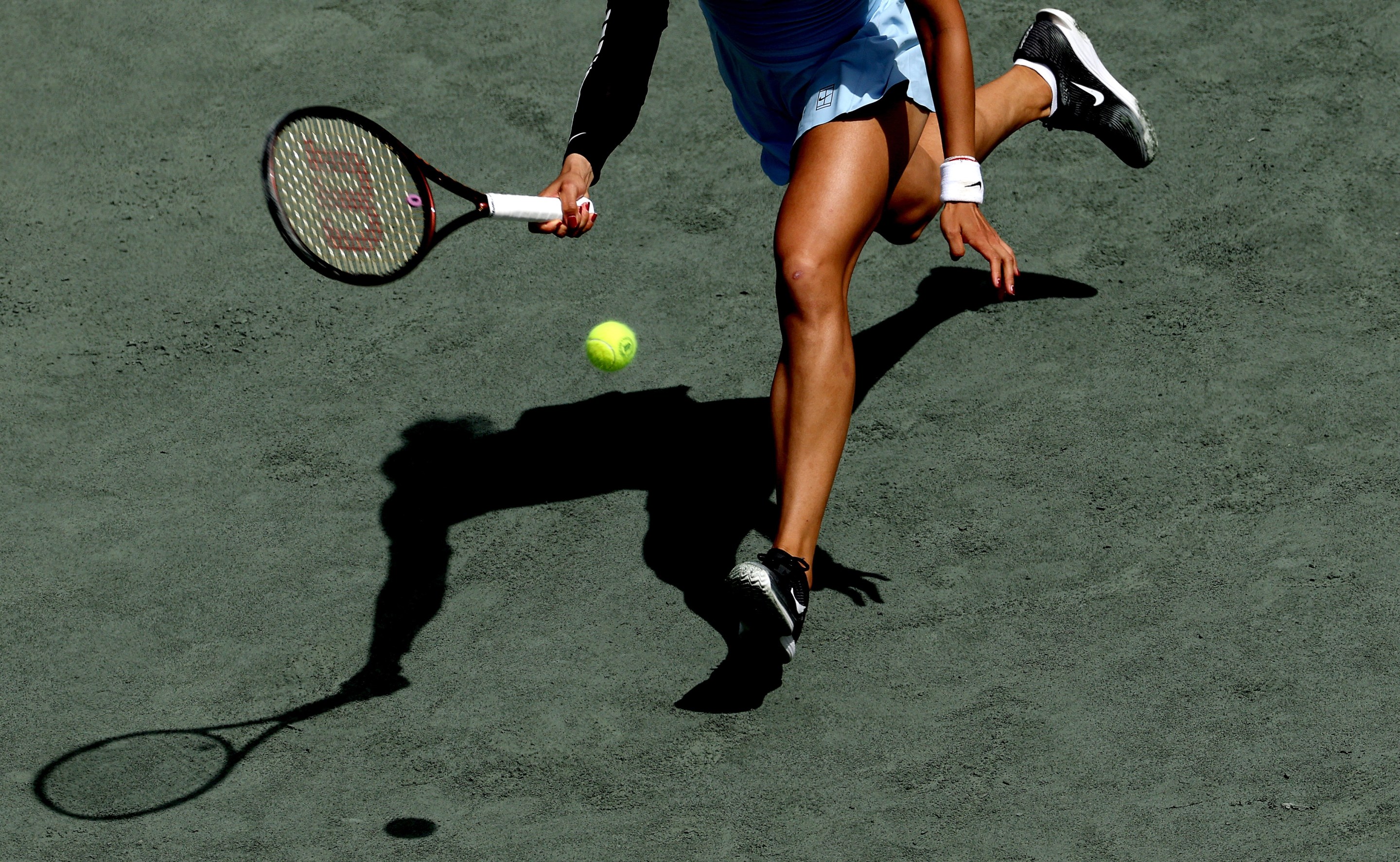

Can you save the world by playing on green clay, staving off climate catastrophe? Probably not, but if all tennis courts in the world were made of green clay, we’d at least be better off, according to a new study in Applied Geochemistry. The paper, co-authored by Frankie Pavia and Jonathan Lambert, models the carbon emissions of different tennis court surfaces by accounting for the transportation of materials, construction, and maintenance. Compared to hard courts—the default setting for U.S. tennis—green clay courts produce 1.6 to 3 times lower carbon emissions in construction. Those green clay courts go on to offset emissions simply by continuing to exist. Because of how the clay material reacts with water and surrounding air, it removes carbon dioxide from the atmosphere; over time, they can even go net-negative.
Pavia and Lambert didn’t set out to fuse their enthusiasm for Earth science and tennis courts, but that’s where they wound up. They met as graduate students at Columbia University, which is based in Manhattan’s Upper West Side and has its campus for Earth sciences across the river in the New Jersey Palisades, so the pair spent a lot of time shuttling back and forth. Eventually they realized that there was a tennis court at Riverbank State Park, where the bus dropped them off, so they convened a consistent doubles crew to play on their way back from work.
They did not yet know that the intersection of these two interests lay in rocks—very helpful rocks. Mitigating climate change will require humans to not just reduce their carbon emissions, but actively remove carbon dioxide from the atmosphere, using a suite of techniques collectively termed as carbon dioxide removal. One such technique is “enhanced rock weathering,” in which rocks with certain chemical makeup draw down carbon dioxide from the atmosphere and store it in a stable form for thousands of years.
This process of weathering occurs naturally wherever silicate rocks are coming into contact with air and water. Carbon dioxide in the air reacts with water and rock, converting the carbon to a dissolved salt, which can eventually flow out into the ocean and get trapped in carbonate rocks on the ocean floor. “Enhanced” rock weathering simply speeds along this process by grinding up the silicate rocks into dust so they have a higher surface area and react more readily. Scientists are studying its potential use in agriculture, an industry that is notoriously difficult to decarbonize; farmers might spread their fields with ground rock and earn carbon removal credits.
Then came a critical discovery for these tennis-playing geoscientists: While reading a paper on the efficacy of enhanced rock weathering, they learned that the rocks in use were actually the same rocks in your average American clay court. Most clay courts you see on the professional tour are red clay, which consist of red brick crushed to a fine dust. But most clay courts built in the U.S. use green clay, which is a chunkier, gray-green grind of silicate rock. This surface is often called Har-Tru, because that is the name of the company that makes it, by mining and grinding up the "billion-year-old Pre-Cambrian metabasalt found in the Blue Ridge Mountains of Virginia." (Thus the green clay comes from blue mountains, so called because the trees on them emit compounds that scatter light and leave a bluish haze when seen from afar.)
After realizing the dual identity of these rocks, Pavia and Lambert did some back-of-envelope calculations to estimate the impact that clay tennis courts might have on carbon removal. “This is in 2022,” Pavia told me, “and I'm actually seeing that three texts after that there, the next message was asking if anyone was tuned in to a J.J. Wolf match.” (That’s some real ball knowledge, and also, what the hell happened to that guy? He seemed pretty good. Wolf sat out for an entire year, then in March won the M15 in Naples—on green clay!—and one match at the Savannah Challenger last week.)
At first, the scientists were tempted to do a bit: an April Fools' post on LinkedIn about starting a company called CO2urts. Then Lambert began working at a company that did certification for various carbon removal techniques, and he found himself in closer contact with the world of enhanced rock weathering. Eventually they revisited their back-of-envelope calculations and realized they'd been off by a few orders of magnitude: Green clay courts might be responsible for even more carbon removal than they'd initially suspected. Plus, in 2024, Qiyu Zhou published a paper about enhanced rock weathering in golf courses—if you can integrate geosciences and golf, why not tennis? That was the beginning of a paper that modeled the carbon impacts of various tennis court surfaces—and in particular, the carbon removal taking place on green clay courts.
There were still big questions to address. First: How do you figure out the total number of green clay courts in the country? “It turned out that there was a fellow who had basically used satellite imagery to try and do this, and assembled this enormous database of all the tennis courts he could find out in the U.S.,” Pavia told me. They emailed him for help, and he sent them data. “It was, like, immaculate—it had latitude, longitude, location, name, state, number of courts, number of courts divvied out by court type. That was basically the nucleus of all of our calculations.” (This happens to be the same person behind TennisMaps, if you want to check out the public-facing visualization of this trove of data.)
Another question: What's the exact size of the ground-up rocks that make up a green clay court? There was a guy for that, too. Pavia reached out to the Seattle Tennis Club, who connected him to its facilities manager. “I spent two hours talking to him about how do you refresh the courts, what’s the maintenance schedule, what's the irrigation, all this stuff,” Pavia said. “He let me wander out onto these courts with a bag and scoop clay into them—and it turned out the guy teaching the lesson was my high school doubles partner, which, also, that's a trip.” Pavia left the club with his bag full of green clay.
From there, they needed to measure the size of the grains in the material, using a technique called wet sieving, where the material was passed through wire meshes of different sizes. They had to rely on the equipment in a colleague's lab to get the job done. “When I did this, they were like, ‘What are the samples?’ I was like, ‘It’s tennis court.’ They were like, ‘What? You need to tell us what you’re doing.’ They were fascinated by it,” Pavia remembered. “It was one of the first times I remember trying to put this into a scientific presentation for an external scientific audience, and not knowing if we were going to get laughed out of the room, or what the reaction would be.” Lambert later presented their research with a poster at the annual American Geophysical Union meeting, where he enjoyed a similarly warm response.
The first journal they submitted to rejected the paper. The gist of the reason: Editors thought the amount of carbon being removed by the green clay courts was small potatoes, just 40,000 tons of carbon dioxide removed in a year, compared to over 38 billion tons emitted in 2025. But Lambert told me that their research was intended to reframe thinking about climate solutions. “To fight climate change, we're all searching for the next new, sexy thing. And this [paper], I think, gets people to think about what are the things we can change in existing industries, embedded industries,” like tennis court construction. Our collective future is going to require much more than one solution, in any case.
“This broader strategy of enhanced rock weathering—the high-end estimates for how much an impact that could have on climate change, is like five percent of anthropogenic emissions, if it fully scales to its full potential,” Lambert said. “So this is also saying: We're never going to find one silver bullet to solve climate change. We need a suite of all of these solutions together, and this is actually one of the more promising ones.”
Enchanted by the efficacy and totally passive nature of enhanced rock weathering, I found myself wondering: Forget tennis courts, should we just be spreading rock dust all over the country and letting it remove atmospheric carbon dioxide? Lambert told me he’d spent some time earlier that day spreading two buckets of metabasalt on a community farm owned by New York University, where he works, with the intention of measuring its impact. “Essentially, you're right: All you do need is reaction with rainfall and then making it to the ocean,” though he pointed out a few caveats. The technique is best used in more acidic soil, because applying the metabasalt will raise the pH. When sourcing the metabasalt, you’d have to be careful about trace minerals like nickel, chromium, vanadium, which could cause contamination down the line. (On a somewhat related note, last year in Montreal, 32 Har-Tru courts were temporarily closed due to heightened asbestos levels in the clay.) And the quicker your water runoff can get to the ocean, the better, because there are potential losses that can happen along the way. That carbon dioxide, which was removed from the air and turned into a dissolved salt, could end up turning back into carbon dioxide before it reaches the ocean deep and enters a kind of long-term storage as rock.
This season, there's only one green-clay tournament at the pro tour level: the WTA 500 in Charleston, won by Jessica Pegula in early April. On the heels of a paper that both scientists describe as the most fun they’ve ever had doing science, they want to deepen their understanding. This paper is just a model—and a model that makes a number of conservative estimates, too—but empirical study could reveal more about the carbon removal potential for clay courts. They’d love to work directly with Charleston.
“What's the temperature on the court each day?” Lambert wondered. “How much water are you applying on the court, and where is your drainage going? Because if we can get that information, that can help us do facility-specific carbon draw-down estimates.”
Green clay might be one way to undo the sins of a professional tour that, due to the nonstop worldwide travel of its participants, probably contributes more to climate change than most sports. “I’ve seen the ATP pay a whole bunch of PR lip service to sustainability over the last three or four years, right? And there's these pledges that players do to try and balance their carbon footprints," Pavia said. "As a fan of tennis, I would love to see the tennis world engage with this in a serious way."
During our conversation, we fantasized about having pros play-test different grain sizes of clay to find the sweet spot between playability and optimal carbon removal. Grinding it too fine could cause respiratory issues, but they’d stop well short of that. There could also be interventions at the everyday, municipal, recreational level. “We joked about getting people to put a sign on green clay courts: ‘Just by playing on these courts, you are helping solve climate change,’” Lambert said.
Pavia pointed out that for Lambert’s game—Eastern forehand grip, one-handed backhand—a shift to slower, higher-bouncing green clay courts would only hurt him. I respected Lambert’s promotion of this solution nevertheless. Here was a scientist willing to secure the welfare of the Earth, even if it would damage his personal tennis performance.
Update (12:09 p.m. ET): A line referencing J.J. Wolf's recent match results has been updated.




![USA's Ben Shelton celebrates his win against Spain's Carlos Alcaraz during the men's singles quarter-final tennis match on day ten of the US Open tennis tournament at the USTA Billie Jean King National Tennis Center in New York City on September 9, 2026. (Photo by Leonardo MUNOZ / AFP) / “The erroneous mention[s] appearing in the metadata of this photo by Leonardo MUNOZ has been modified in AFP systems in the following manner: [USA's Ben Shelton] instead of [Spain's Carlos Alcaraz]. Please immediately remove the erroneous mention[s] from all your online services and delete it (them) from your servers. If you have been authorized by AFP to distribute it (them) to third parties, please ensure that the same actions are carried out by them. Failure to promptly comply with these instructions will entail liability on your part for any continued or post notification usage. Therefore we thank you very much for all your attention and prompt action. We are sorry for the inconvenience this notification may cause and remain at your disposal for any further information you may require.”](https://lede-admin.defector.com/wp-content/uploads/sites/28/2026/09/GettyImages-2293730421.jpg?resize=2880%2C1920)