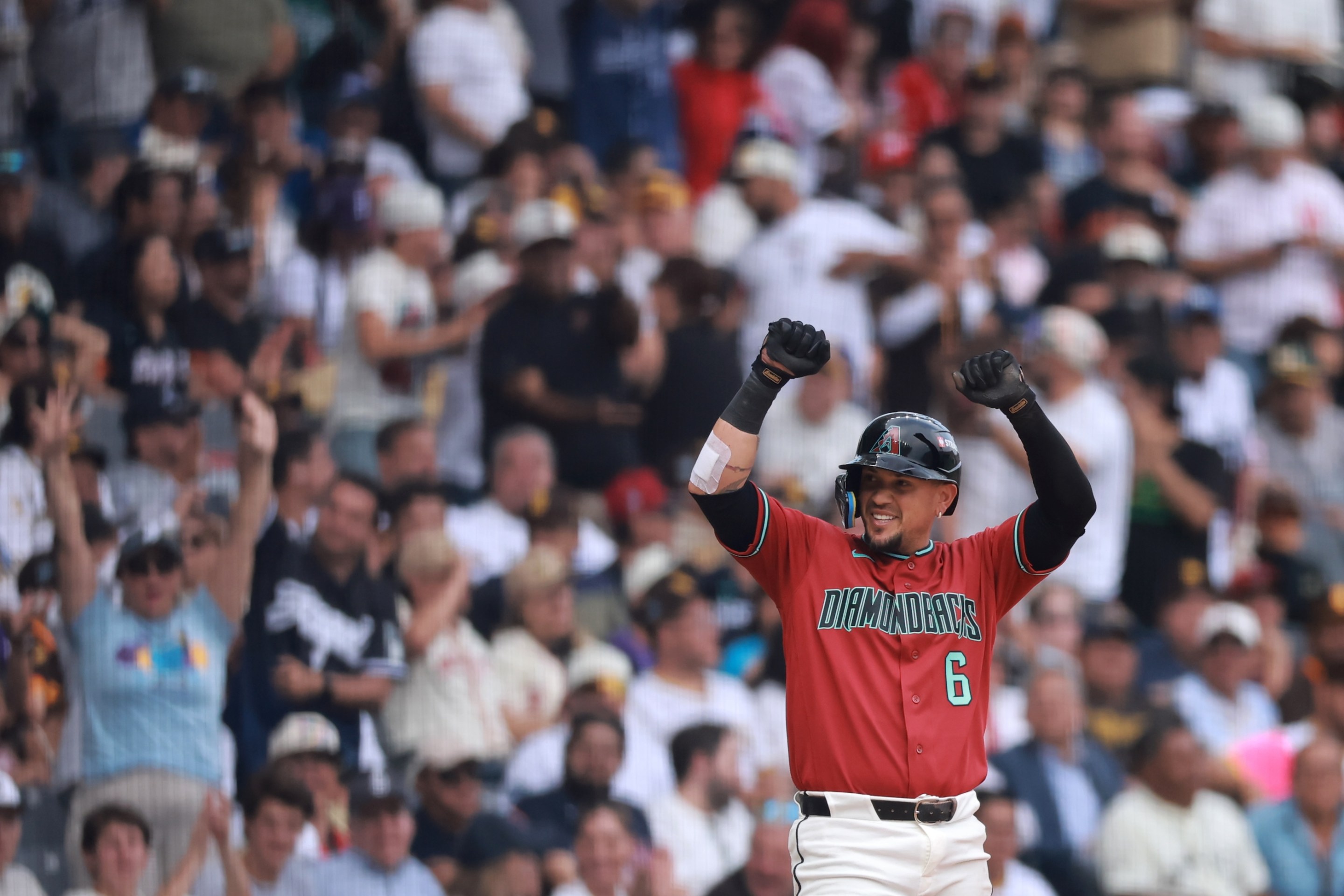
"I’ve been trying to avoid writing about Vargas in this space," Baseball Prospectus fantasy baseball writer Michael Waterloo wrote last week. "He’s 34 years old, and the vast majority of fantasy players have never heard of him before the last two weeks. We have a nearly 1,400 plate appearance sample over his career to scream that what he is doing is not sustainable, nor who he truly is, and I fully believe that." These are all decent enough reasons for Waterloo not to write about Ildemaro Vargas, and there are others. The next paragraph started with the word "But."
Waterloo was writing about Vargas in the context of players who were likely to be available on fantasy waiver wires but could deliver some short-term help; among the good reasons to avoid such a topic that Waterloo did not mention re: not wanting to write about Ildemaro Vargas is that the last few weeks have marked the only time in his 10 MLB seasons when Vargas could conceivably not have been on fantasy waiver wires. Vargas, whose 27-game hitting streak ended in the first O-fer of his season on Saturday, dropping his average down to a MLB-best .388, won his decade in the bigs on versatility, vibes, and the reliable delivery of the Great Value Brand version of Luis Arraez's offensive loadout—very few walks and even fewer strikeouts, a ton of al dente contact on pitches in but also frequently outside the strike zone.
This sort of player is very valuable to actual MLB teams—Vargas is in his third stint with the Diamondbacks—but not really in a way that provides meaningful professional stability. Vargas was signed by Arizona out of an independent league in 2015; before he became teammates with Sean Burroughs and Prentice Redman on the Bridgeport Bluefish, Vargas had done a six-year hitch in the Cardinals' system that topped out with eight games at Double-A. When the Diamondbacks signed him, he was 23 and had an OPS that started with a 6 in the Atlantic League. He was in the Majors by 2017. That Vargas has played in parts of every season since undersells how precarious his big-league life has been. The Diamondbacks traded him for cash in 2020 and reacquired him for cash in 2021; he played for the Twins, Cubs, and Pirates in the interim. Vargas's numbers generally looked better the more he played, but he never played that much, and with the exception of a 2022 season split between the Cubs (again) and Nationals, he was never within shouting distance of league average. There is probably some correlation, there.
But a career like Vargas's can't really be read by scanning his career OPS+ figures and making various distress faces. Baseball is a job and a baseball team is a workplace, and Vargas's role within that bigger whole was not necessarily—was, even, necessarily not—about putting up numbers. It was important that his glove worked fine at first, second, and third base, and that he always made contact even if that contact did not always amount to much, but Vargas quickly emerged as a smiling, goofy, human-sized point of consensus in the ongoing attempt to ascertain the actual value of being what former teammate Joey Gallo described as "an A-plus dude" in the otherwise lavishly quantified baseball landscape.
"Perhaps on paper Vargas was nothing more than a forgettable utility player on a last-place team," Vargas's comment in the 2024 Baseball Prospectus Annual reads, "but for the Nationals and their fans he was an inspiration: the guy whose joyous shouts of 'Campeon!' echoed through the clubhouse, the veteran presence who was a role model both on and off the field for the up-and-coming young guard." When the Nats awarded him the organization's Heart and Hustle Award near the end of that season, MLB.com ran a story in which eight of Vargas's coworkers described the singular pleasure of his company, and sketched the outlines of the value he provided. "Everything he does is perfect for us," infielder Luis Garcia Jr. said. "Sometimes you’re a little bit down, and a couple minutes later you hear, ‘Hey! Hey!’ So I don’t have a favorite moment, because everything he does is my favorite moment."
Vargas came into Saturday's game against the Cubs with a .404 batting average and a .673 slugging percentage, both of which absolutely can be chalked up to the fact that the season is so young. Vargas really does seem to have tweaked some things in his approach—in this minuscule sample, he is (unsurprisingly, probably unsustainably) hitting the ball somewhat harder, if still not notably hard, and (much more surprisingly, possibly sustainably) elevating and pulling the ball more than ever before. The old grounders have become line drives, and six of those have cleared the fences, which is as many as Vargas has ever managed in a full season. "This won’t continue," FanGraphs' Justin Mason noted in his mention of Vargas in a blog headlined Fun With Small Sample Sizes. "Especially with a bat speed that is below league average."
Which brings us back to all those convincing caveats. Vargas may continue to elevate the ball more than in the past, and that might goose his slugging percentage closer to the .400 mark than it has traditionally been, but the likelihood is that he will recede over time back toward the sort of role he has traditionally played and the type of player that he has previously been. Seasons are long and the game is very hard; the best bet is that the stuff that makes Vargas valuable will continue to resist being codified in blue or red on a Baseball Savant page. This is not a knock on Vargas so much as it is a statement of fact; only some of what every player does shows up in the numbers, and what can be quantified about Vargas suggests that what he does best is both real and mostly invisible.
A player like him stays employed by staying afloat, and Vargas has made buoyancy into something like his carrying tool; we are seeing him, at this moment, smiling atop one of the waves that he has ridden, up and down and toward and away, for a hard-won decade. "He's always been a winning player," Brewers manager Pat Murphy said last week, after Vargas ran his streak to 23 games in a 13-1 loss. "He's always been a little less 'tools' than—his performance is better than his tools. He's playing with a freedom. He's finding the barrel. He knows himself. As you mature as a player and get more time, you can find pockets like this."